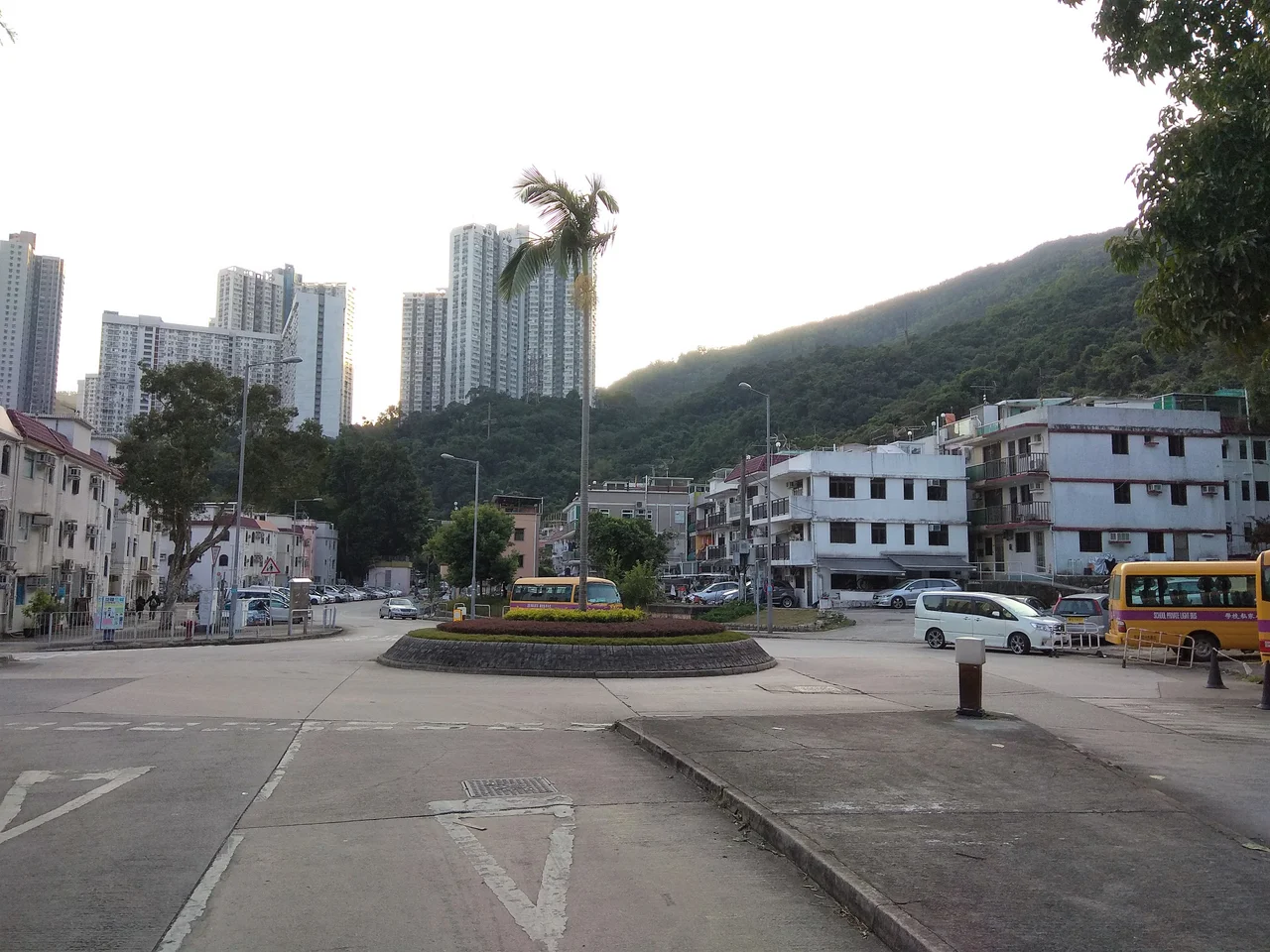

Tseung Kwan O Village
The villagers came back. That is the most striking fact about Tseung Kwan O Village: when the Qing dynasty issued the Great Clearance in the 1660s, forcing coastal populations inland to cut off support for maritime resistance, the people of this settlement at the northern tip of Junk Bay left. The ban lasted years. When it was finally lifted in the late seventeenth century, the villagers — or their descendants — returned to the same shore and rebuilt. The village they re-established has been there since, surviving Ming-to-Qing transition, colonial administration, postwar development, and the comprehensive urbanisation of Junk Bay into the district now called Tseung Kwan O. The ocean that was once 100 feet from their doors is now much further away, buried under reclaimed land. The village remains.
Founded, Emptied, Rebuilt
Tseung Kwan O Village traces its founding to the early Ming dynasty, placing its origins somewhere in the fourteenth or fifteenth century. For a settlement in the New Territories, this is considerable antiquity. The Ming period brought relative stability to coastal Guangdong; fishing and horticulture could sustain small communities in sheltered bays like Junk Bay. Then came the Great Clearance of the early Qing dynasty — a forced evacuation of China's southeastern coastline ordered to deny supplies to maritime holdouts loyal to the previous dynasty. Entire villages were emptied inland. Tseung Kwan O was one of them. The abandonment lasted long enough that returning residents would have found their original structures deteriorated and their fields overgrown. That they came back regardless, re-established the village, and maintained it through the colonial period, speaks to the depth of connection between these families and this specific piece of shoreline.
The Ng and Chan Families
The village's two principal family lineages are the Ng and Chan clans, whose presence has defined the community's social structure across generations. The village head has historically alternated between the two families — the current head is from the Chan family, having succeeded one from the Ng family. A British law passed in 1895 recognised the inhabitants of established New Territories villages as native to the territory and granted them specific rights over land, burial, and inheritance that did not apply to later arrivals. As Hong Kong's population has grown and land has become scarcer, these rights have become increasingly contested. The old Tseung Kwan O dialect, once the marker of community belonging, is fading: most younger residents no longer speak the ancestral tongue, though a few carry it forward. Language and law together are the threads by which village identity persists — and both are under pressure.
A Village That Fished and Farmed
Before the urbanisation of Junk Bay, Tseung Kwan O Village sustained itself through a combination of fishing and horticulture. The fishing methods were practical rather than refined: dynamite and nets in an era when regulations were light and the bay was full. Owls were trapped with simple rope snares and dried for meat — an unusual but documented practice that tells you something about the resourcefulness the village economy required. Annual celebrations brought neighbouring villages together for trading and socialisation, a reminder that these communities were not isolated but part of a coastal network. All of that changed as the Hong Kong government began major development of the Junk Bay area in the 1980s. The ocean that had been a hundred feet from the village's edge was reclaimed. An urban district rose on the fill. The fishing grounds disappeared into the development. What had been a working waterfront village found itself landlocked in its own bay.
Surrounded but Standing
Today Tseung Kwan O Village sits at the northern tip of what has become one of Hong Kong's major new town districts, a dense high-rise environment built largely on land that did not exist when the village was founded. The village itself remains a recognised settlement under the New Territories Small House Policy, a legal framework that acknowledges the ancestral rights of indigenous villagers to build in their home village. The contrast between the old settlement and its surroundings is striking — low-rise village structures against a backdrop of towers, a community that predates the district by centuries now enclosed within it. A CLP Group power substation in the vicinity serves as a reminder of how completely the infrastructure of a modern city has grown up around what was once a remote fishing village. The bay is still called Junk Bay on older maps. The village is still here.
From the Air
Tseung Kwan O Village lies at approximately 22.327°N, 114.250°E at the northern tip of Junk Bay (Tseung Kwan O) in the Sai Kung District of Hong Kong. From the air at 1,500–3,000 feet, the village is visible as a lower-profile cluster among the dense high-rise development of Tseung Kwan O new town. Junk Bay itself — an enclosed inlet of Clear Water Bay — is the dominant geographic feature, with the bay's reclaimed waterfront clearly distinguishable from the older contours of the surrounding hills. The Tseung Kwan O MTR line terminus and the Tseung Kwan O landfill are visible to the north and east. Hong Kong International Airport (VHHH) on Lantau Island lies approximately 25 nautical miles to the west-southwest.
Nearby Stories
- Chapel of St. Francis Xavier 3.5 km away
- Cuiheng 4.1 km away
- 2015 Shenzhen Landslide 16 km away
- Shunde 31 km away
- Wanshan Archipelago 37 km away
- Nanxiong Formation 96 km away
- Heyuan 149 km away
- Checheng Fu'an Temple 629 km away