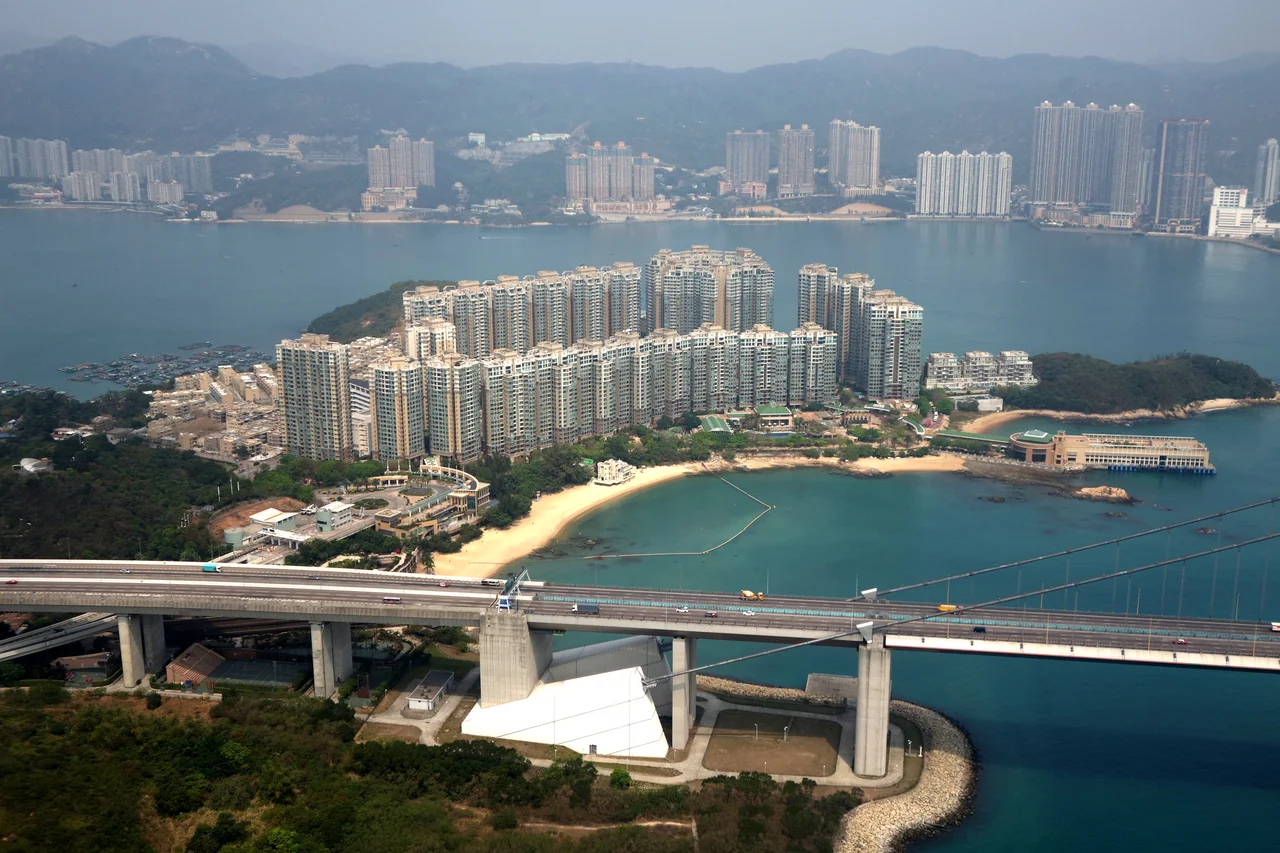

Tsing Ma Bridge
On 27 April 1997, Margaret Thatcher stood at the opening ceremony for a bridge that connected Hong Kong's largest island to the rest of the territory for the first time. Security around the former British Prime Minister was extremely tight — she was considered one of the Irish Republican Army's principal targets at the time. A flotilla of police vessels passed beneath the structure while Royal Air Force aircraft crossed above the towers. More than 100,000 spectators lined the closed roads to watch. What they were celebrating was not just a bridge. It was the completion of a project that turned a rural, water-locked island into a place where an international airport could be built and reached.
The Island That Needed a Link
Lantau Island is Hong Kong's largest island — larger than Hong Kong Island itself. Until 1997, it could be reached only by water. Ferry services connected it to the urban areas of the territory, but there was no road, no rail line, no crossing of any kind. The island remained almost entirely rural as a result, while the rest of Hong Kong densified around it. The decision to build a new international airport at Chek Lap Kok, on the north coast of Lantau, forced the issue. Kai Tak Airport, wedged between Kowloon tenement blocks and accessible by one of aviation's most famously demanding approaches, had run out of room. The new airport required a land connection. The Tsing Ma Bridge was the most ambitious element of that connection — the centrepiece of the Lantau Link, which also included the Ting Kau Bridge and the Kap Shui Mun Bridge.
What 70,000 Wires Hold Up
The Tsing Ma Bridge carries its 1,377-metre main span between two towers that stand 206 metres above sea level. The name joins the two islands it connects: Tsing Yi and Ma Wan. Designed by the firm Mott MacDonald, the bridge drew inspiration from Scotland's Forth Bridge and England's Severn Bridge, though it surpassed both in scale. Construction began in May 1992 and was built by an Anglo-Japanese consortium comprising Costain, Mitsui, and Trafalgar House. The two main suspension cables each measure 1.1 metres in diameter, spun in place from 70,000 individual galvanised steel wires of 5.38 mm diameter each. The cables pass over saddles atop the towers and terminate in massive concrete anchorages: the Tsing Yi anchorage required 200,000 tonnes of concrete; the Ma Wan anchorage, 250,000 tonnes. The project cost HK$7.2 billion.
Two Decks, Every Kind of Traffic
Most suspension bridges carry one mode of transport. The Tsing Ma carries two — and this is what distinguishes it globally. The upper deck handles six lanes of automobile traffic, three in each direction, and is the route that private cars and buses take between the city and the airport. The lower deck is where the engineering becomes unusual: it contains two MTR Airport Express rail tracks and two sheltered road carriageways. Those sheltered lanes serve a purpose specific to Hong Kong's climate. When a particularly severe typhoon strikes and wind speeds on the upper deck become unsafe, traffic is diverted to the enclosed lower level and the bridge continues to operate. The span is currently the longest of any bridge in the world that carries rail traffic — a distinction that has held since the bridge opened.
The Opening Night Hong Kong Remembered
The 20-minute fireworks display on opening night cost HK$5 million and began at 8 pm. Tuen Mun Road was closed to traffic from 7:40 pm. More than 2,300 police officers were deployed, not only to manage a crowd of more than 100,000 but also to study the logistics for an event just weeks away: the handover of sovereignty from Britain to China in July 1997. The crowd control operation at the bridge opening was explicitly reviewed for lessons applicable to the handover ceremony. Bus queues formed before 7 am that morning, as people sought to see both the new bridge and the North Lantau New Town, still under construction nearby. Police issued warnings against rushing the new road and causing chaos. The warnings were largely heeded, but the enthusiasm of the crowd was not easily contained.
Watching from the Shore and From Above
The Lantau Link Visitors Centre and Viewing Platform, on the northwest corner of Tsing Yi Island near the bridge's Tsing Yi end, gives visitors a ground-level perspective on a structure that rewards close inspection. From the platform, the Ting Kau Bridge and Kap Shui Mun Bridge are also visible. The Tsing Yi Nature Trails offer elevated views at several points during the hike. The bridge has also been visible from a very different vantage: the Hong Kong Marathon once incorporated the Tsing Ma Bridge as part of its course, drawing runners across the span before complaints about traffic impact led organisers to remove it in 2017. Tolls on the Lantau Link were eliminated on 27 December 2020. The bridge — its concrete towers, its catenary cables, its layered decks — has become one of the defining images of Hong Kong's skyline as seen from the water or the air.
From the Air
Tsing Ma Bridge spans approximately 22.35°N, 114.07°E, connecting Tsing Yi Island to the west and Ma Wan to the east before the route continues to Lantau. From the air, the bridge is one of Hong Kong's most immediately recognisable landmarks: a double-towered suspension bridge with a distinctive lower-deck structure, crossing a channel busy with container ship traffic. The towers rise 206 m above sea level, making them visible reference points for navigation in the region. Hong Kong International Airport (VHHH) lies approximately 8 km to the west on Lantau Island. Recommended viewing altitude is 1,500–4,000 feet, where the full span and both anchorage structures are legible. The approach corridor for VHHH runway 25L/R passes to the south of the bridge; pilots and passengers on approach from the east often have a direct sightline across the deck.
Nearby Stories
- Chapel of St. Francis Xavier 3.5 km away
- Cuiheng 4.1 km away
- 2015 Shenzhen Landslide 16 km away
- Shunde 31 km away
- Wanshan Archipelago 37 km away
- Nanxiong Formation 96 km away
- Heyuan 149 km away
- Checheng Fu'an Temple 629 km away