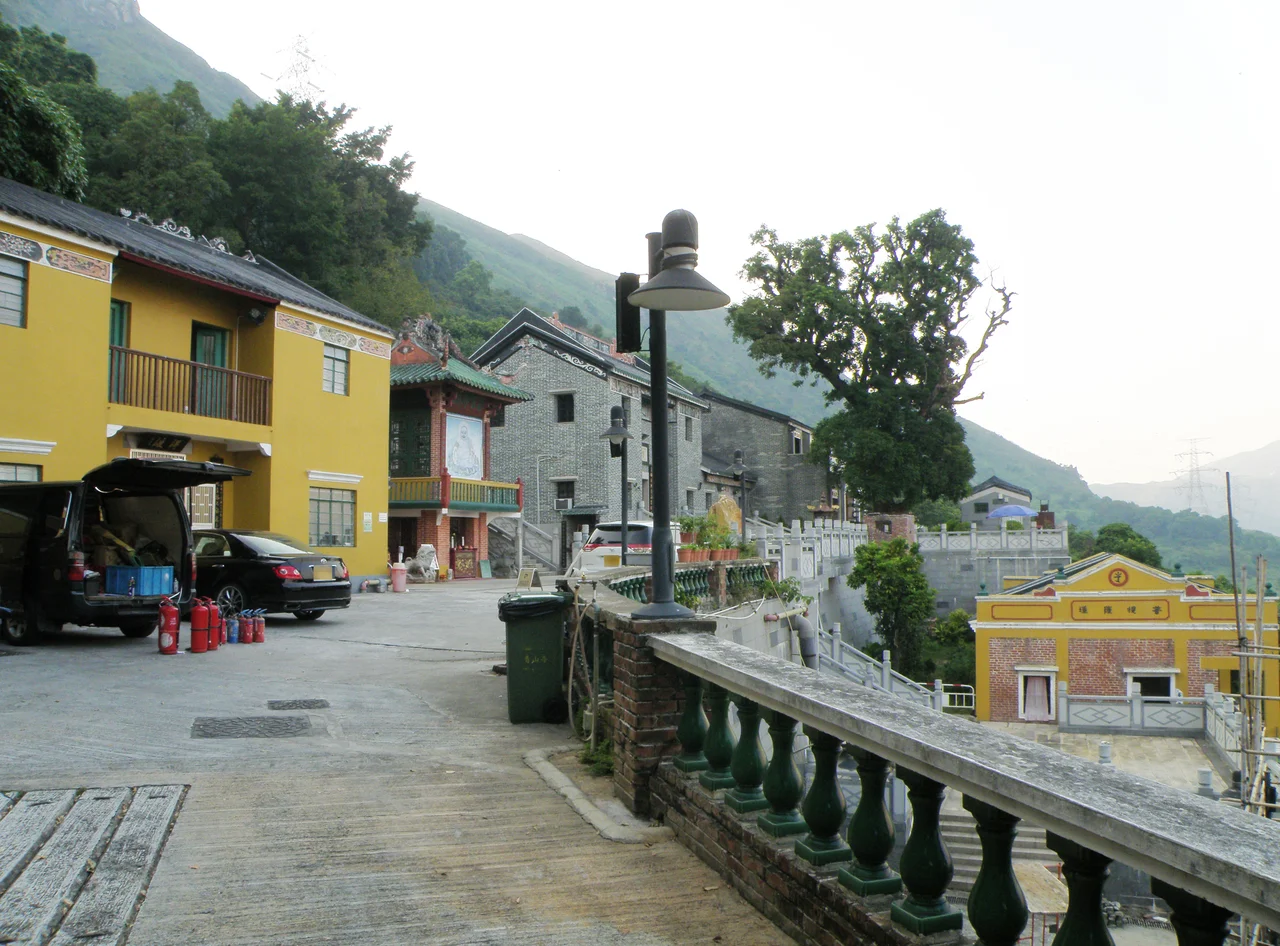

Tsing Shan Monastery
The legend begins with a monk travelling in a wooden cup. According to the account that has come down through the monastery's history, an Indian monk — a figure of ascetic wandering, drawn to remote and beautiful places — arrived at the foot of what is now called Castle Peak and chose to stay. He built a shelter for meditation. His name was Pui To, and in time his reputation spread widely enough that his followers built a pagoda at the place where he had lived and practised. The Pui To Pagoda may have been first constructed during the Jin dynasty, between the third and fifth centuries CE, and was redeveloped during the Song dynasty. If the earlier date holds, Tsing Shan Monastery stands on ground that has been a site of Buddhist practice for well over a thousand years.
The Oldest Temple in Hong Kong
Among the structures within the monastery complex, the Tsing Shan Temple carries a particular distinction: it is considered the oldest temple in Hong Kong. The claim is difficult to verify with the precision a historian might prefer, since records from before the colonial period are fragmentary and the monastery has been rebuilt and expanded multiple times. What is clear is that this site has operated continuously as a place of worship for an extraordinary length of time by any standard. The temple's main worship hall faces a set of stairs above which the phrase 'Everything on Earth Has Ties and Reaches Nirvana Together' is inscribed — a statement that frames the temple's purpose as something larger than individual devotion. The peaceful forest setting at the base of Castle Peak does the rest of the philosophical work.
What the Portico Says
Above the entrance archway to the monastery, two inscriptions face in opposite directions. On the front, the words 'Fragrant Sea and Prestigious Mountain' — a phrase attributed to Cecil Clementi, who served as Governor of Hong Kong from 1925 to 1930. On the reverse, 'Repentance is Salvation,' an inscription by Reverend Tit Xim. That a colonial governor's calligraphy adorns the entrance of a Buddhist monastery is not as incongruous as it might seem: Clementi was unusual among colonial officials for his genuine fluency in Chinese language and culture. He studied Cantonese and Hakka, wrote Chinese poetry, and engaged seriously with the traditions he encountered in the territory. His contribution to the portico reflects a moment of unusual respect across a very wide cultural distance. The crest tile of the archway, crafted in Shiwan in Guangdong, is itself considered a fine example of that region's distinctive ceramic tradition.
Three Structures, Many Layers
The monastery complex encompasses the Pui To Pagoda, Tsing Wan Koon (also written Ching Wan Koon), and the Tsing Shan Temple. They are not a single unified structure but a gathering of buildings that accumulated over centuries, each with its own purpose and its own presiding deity. Tsing Wan Koon is dedicated to Dou Lao, a goddess whose domain is the relief of worldly worry — a practical concern for any community of worshippers dealing with the pressures of ordinary life. At the back of the Pui To Pagoda, a statue of Reverend Pui To keeps watch. The compound is set within wooded grounds that soften the transition between the built structures and the mountain behind them. Regular maintenance has kept the historical fabric of these buildings largely intact, though the word 'intact' here means maintained in the spirit of the original rather than unchanged.
Grade I, Grade II, and What Those Categories Mean
Hong Kong's Antiquities Advisory Board has assessed and graded the various structures within the Tsing Shan Monastery complex, assigning Grade I or Grade II historic building status to different elements. Grade I is the higher designation, indicating exceptional historic significance and architectural value, carrying a strong presumption against demolition or major alteration. The 'Heung Hoi Ming Shan' Pai-lau — the entrance archway with its two inscriptions — holds Grade I status, as does the main hall. Several subsidiary structures, including the dormitory, guest hall, and various pavilions, have been assessed individually, reflecting the understanding that the monastery is not a single building but a landscape of heritage buildings accumulated over time. The Kwun Yam Pavilion, dedicated to the Goddess of Mercy, and the Hall of Merit are among the other named structures within the complex.
At the Foot of Castle Peak
Castle Peak itself — called Tsing Shan in Cantonese, meaning 'green mountain' — rises to 583 metres behind the monastery. The peak gives the monastery both its alternative name and its visual backdrop. From the valley below, the mountain's wooded slopes rise steeply, creating a sense of enclosure that made the site attractive to Buddhist practitioners seeking retreat from the ordinary world. The area around Tuen Mun has been inhabited and actively used since at least the Tang dynasty, and the monastery's position at the base of Castle Peak placed it near one of the more important routes between the Pearl River Delta and the eastern part of the New Territories. Pilgrims have been coming here for a very long time. Some still do.
From the Air
Tsing Shan Monastery is situated at approximately 22.39°N, 113.96°E at the base of Castle Peak (583 m) in Tuen Mun District. From the air, the monastery complex appears as a cluster of traditional rooflines set into the lower wooded slopes of the mountain, clearly distinguishable from the modern residential development of Tuen Mun to the east. Castle Peak is the tallest point in the western New Territories and serves as a prominent navigation landmark. The nearest major airport is Hong Kong International Airport (VHHH) on Lantau Island, approximately 20 km to the southeast. Recommended viewing altitude is 2,000–4,000 feet, where the relationship between the monastery, the mountain, and the Tuen Mun urban area is most clearly read. Visibility is often excellent in the cooler months from October through March, when the Pearl River Delta haze diminishes.
Nearby Stories
- Chapel of St. Francis Xavier 3.5 km away
- Cuiheng 4.1 km away
- 2015 Shenzhen Landslide 16 km away
- Shunde 31 km away
- Wanshan Archipelago 37 km away
- Nanxiong Formation 96 km away
- Heyuan 149 km away
- Checheng Fu'an Temple 629 km away