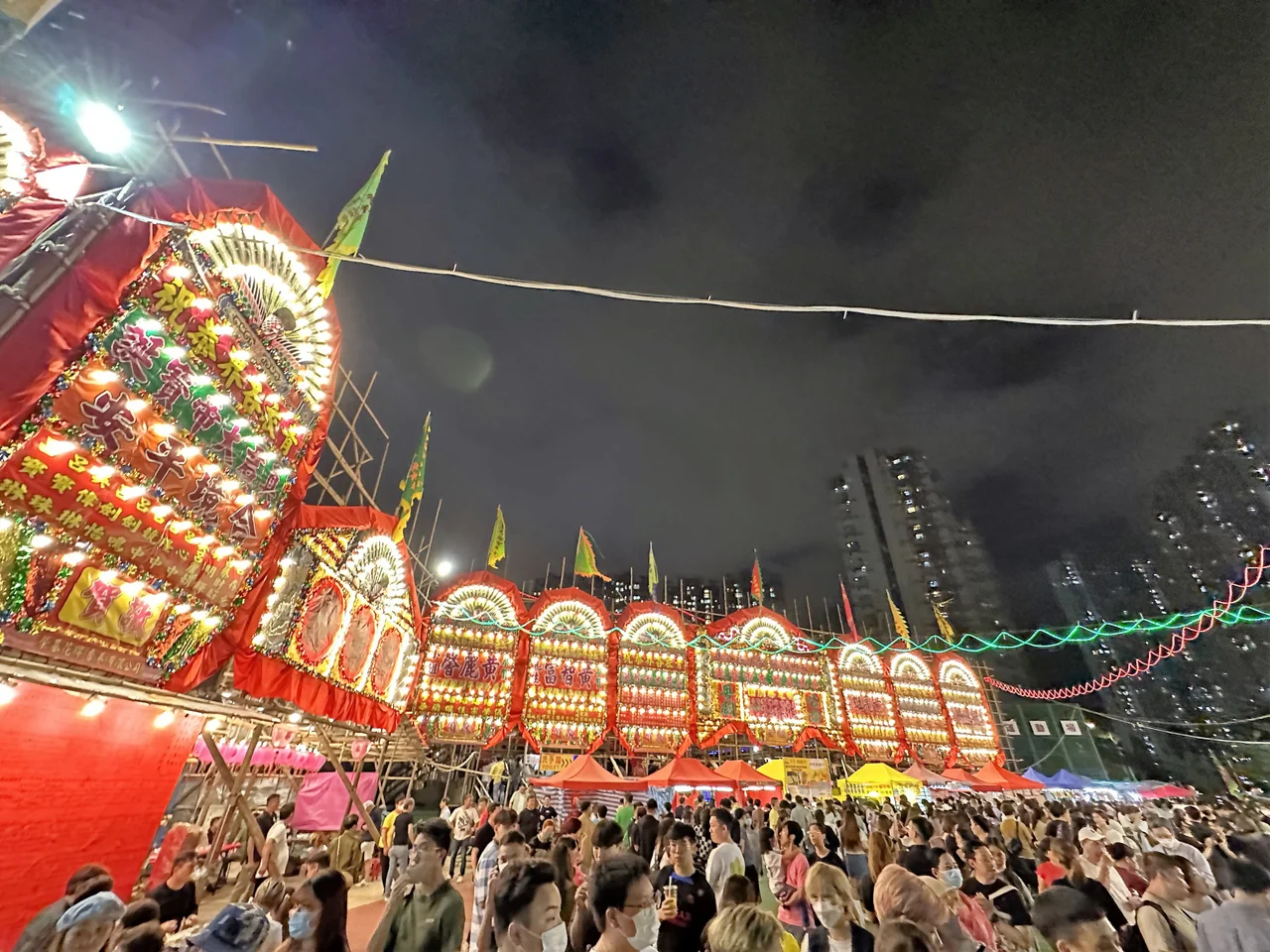

Tsing Yi Bamboo Theatre
Every year, on a football field next to a municipal service building in Tsing Yi, workers erect a theatre from bamboo. The scaffolding goes up, the roof goes on, the stage appears — and what looked like construction site becomes a performance space seating hundreds, designed to last ten days and then come down. The Tsing Yi Bamboo Theatre has been doing this since well before 1961. It exists to honour two deities: Tin Hau, the Empress of Heaven and protector of those who live by the sea, and Zhen Jun, a Song dynasty hero who died fighting pirates along the Guangdong coast. One theatre, the tradition says plainly: two commemorations.
The Logic of Combining Two Festivals
The two celebrations were originally separate events. The birthday of Tin Hau falls on the twenty-third day of the third lunar month; the commemoration of Zhen Jun falls on the fifteenth. Before 1961, a bamboo theatre would be built for the first celebration, dismantled, and then built again for the second — an enormous amount of labour and cost for a community to absorb twice in the space of eight days. At some point, the practical decision was made to keep the structure standing between the two dates. The theatre became a single venue for both festivals, running for ten days in total, covering the period from roughly late April to early May in the solar calendar. What began as economy became tradition. 'One theatre, two commemorations' is now a phrase that captures something essential about how the festival understands itself.
Tin Hau and the Memory of the War
Tin Hau's relationship with the people of Tsing Yi is older than living memory and deepened during the Second World War. According to local account, during the Japanese occupation of Hong Kong, the inhabitants of Tsing Yi were protected from aerial attack by sheltering near the Tin Hau Temple — the bombs, as the story has it, fell elsewhere. Whether or not the account is literally accurate, its significance is clear: Tin Hau became understood as a protector of this particular community through this particular ordeal. After the war, people played operas and organised performances during her commemoration specifically as an act of thanks. The drama was not entertainment first; it was gratitude made visible, a community expressing something too large for ordinary words through the heightened language of Cantonese opera.
Zhen Jun, the Brave Dead Hero
Zhen Jun's story is precisely dated in ways that Tin Hau's ancient legend is not. Born during the Song dynasty, he lived as a person of courage and honest dealing who helped those around him. When pirates threatened the Guangdong coastal communities — a chronic danger during periods when central authority was weak — Zhen Jun died in the effort to defend the government and the villagers. His death earned him divine recognition: a temple was built in his honour, and his birthday on the fifteenth day of the third lunar month became a date of annual commemoration. The Zhen Jun Temple in Tsing Yi was moved to its present location near the Tsing Yi police station in 1986. The Shen Gong dramas performed in his honour — ritual theatre with a religious dimension — are distinct in style from the secular Cantonese opera on the main stage, but both forms share the theatre space across the ten festival days.
The Stage, the Stalls, the Crowd
Cantonese opera is the headline act. Elderly audiences make up the core of the theatre's following, drawn by the formal conventions of a performance style that shaped their parents' and grandparents' cultural lives — the painted faces, the falsetto singing, the stylised gestures that compress emotion into form. But the bamboo theatre is surrounded by something equally compelling for people of every age: food stalls. Cart noodles, egg waffles, wife cakes, fried capsicums and eggplants with minced fish, fish balls, squid stew, skewers. And hand-made candy in shapes of geese, butterflies, flowers, and the animals of the Chinese zodiac — objects too intricate to be produced at scale and too delicious to remain unfinished. The queues at the stalls are long. Joss sticks burn at the temple area within the festival grounds. The theatre holds classical singing, the streets hold the smell of grilling meat, and the whole compound holds a density of experience that makes the ten days feel both ancient and completely alive.
A Festival That Welcomes Everyone
Afternoon performances at the bamboo theatre are free. Evening shows require a ticket, priced in a range of HKD 100–300; visitors who want only the food stalls or who are willing to stand at the back without a seat need not buy one. This pricing structure is not incidental. The bamboo theatre has always been described as a festival of civilians — an event that crosses class lines, where the person queuing for candy and the person holding a reserved seat for the opera are part of the same gathering. Since the 1960s, the festival has also been attracting younger audiences, not because the opera has been updated or the format has been modernised, but because younger visitors are finding value in watching something that connects them to Hong Kong's past. The bamboo theatre is reached on foot from Exit C of Tsing Yi MTR station on the Airport Express line, about eight minutes along Tsing King Road.
From the Air
Tsing Yi Bamboo Theatre is located at approximately 22.35°N, 114.11°E on Tsing Yi Island, at the Fung Shue Wo Road Football Field adjacent to the Municipal Service Building. Tsing Yi is an industrial and residential island connected to the mainland by bridges, easily identified from the air by the container port facilities on its southern and western shores and the Tsing Ma Bridge approaching from the west. The MTR Tsing Yi station is a short walk from the theatre site. Hong Kong International Airport (VHHH) is approximately 10 km to the west. Viewing altitude of 1,500–2,500 feet gives a clear perspective on Tsing Yi Island's layout, including the contrast between the industrial waterfront and the residential interior where the festival grounds are located. The bamboo theatre itself is only present in late April to early May; for most of the year, the site appears as an ordinary football field.
Nearby Stories
- Chapel of St. Francis Xavier 3.5 km away
- Cuiheng 4.1 km away
- 2015 Shenzhen Landslide 16 km away
- Shunde 31 km away
- Wanshan Archipelago 37 km away
- Nanxiong Formation 96 km away
- Heyuan 149 km away
- Checheng Fu'an Temple 629 km away