
Tsui Sing Lau Pagoda
In 1382, a man named Tang Yin-tung dreamed that the stars fell to earth. They gathered, he said, into a single point — the flat ground of Ping Shan in what is now the northwestern New Territories of Hong Kong. A fung shui master had already told the Tang Clan that this land was auspicious but incomplete. The dream resolved the ambiguity. Tang Yin-tung ordered a pagoda built on that exact spot to concentrate the heavens' scholarly energy — what the Chinese called the light of the stars — for the benefit of his clan. The structure has stood ever since, more or less, and nothing quite like it survives anywhere else in Hong Kong.
Stars and Scholarship
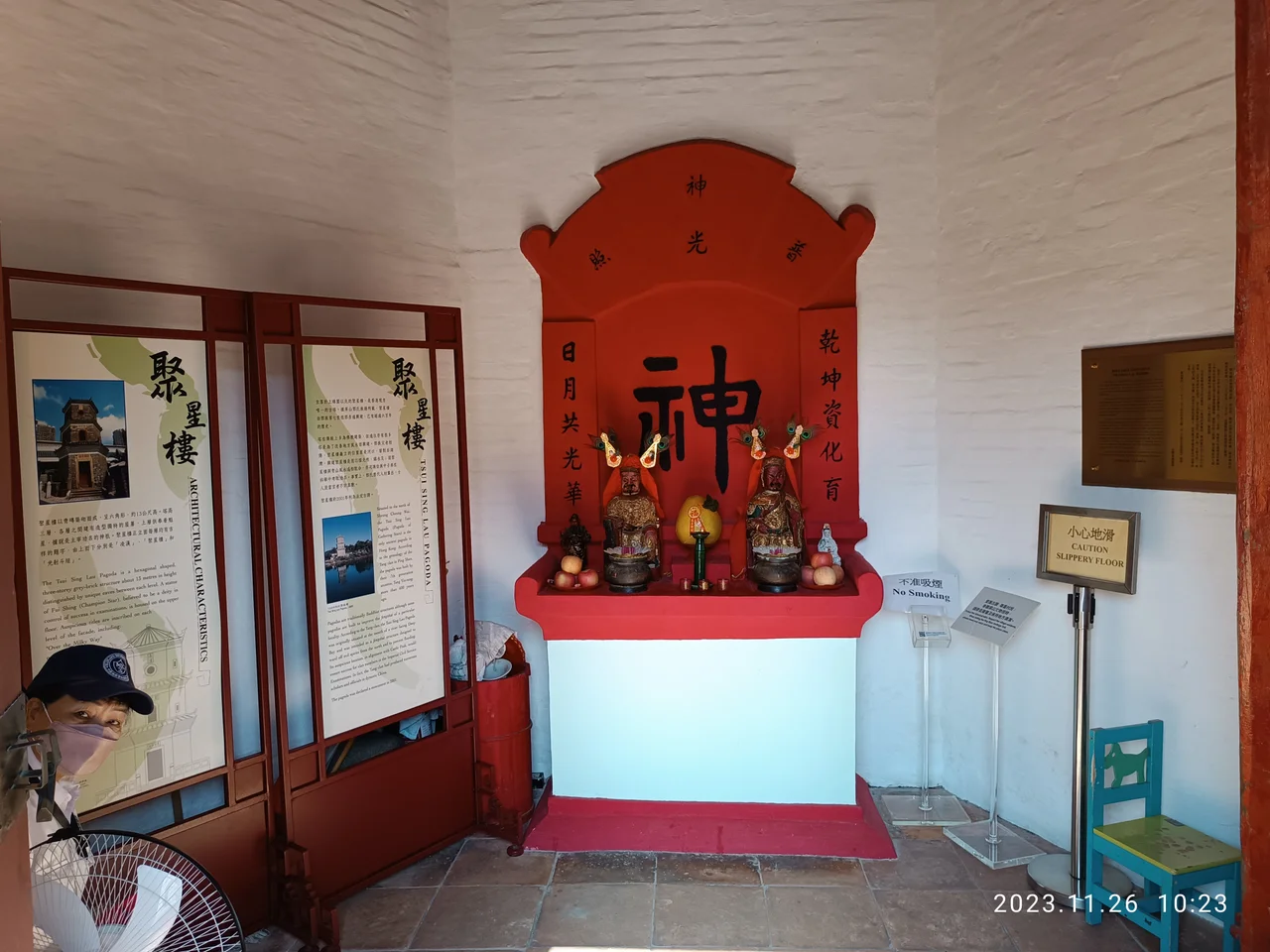
The name Tsui Sing Lau means Pagoda of Gathering Stars. That name was not decorative. The Tang Clan's purpose in building it was specific and practical: to improve the clan's results in the imperial examination system, which was the only path to official rank and social advancement in dynastic China. Fui Shing, the god worshipped on the pagoda's top floor, was the deity who determined which scholars passed. Inscriptions on the three floors track an ascending cosmic ambition: the ground floor reads Light Shines Straight Onto the Dippers and the Enclosures; the second floor, The Pagoda of Gathering Stars; the top, Over the Milky Way. The Tang Clan's strategy appears to have produced results. After the pagoda's construction, numerous clan members received imperial titles and appointments during the Ming and Qing dynasties.
What Time Has Done
The pagoda was originally built with seven floors. Three remain. Erosion reduced it over the centuries, and what stands today is hexagonal, made of mud bricks and granite, rising from a low foundation on ground that was once closer to the mouth of Deep Bay. The structure was built at least 600 years ago — the Tang Clan attributes it to the seventh-generation ancestor Tang Yin-tung, and the category listing places construction in the Ming dynasty. It is small by most standards of monumental architecture. Approach it and what strikes you first is its compactness: the pagoda commands the flat landscape of Ping Shan without overwhelming it, a quiet statement about permanence rather than scale. Hong Kong's Antiquities and Monuments Office declared it a monument on 14 December 2001 — the formal protection that acknowledged what the landscape had somehow already preserved.
The Ping Shan Heritage Trail
The pagoda does not stand alone. It is the most distinctive landmark on the Ping Shan Heritage Trail, a walking route through the historic Tang Clan settlements of Ping Shan village. The trail connects ancestral halls, a study hall, temples, and the pagoda itself — a rare intact sequence of a traditional walled-village complex in a part of Hong Kong that has otherwise been thoroughly modernised. Tin Shui Wai, the new town immediately to the south, was developed in the 1980s and 1990s into one of Hong Kong's largest public housing areas. Standing beside Tsui Sing Lau Pagoda and looking south, you can see both eras at once: the compact hexagonal tower in the foreground, and beyond it, the repeating geometries of modern high-rise estates. The juxtaposition is not incidental. It is the argument the trail makes.
A Structure Built for Two Things at Once
Every element of Tsui Sing Lau Pagoda served a dual function. It was spiritual technology — a device built to redirect cosmic forces toward the Tang Clan's scholarly ambitions. It was also engineering, responding to the fung shui master's assessment of Ping Shan's geographical weaknesses: the threat of floods from the north, the presence of malign spirits, the incomplete alignment of the land's energies. The pagoda was positioned to ward off what threatened and attract what was needed. That the structure was Buddhist in form while serving a Confucian ambition — examination success — reflects the pragmatic theological mix of the era. Six hundred years later, when the Antiquities and Monuments Office formalised its protection, the logic was different but the instinct was the same: something irreplaceable had to be kept.
From the Air
The Tsui Sing Lau Pagoda stands at 22.448767°N, 114.006151°E in Ping Shan, in the northwestern New Territories. At low altitudes — below 1,500 feet — the pagoda is identifiable as a small hexagonal tower set amid the flat agricultural land of Ping Shan, in distinct contrast to the high-rise density of Tin Shui Wai immediately to the south. The Deep Bay (Shenzhen Bay) coastline is visible to the northwest. Hong Kong International Airport (VHHH) lies approximately 8 nautical miles to the south on Lantau Island. The Shenzhen border and the Chinese mainland are clearly visible to the north at most viewing altitudes.
Nearby Stories
- Chapel of St. Francis Xavier 3.5 km away
- Cuiheng 4.1 km away
- 2015 Shenzhen Landslide 16 km away
- Shunde 31 km away
- Wanshan Archipelago 37 km away
- Nanxiong Formation 96 km away
- Heyuan 149 km away
- Checheng Fu'an Temple 629 km away