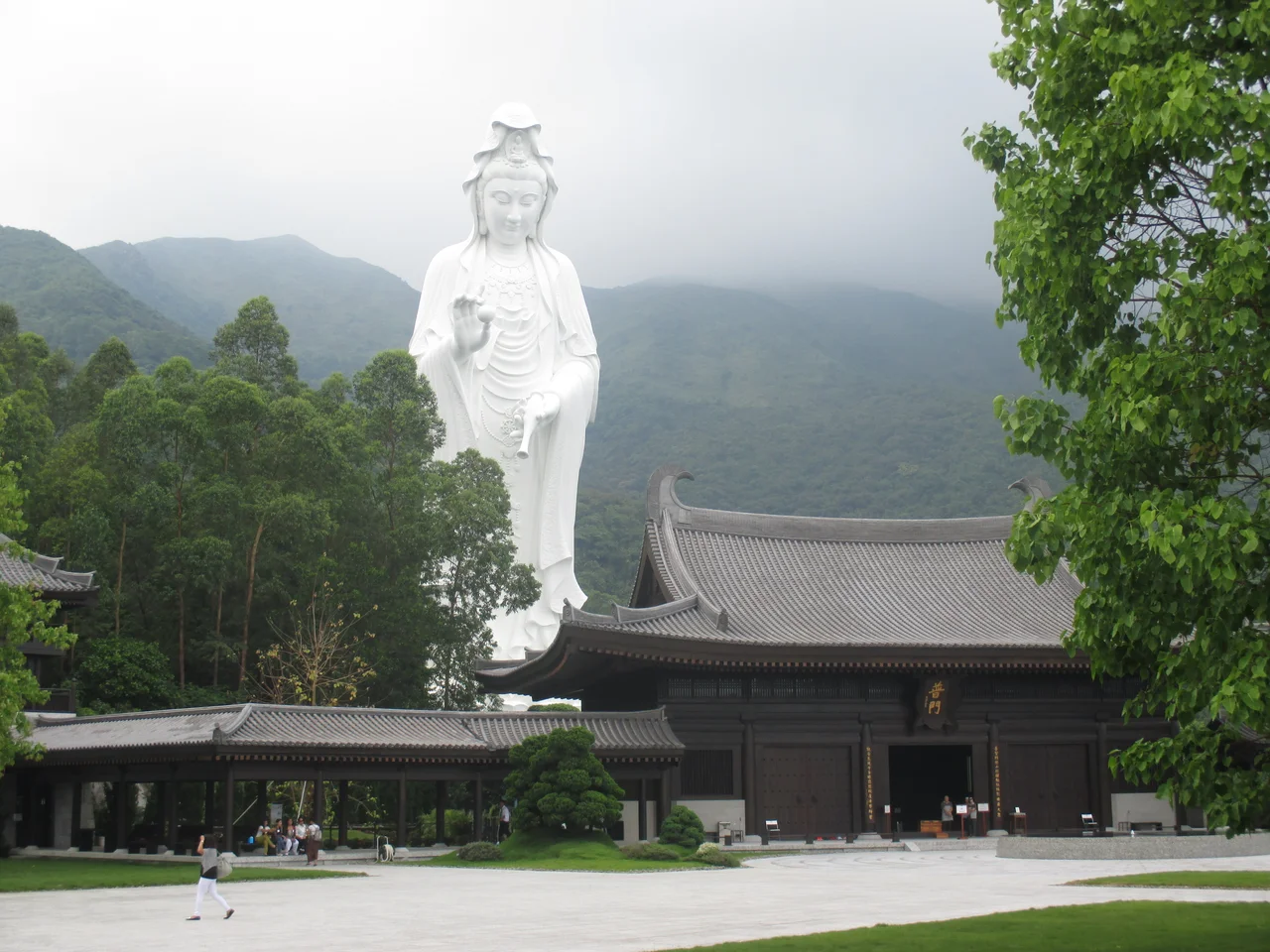

Tsz Shan Monastery
From the front of the monastery, you look out over Plover Cove Reservoir. Turn around and the Pat Sin Leng mountain range fills the horizon. Then look up: a 76-metre bronze-cast statue of Guan Yin, the Bodhisattva of Compassion, rises above everything. She leans slightly forward, as if bending toward the world she is watching over. The statue is coated in white fluorocarbon self-cleaning paint and rests on a three-tier lotus platform set into a six-metre granite base. Tsz Shan Monastery in Tung Tsz, Tai Po District, opened in April 2015 after nearly a decade of planning and construction — and the scale of the project, in every dimension, reflects the ambition behind it.
A Foundation's Vision
The Li Ka Shing Foundation initiated the monastery project and reportedly invested over HK$3.3 billion in it, covering land acquisition, construction, and ongoing operations. Li Ka-shing, one of Hong Kong's most prominent businesspeople and the foundation's founder, spoke at the opening about his belief in the restorative power of Buddhist art. That belief shaped the project's scope: this was not simply a functioning monastery but an institution designed around contemplation, scholarship, and public access. The monastery covers approximately 500,000 square feet, and the site encompasses not just the main temple complex but also the Buddhist Art Museum — opened in 2019 beneath the Guan Yin statue — and a Buddhist Spiritual Counselling Centre. The investment of private resources in a religious and cultural institution at this scale is unusual anywhere. In Hong Kong, it is remarkable.
Architecture of the Tang Ideal
The monastery's designers drew on the aesthetic of the Tang, Northern Song, Liao, and Jin dynasties — a period of roughly 600 years beginning in the seventh century CE, during which Chinese Buddhist temple architecture reached what many consider its most refined expression. The result is deliberate, unhurried, and precise. Three main buildings sit along a central axis, each on a rising platform as the complex climbs the hillside. Surrounding corridors frame each courtyard. A secondary axis leads from the Grand Courtyard past the Universal Gate to the Guan Yin statue — the path of devotion made architectural. Inside the halls, the materials are dark African padauk wood, white-grey granite, marble, and bronze. The monastery's materials connect the building to the earth rather than separating it from nature — a principle that extends to the entire site's integration into the hillside.
The Statue
At 76 metres total height — 70 metres of bronze statue on a six-metre granite base — the Guan Yin of Tsz Shan Monastery is one of the largest statues in Hong Kong. She is modeled on Song dynasty sculptural conventions, and her iconographic program is specific. On her topknot sits a small image of Amitabha, signaling the protection of the Pure Land tradition. Her right hand holds a wisdom mani pearl; her left holds a vase from which she pours pure water. A keyura necklace adorns her neck. Her pose — body angled slightly forward, gaze directed downward — is deliberate: she looks down from above on all beings. This is not a passive gesture. In Buddhist iconography, that downward compassionate gaze is an act of attention. The statue's scale makes it visible for miles.
Practices of the Mind
The monastery offers four contemplative practices to visitors: tea meditation, water offering, Zen calligraphy, and walking meditation. These are not simply tourist activities. The monastery frames them as traditional Buddhist practices for taming what the tradition calls the deluded mind — the distracted, reactive consciousness that Buddhist teaching diagnoses as the source of suffering. Tea meditation slows the attention. Walking meditation trains awareness in movement. Zen calligraphy requires both precision and letting-go. The monastery's framing of these practices is explicit: they exist to help visitors establish a habit of caring for the mind. Tsz Shan is a working religious institution, not a museum, and the practices offered reflect that seriousness. Visitor access is managed to preserve the character of the place.
Site and Setting
The view from the monastery matters. Plover Cove Reservoir — one of Hong Kong's largest reservoirs, created in the 1960s by damming a sea inlet — extends to the south and west. Pat Sin Leng, whose name translates as Eight Immortals Ridge, rises behind the monastery to the north. The combination of water, mountain, and an expansive sky makes Tsz Shan one of the more dramatically situated religious sites in Hong Kong. The Buddhist Art Museum, opened in 2019 beneath the Guan Yin statue, houses a significant collection of Buddhist art and artifacts accessible to the public. Together, the museum and the monastery have made Tung Tsz a destination that draws visitors for reasons both devotional and cultural.
From the Air
Tsz Shan Monastery is located at 22.474203°N, 114.205577°E in the Tung Tsz area of Tai Po District, in the northeastern New Territories of Hong Kong. The 76-metre Guan Yin statue is visible from the air at low to medium altitudes against the dark forested backdrop of Pat Sin Leng. Plover Cove Reservoir is the large body of water immediately to the south and west — a strong visual fix. At 3,000 feet, the Pat Sin Leng ridgeline (highest point approximately 590 metres) and the reservoir together frame the monastery site precisely. The nearest airport is Hong Kong International Airport (VHHH) on Lantau Island, approximately 25 nautical miles to the southwest. Shenzhen's urban area is clearly visible across the Shenzhen River to the north.
Nearby Stories
- Chapel of St. Francis Xavier 3.5 km away
- Cuiheng 4.1 km away
- 2015 Shenzhen Landslide 16 km away
- Shunde 31 km away
- Wanshan Archipelago 37 km away
- Nanxiong Formation 96 km away
- Heyuan 149 km away
- Checheng Fu'an Temple 629 km away