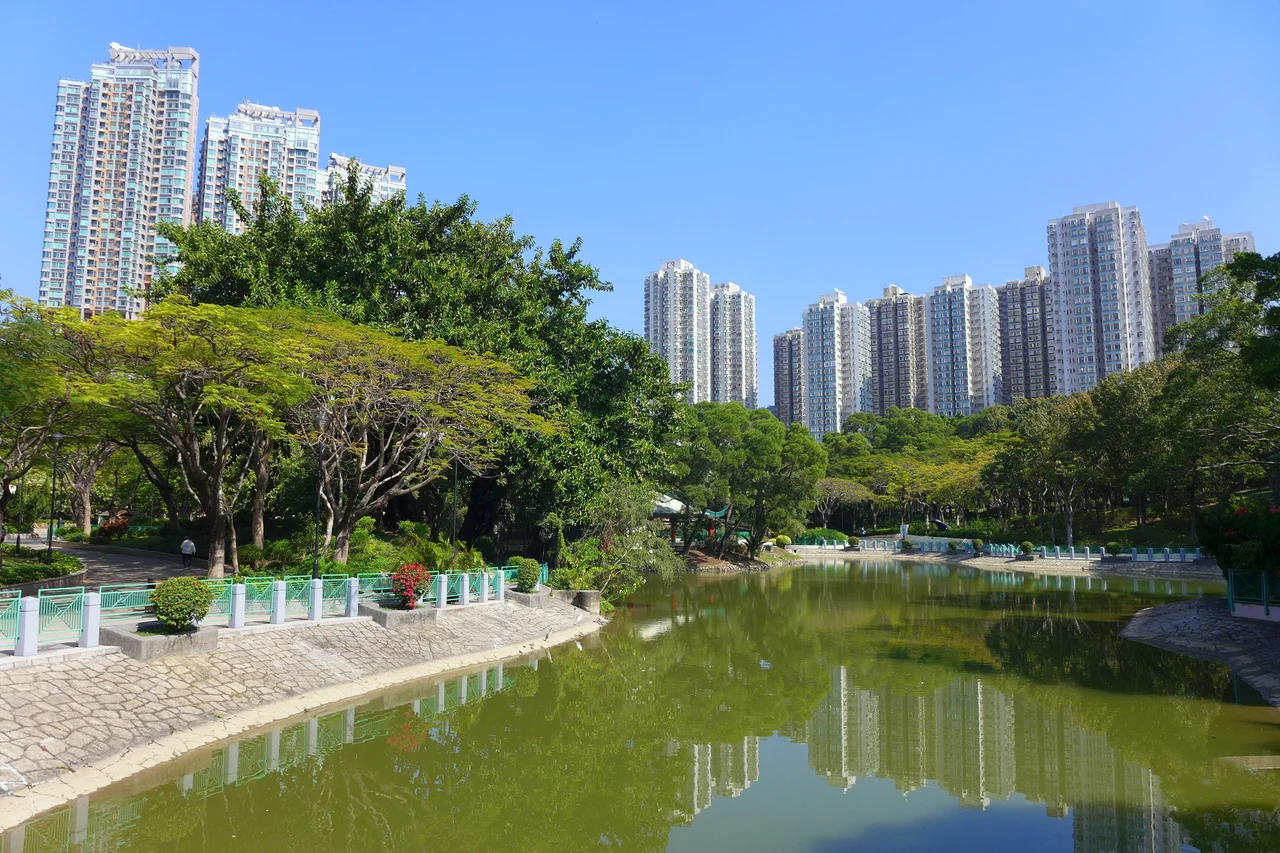

Tuen Mun Park
The ground beneath Tuen Mun Park was once the floor of Castle Peak Bay. In the 1970s, engineers reclaimed that seabed, and for a while the empty site served as a temporary housing area while Hong Kong figured out what came next. What came next, in November 1981, was a private consultant named EBC Hongkong, commissioned to design something ambitious: artificial lakes, water features, a roller-skating rink, a model boat pool, and spaces for children to play. The park that emerged from that bay mud became the largest town park in the New Territories, covering 12.5 hectares. In 1990, the Hong Kong Institute of Landscape Architects gave it a Silver Medal. The award was deserved. What no one fully anticipated was that the park would also become a stage for some of the most genuinely Hong Kong dramas of the decades that followed.
Built from the Bay
Tuen Mun Park sits between the Tuen Mun River and the town centre, neatly bounded by Tuen Mun Town Plaza, the Public Library, and the Town Hall. Two rail stations — the terminus of the Tuen Ma line and the Light Rail's Town Centre stop — flank it. Everything about the park's location says 'civic heart.' That was always the point. The park was conceived in the 1970s alongside Tuen Mun's new town development, the two projects growing together as Hong Kong threw up housing estates on the reclaimed northwestern shore. The artificial lakes were engineered rather than natural, the water cascades designed for spectacle, but over decades the greenery matured and the spaces became genuinely pleasant. The park won its landscape award and settled into the rhythm of a beloved community space — morning tai chi practitioners, families on weekends, retirees claiming benches in the afternoons.
Forty-Three Tanks and a Bronze Tripod
Among the park's more unexpected attractions is the Reptile House, opened in 1999 as one of the first of its kind in the Leisure and Cultural Services Department. Tucked into the southern turfed area, its 245 square metres of floor space hold indoor terraria and a courtyard exhibit displaying twenty species across 43 live exhibits. Bearded dragons bask under heat lamps. A spectacled caiman regards visitors with ancient patience. Veiled chameleons and Tokay geckos occupy separate enclosures; a ball python coils beside a blue-tongued skink. Seven scale models supplement the living specimens, and informational panels explain the biology of each. Around 400,000 visitors come through each year — 75,000 of them in organised groups — making it one of the most-visited points in the park. Children press their faces against the glass. Adults who expected a gentle stroll sometimes find themselves unexpectedly absorbed in the quiet drama of a boa constrictor considering its options.
Cooking Without Salt
The park's noise controversy became one of Hong Kong's more enduring community disputes. For years, retired singers gathered in the open air to perform with amplifiers, and the residents of neighbouring Kam Wah Garden found themselves sealed inside their flats with windows shut, one resident describing the constant performances as 'a poison to us all.' In 2006, the LCSD proposed designated singing zones without external amplification. The singing groups objected: performing without amplifiers, they said, was 'like cooking without salt.' A proposed noise barrier was designed, then scrapped when the Architectural Services Department determined it would reflect traffic noise back toward the residential area. Eventually, a performance stage and two self-entertainment zones were established farther from the residential blocks. The amplifiers kept appearing anyway.
Reclaim Tuen Mun
By 2019, the controversy had shifted in character. Many of the performers in the park were women from the mainland — the so-called dai ma, or 'dancing aunties' — singing in Mandarin with amplifiers and accepting cash-filled red packets from spectators. The tensions in the park reflected wider anxieties in Hong Kong about identity and public space. On 6 July 2019, thousands of residents marched down Tuen Mun Heung Sze Wui Road and into the park, chanting 'reclaim Tuen Mun, give me a quiet park.' Three days later, the Tuen Mun District Council unanimously passed a motion calling to close the self-entertainment zones; the LCSD announced their closure that same evening. Then, against the backdrop of Hong Kong's intensifying broader protest movement, another march came on 21 September 2019. Police fired tear gas and sponge grenade rounds; protesters threw Molotov cocktails. The Light Rail was suspended. A park that began as a solution to noise disputes had become something else entirely — a geographic node in a much larger argument about what Hong Kong was becoming.
Lakeside, Still
Today the park continues its original function alongside its contested history. The artificial lake reflects the sky on clear days. Children navigate the badminton and volleyball courts. The amphitheatre hosts approved events. Tuen Mun station, just through Exit B, connects the park to Kowloon and beyond. The lake paths are popular with early-morning walkers who arrive before the heat builds, and the Reptile House opens its doors to another round of school groups. Whatever arguments have played out in the park's open spaces, the landscape itself keeps offering what it was designed to offer: a green pause in the middle of one of Hong Kong's most densely settled new towns, built on ground that was once the sea.
From the Air
Tuen Mun Park sits at approximately 22.39°N, 113.97°E in the northwestern New Territories, near the terminus of Castle Peak Bay. From the air, the park's artificial lake and green buffer between the town centre towers and the Tuen Mun River channel are clearly visible. Hong Kong International Airport (VHHH) lies roughly 8 km to the southwest across the water. Recommended viewing altitude: 1,500–2,500 feet for a clear view of the park's layout, the surrounding new town grid, and the bay beyond. Castle Peak (583 m) rises to the northwest and provides a useful landmark.
Nearby Stories
- Chapel of St. Francis Xavier 3.5 km away
- Cuiheng 4.1 km away
- 2015 Shenzhen Landslide 16 km away
- Shunde 31 km away
- Wanshan Archipelago 37 km away
- Nanxiong Formation 96 km away
- Heyuan 149 km away
- Checheng Fu'an Temple 629 km away