.jpg)
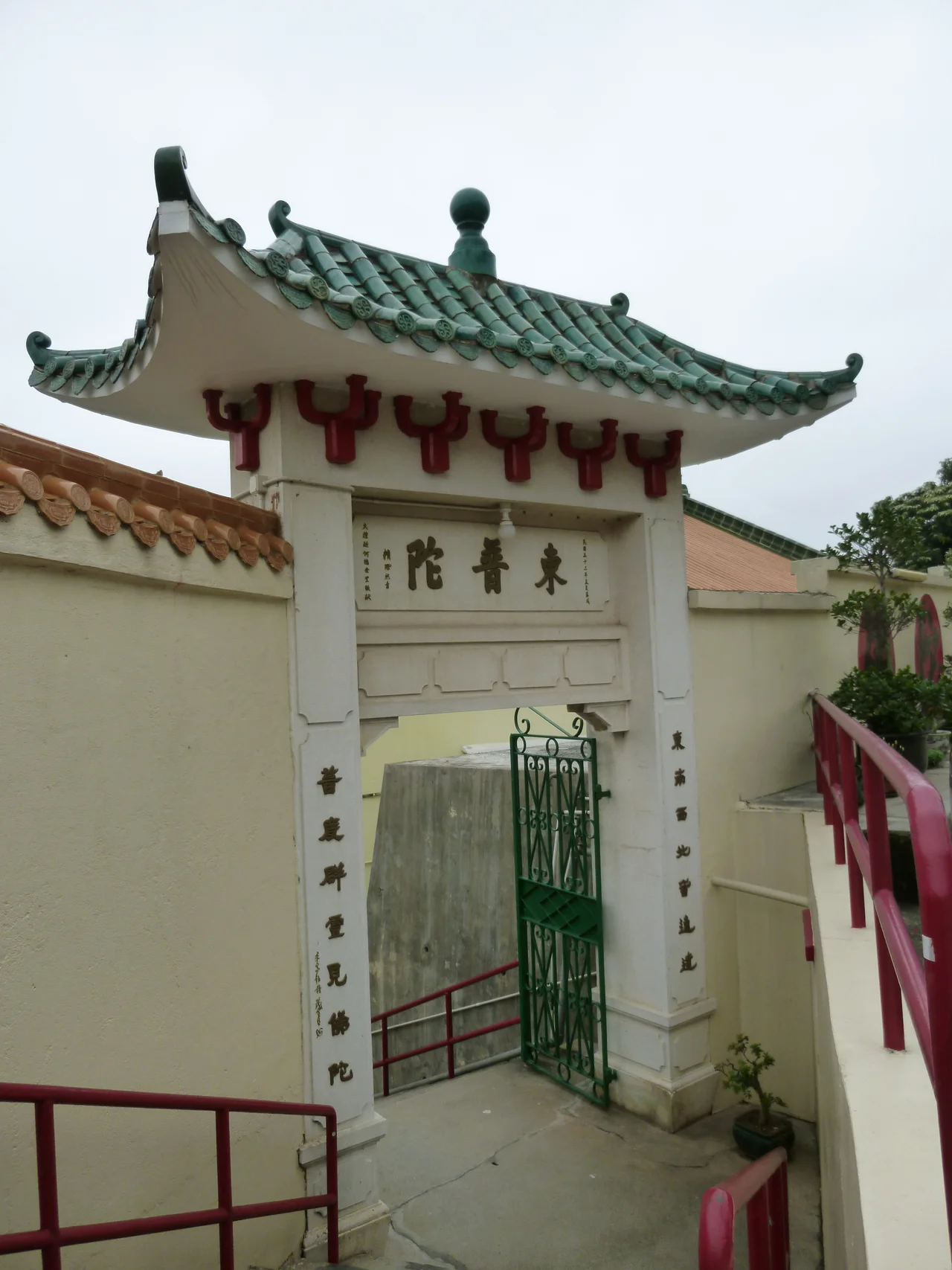
Tung Po Tor Monastery
In the Memorial Hall of the Tung Po Tor Monastery, visitors can see the personal articles used by the founder Mau Fung — and also, displayed alongside them, gifts said to have been given by the Emperor of Japan: yellow sateen, Five Garments, and a Bag. How those objects came to rest in a Buddhist monastery in Hong Kong's New Territories, and what they meant to the people who placed them there, is a question the monastery holds quietly. The hall doesn't explain. It simply displays.
A Foundation and Its Purpose
Mau Fung established Tung Po Tor Monastery in 1932, dedicating it to the worship of Kwun Yum — the Goddess of Mercy, known in Chinese as Guanyin and in Sanskrit as Avalokiteśvara. The site chosen was the foot of Tin Fat Shan in Lo Wai, Tsuen Wan, where the hillside provides a sheltered setting appropriate for monastic retreat. The original complex included two principal structures: the main hall, called Yuen Tung Po Din, and an entrance hall, called Tin Wong Din, separated by an open courtyard. In front of the main hall stands a large bronze tripod. The ground beneath the tripod, the source records, was formed in a blast during the Sino-Japanese War — a scar in the earth that was incorporated into the site's fabric rather than removed, a wartime wound that became part of the monastery's material memory.
Red Columns and Heavenly Kings
The Tin Wong Din — also called Wai Tor Din — is a two-storey building of concrete and stone. Its pitched roofs rest on timber rafters and purlins covered with clay tiles, a construction method that places it in dialogue with traditional Chinese religious architecture while using the practical materials of its era. Inside, four round columns painted red are arranged in a 1:2:1 proportion across the interior. The external walls are plastered and painted earth yellow, a colour that recurs throughout monastery architecture in the region. On the ground floor, an altar holds a statue of Maitreya — the future Buddha — facing the entrance, and a statue of Wai Tor (Skanda) facing the garden courtyard. At the two side platforms stand the four large statues of the Four Heavenly Kings, guardians of the four cardinal directions. Upstairs, the space serves a different purpose entirely: it is a classroom and library where young monks study. The ridge of the building is decorated with a pearl and two aoyus — mythological creatures whose image traditionally protects against fire.
A Ming Bronze in a Modern Setting
Among the monastery's most striking objects is a statue of a Buddhist medical practitioner cast in ancient bronze during the Ming dynasty — a period stretching roughly from 1368 to 1644. The statue's presence in a 1932 monastery raises questions the source does not answer: where did it come from, how did it arrive, and what chain of custodianship carried it from the Ming period through the intervening centuries to this hillside in Tsuen Wan? Such objects often have complicated histories of movement, purchase, gift, or salvage. What the monastery chose to do was simply to keep it — to make it part of a living religious space rather than a museum exhibit, which is perhaps the most honest form of preservation available.
Grade II and Still Standing
In April 2010, Hong Kong's Antiquities Advisory Board declared Yuen Tung Po Din, Tin Wong Din, and Wai Tor Din as Grade II historic buildings — a designation recognising their architectural and historical significance, even if they do not meet the higher threshold required for Grade I status. The classification brought formal recognition without dramatically changing the monastery's daily reality. It is still a working place of worship. Monks still use the classroom upstairs. Visitors still come to the Kwun Yum hall and the courtyard. The bronze tripod still stands on its wartime ground. The Memorial Hall still holds its quiet display of the founder's belongings, alongside those Japanese gifts that arrived under circumstances the monastery does not explain — and perhaps does not fully know.
From the Air
Tung Po Tor Monastery is located at approximately 22.38°N, 114.13°E on the lower slopes of Tin Fat Shan in Tsuen Wan, in the eastern part of Hong Kong's New Territories. The monastery's position at the foot of a hillside within a semi-rural enclave makes it less visible from altitude than surrounding urban areas; look for the transition between Tsuen Wan's urban grid and the green hillside to the north. Hong Kong International Airport (VHHH) is approximately 18 km to the west. Recommended viewing altitude: 1,500–2,500 feet to distinguish the monastery compound from the surrounding woodland and residential development.
Nearby Stories
- Chapel of St. Francis Xavier 3.5 km away
- Cuiheng 4.1 km away
- 2015 Shenzhen Landslide 16 km away
- Shunde 31 km away
- Wanshan Archipelago 37 km away
- Nanxiong Formation 96 km away
- Heyuan 149 km away
- Checheng Fu'an Temple 629 km away