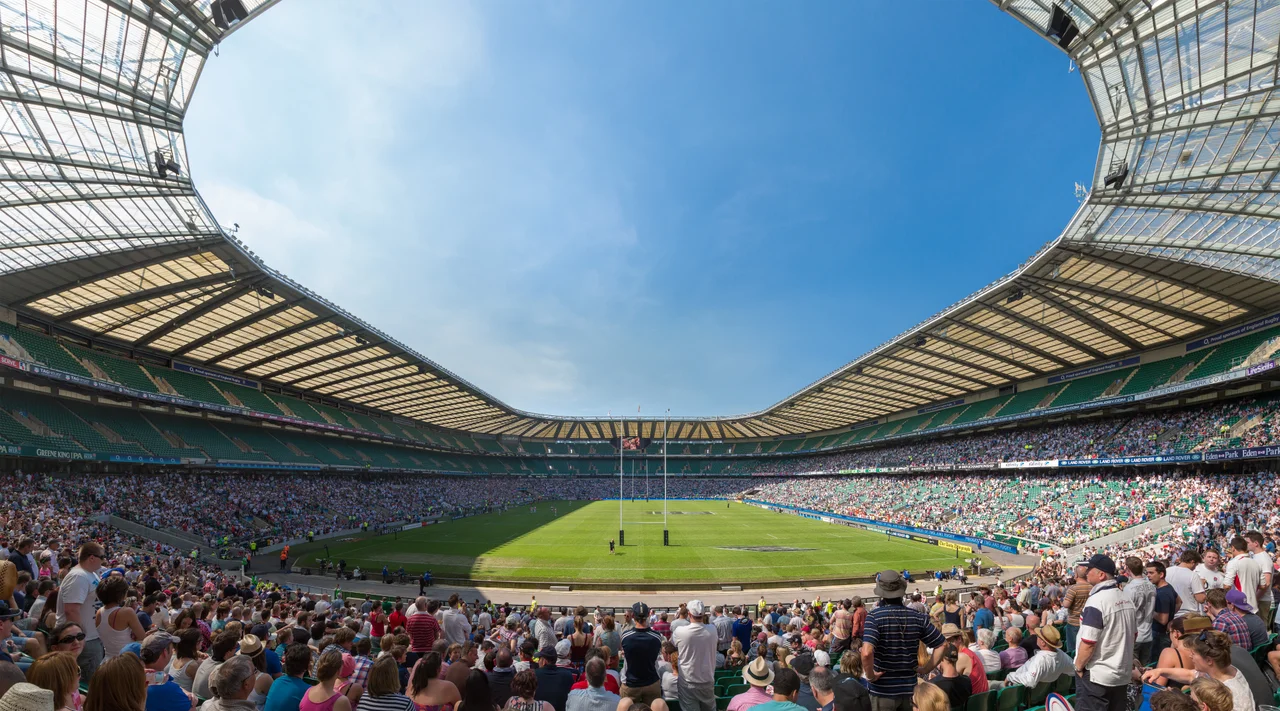

Twickenham Stadium
Before it was rugby's cathedral, it was a market garden growing cabbages. In 1907 the Rugby Football Union paid five thousand pounds, twelve shillings and sixpence for the 10.25 acres in southwest London, and rugby people still call the place the Cabbage Patch. By 1909 the first stands were up. By January 1910, England were playing Wales there in the first international. By 1995, it held 75,000 in an all-seater bowl. Today, at 82,000, it is the world's largest stadium devoted to rugby union, the second-largest stadium in the United Kingdom, and the fourth-largest in Europe.
Why Twickenham Exists
The RFU had been hiring grounds for matches - Crystal Palace, mostly - and watching the receipts go to other people. Sold-out tests against New Zealand and South Africa convinced them they needed a ground of their own. Committee member Billy Williams and treasurer William Cail tracked down the Twickenham market garden and the deal was done. The first game on the new ground was a club fixture between Harlequins and Richmond on 2 October 1909. The first international followed three months later: England beat Wales 11-6 in front of 20,000 spectators. During the First World War the ground was used to graze cattle, horses and sheep. In 1921, King George V unveiled a war memorial. The Cabbage Patch had become the Home of Rugby.
Swing Low, Sweet Chariot
The last match of the 1988 Five Nations was a small disaster waiting to happen. England had lost 15 of their previous 23 championship matches. The Twickenham crowd had seen exactly one English try in two years. At half-time the team were 0-3 down to Ireland, and the mood was funereal. Then the second half began and something extraordinary unfolded. England played a running game nobody had thought them capable of - six tries, a 35-3 victory. Three of those tries were scored by Chris Oti, a black left winger with extraordinary pace. Up in the stands, a group of boys from the Benedictine school at Douai began singing a spiritual that was their school's try-scoring tradition. When Oti scored his second, neighbours joined in. When he completed his hat-trick, the whole ground was singing 'Swing Low, Sweet Chariot.' It has been sung at every England home match since - a song that began as the music of enslaved African Americans, adopted at Twickenham in celebration of a black Englishman, and now woven into the identity of English rugby. The complicated history of all that travels with the song every time the crowd sings it.
World Cup Memories
Twickenham hosted the 1991 Rugby World Cup Final, in which Australia beat England 12-6. It hosted the 2015 Final, in which New Zealand beat Australia 34-17 for back-to-back titles. In between came the 1999 semifinal where France produced one of the greatest upsets in the sport's history, beating defending champions New Zealand 43-31. In September 2025 it hosted the Women's Rugby World Cup Final, won by England 33-13 over Canada in front of a sold-out crowd. The ground has also expanded its remit beyond rugby union. In 2001 and 2006, during Wembley's reconstruction, Twickenham hosted the Rugby League Challenge Cup Final. In 2016 and 2017 it hosted NFL London Games. The Top Gear motoring show once played 'car rugby' on the pitch, with Kia Ceeds as backs and Kia Sportages as forwards; Jeremy Clarkson's team won 17-14.
The Stage and the Speakers
When the rugby balls are away, the speakers come out. The first time the stadium opened to concerts was a consequence of Wembley's chronic construction delays in the mid-2000s. The Rolling Stones played their Bigger Bang Tour at Twickenham. So did R.E.M. in 2008, Bon Jovi the same summer, and Iron Maiden on a Somewhere Back in Time tour stop with Avenged Sevenfold supporting. Lady Gaga's two Born This Way Ball shows in September 2012 broke the record for the fastest sell-out in UK stadium history: 50,625 tickets in 50 seconds. Rihanna's 2013 Diamonds World Tour drew 95,971 across two nights. The list runs through Beyonce, Eminem, Metallica, Depeche Mode, the Eagles, U2. Since the mid-1950s, the stadium has also quietly hosted the Jehovah's Witnesses' annual London convention, with up to 25,000 attending for Bible talks.
Allianz Stadium
In August 2024 the RFU announced that for ten years from September 2024 the ground would be called the Allianz Stadium Twickenham, in a corporate sponsorship deal. The locals will go on calling it Twickenham, or simply Twickers. From the air, the ground is unmistakable - a vast oval roof on the south side of the River Crane, with the smaller Stoop Stadium of Harlequins sitting just to the east. Match days produce one of London's distinctive traffic patterns, with 82,000 people converging on a quiet residential corner of Richmond upon Thames and then dispersing back into it. The World Rugby Museum lives inside the stadium, telling the story of the global game from William Webb Ellis's allegedly creative dribbling at Rugby School in 1823 forward.
From the Air
Twickenham Stadium lies at 51.4561 N, 0.3417 W in the London Borough of Richmond upon Thames, southwest London. View from 1,500-2,500 ft AGL to capture the oval roof and the smaller Stoop Stadium just to the east. Nearest airports: London Heathrow (EGLL) 4 nm west-northwest, RAF Northolt (EGWU) 7 nm north. Note Heathrow's controlled airspace - the stadium sits just inside the southeastern edge of London Terminal Control.
Nearby Stories
- Battle of Britain, Northfleet 1.1 km away
- Bayham Old Abbey 5.4 km away
- Catharine Macaulay 6.4 km away
- Hatfield rail crash 8.8 km away
- Chequers 8.9 km away
- Chelmsford Cathedral 10 km away
- Queen Victoria Hospital 13 km away
- Fishbourne Roman Palace 36 km away