.jpg)
Ufford, Suffolk
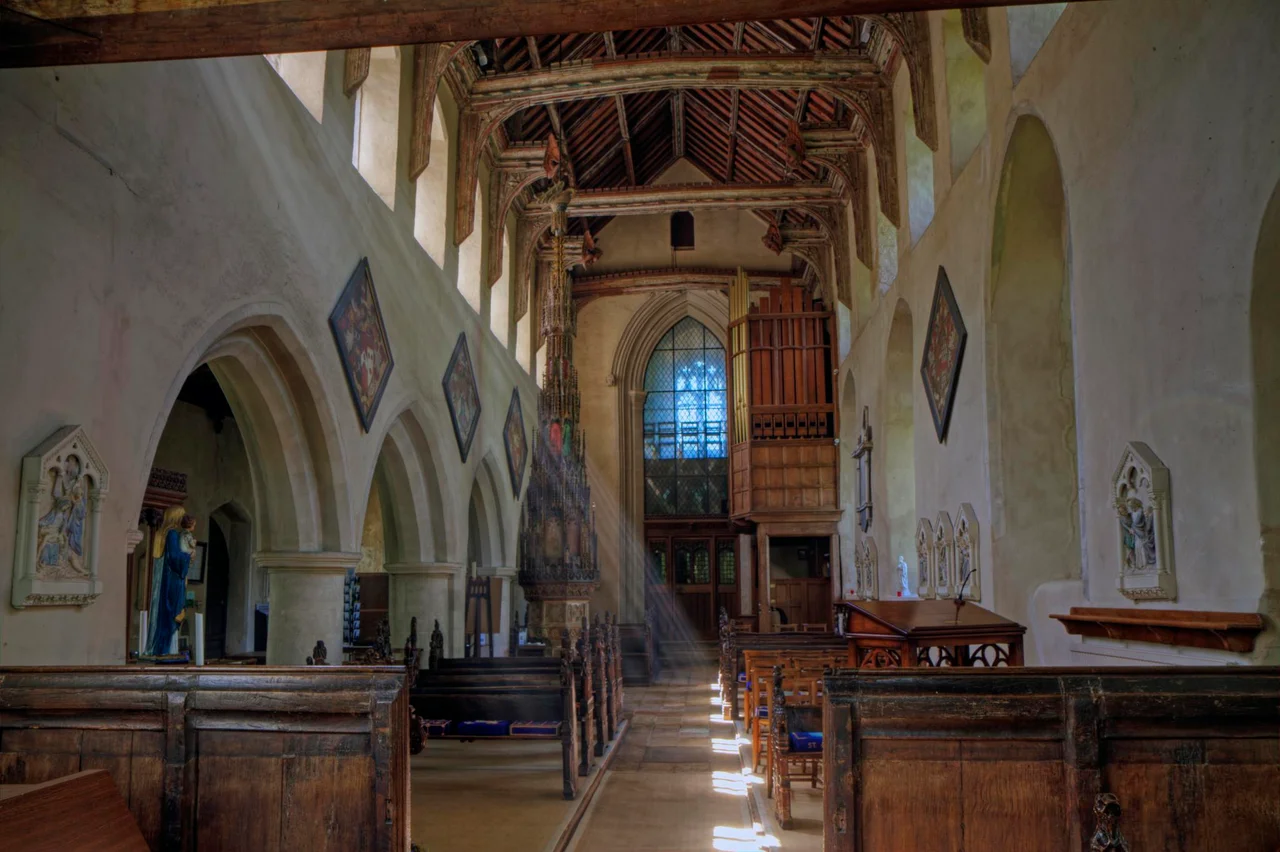
On a January day in 1644, William Dowsing arrived at St Mary's Church in Ufford with parliamentary orders to smash any image he considered idolatrous. Dowsing was Suffolk's licensed iconoclast during the English Civil War, a man who travelled methodically from church to church chiselling angels off rood screens and pulling brass effigies from chancel floors. His diary records, in his own words, that the Ufford font cover was 'gorgeous... like a pope's triple crown'. By every rule of his commission he should have hauled the thing down. He did not. He left, the diary went on to other parishes, and the medieval wood-carving that should have been destroyed in 1644 is still where the carpenters left it almost six centuries ago - twenty feet of pinnacled, painted timber rising above the font.
Uffa's Enclosure, Not Uffa's Ford
The village name is a small puzzle that took linguists a long time to solve. Ufford looks as though it ought to mean 'Uffa's ford' - that is, the place where Uffa's people crossed a river. The village does sit two miles south-south-west of Wickham Market, with the Deben running through the area, so the reading seems natural. It is also wrong. The Old English form actually means 'Uffa's enclosure' - the worth or homestead of a Saxon landholder named Uffa, with no ford involved. The distinction matters because it tells you the village was named for the man who held the land, not for the geography. Ufford has twenty-eight listed buildings still standing, most of them dwelling houses in the eastern part of the village, some of them thatched. Among them, the eleventh-century Church of St Mary is the only Grade I listed structure - the oldest of the twenty-eight, and by far the most significant.
The Font Cover That Dowsing Spared
Medieval English churches all had font covers - lockable wooden lids designed to prevent the theft of consecrated holy water, which was sometimes used in folk magic. Most were small, square and functional. Ufford's, carved around 1450, is something else entirely. It rises twenty feet above the font in a series of telescoping octagonal stages, each pinnacled and traceried like a miniature spire. At its summit is a pelican pecking at its own breast - the medieval symbol of Christ feeding the faithful with his blood, drawn from a legend that pelican mothers tore open their breasts to feed their chicks in times of famine. It is the tallest such cover in England. Dowsing's decision to leave it intact was not sentimental - it was strategic. The cover was so elaborately constructed that destroying it would have taken hours of work and probably destroyed the font beneath it. He moved on to easier targets.
Bells, Including One That Speaks Latin
Eight bells hang in St Mary's tower for change ringing - the English art of ringing bells in mathematical sequences rather than simple tunes. The heaviest weighs thirteen hundredweight, about 660 kilograms. The oldest dates from about 1380, cast by William Dawe of London. Its inscription is in Latin: Sum rosa pulsata mundi Katerina vocata - 'When struck I am the Rose of the World, called Katherine'. The bell is medieval Catholic theology written in bronze, dedicated to St Catherine and addressing itself to whoever might be listening. It is also, presumably, what the parishioners heard in the years before the Reformation, when the village still had a Latin liturgy and the great font cover was still freshly painted. The tower belongs to the Suffolk Guild of Ringers; the bells were rehung and three of them recast by John Taylor & Co in 1936. The first peal at Ufford rang on 24 October 1885. By 2019, the tower had recorded 152 peals.
The People Who Lived Here
Robert d'Ufford, 1st Earl of Suffolk, lord of the manor in the early fourteenth century, took his title from the village. The Cholmondeley novelist Mary Cholmondeley - one of the late-Victorian writers who fell out of fashion in the early twentieth century and is now slowly being rediscovered - lived in Ufford for several years before the First World War. Admiral of the Fleet Terence Lewin, Baron Lewin, who served as Chief of the Defence Staff during the Falklands War in 1982, lived in the village in his retirement. He died in 1999. The village today has 1,008 residents by the 2019 estimate, two pubs - the Ufford Crown and the White Lion - a community hall and a recreation ground. The Ufford Park Hotel keeps a golf course on the edge of the parish. None of this would look unusual to anyone who has spent time in rural Suffolk. What sets Ufford apart is what is locked inside St Mary's: that miraculous font cover, towering twenty feet above the medieval stone basin, untouched since the Puritans decided it was too beautiful to break.
From the Air
Ufford sits at 52.12 degrees north, 1.35 degrees east, in the Deben valley two miles north of Melton and Woodbridge. The village is small - mostly the strip along the B1438 and the cluster around the church. Recommended viewing altitude is 1,500-2,500 feet. The River Deben winds south through Woodbridge and provides the main navigation reference; the A12 dual carriageway runs to the west of the village. Nearest airfields are RAF Wattisham (EGUW) to the west and Norwich (EGSH) to the north. The Suffolk coast is a short distance to the east - coastal sea fog can drift inland on calm summer mornings.
Nearby Stories
- Walton-on-the-Naze 2.7 km away
- Clare, Suffolk 9.5 km away
- RAF Lakenheath 10 km away
- RAF Hardwick 11 km away
- Beeleigh Abbey 13 km away
- Four Days' Battle 45 km away
- Southern Bight 75 km away
- Battle of Lowestoft 79 km away