
UK Holocaust Memorial
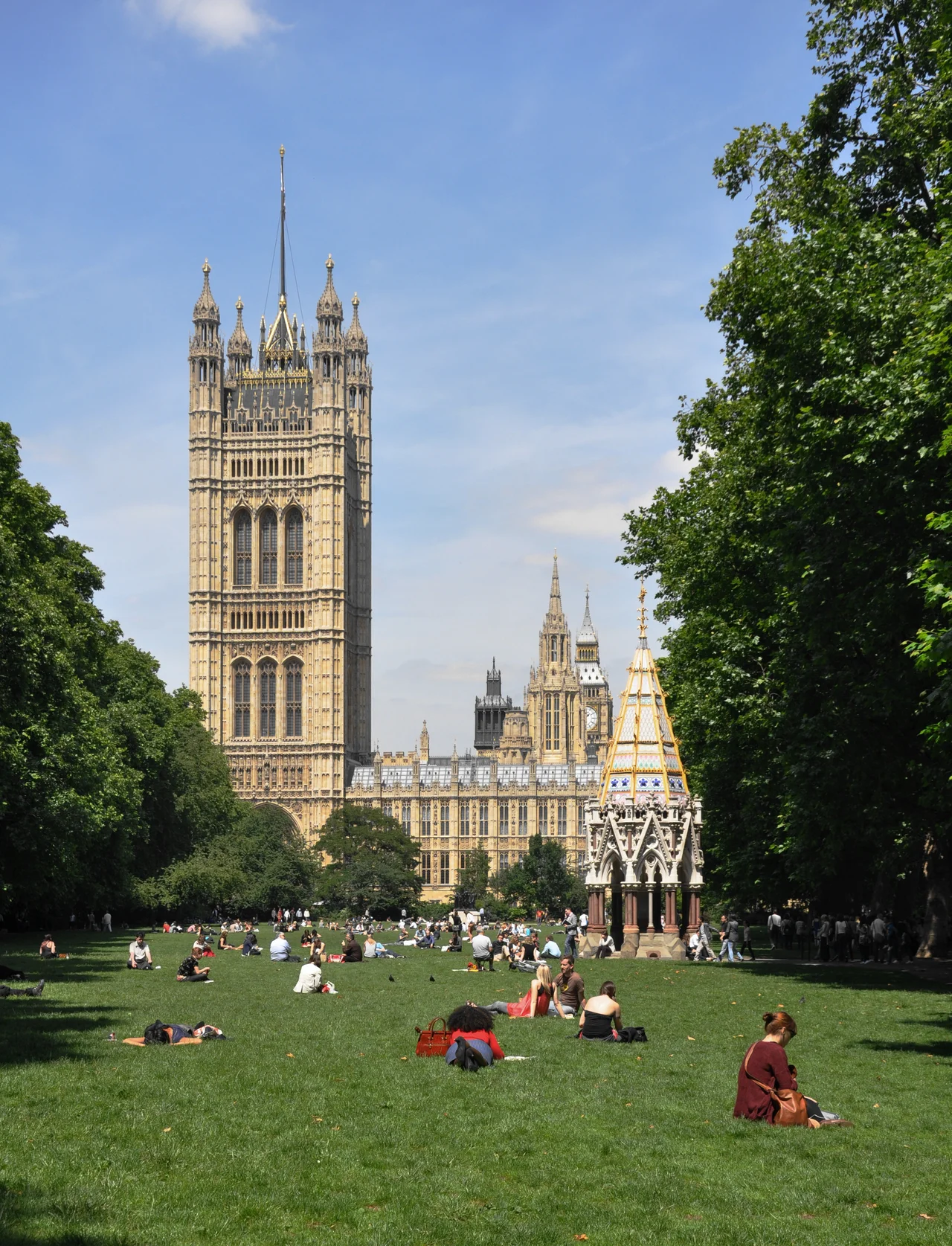
On a small green park between the Palace of Westminster and Lambeth Bridge, Britain has been arguing for a decade about how to remember the worst crime of the twentieth century. Victoria Tower Gardens is the patch of ground in question - a Grade II* listed park, barely three and a half acres, holding three existing memorials and a children's playground in the gap between the Houses of Parliament and the river. Since 2016 it has also been the proposed site of the United Kingdom's national Holocaust Memorial and Learning Centre, and almost every part of that proposal has been fought over.
Why a New Memorial
There is already a Holocaust memorial garden in Hyde Park. It was opened in 1983, and the Holocaust Commission convened by Prime Minister David Cameron in 2014 concluded, after collecting nearly 2,500 responses, that the nation was no longer satisfied with it. The Commission gathered Holocaust survivors at Wembley Stadium - one of the largest such gatherings ever held in Britain - and what they found was uncomfortable: too few young people were learning the history; regional projects were underfunded; the testimonies of survivors and the soldiers who had liberated the camps were going unrecorded as the witnesses themselves aged and died. The Commission recommended a 'striking and prominent' new national memorial, a world-class learning centre, an endowment for Holocaust education, and an urgent programme to capture survivor testimony before it was lost. The proposed memorial is meant to honour Jewish victims of the attempted Nazi extermination, alongside Roma and Sinti, disabled people murdered under the Aktion T4 programme, and others marked by the regime.
The Westminster Site
Of more than fifty sites considered, the foundation chose Victoria Tower Gardens - a few yards from Parliament, in the heart of the UNESCO World Heritage Site of Westminster. The choice was deliberate. The memorial was to stand where the laws of the United Kingdom are made, a deliberate juxtaposition of remembrance and democracy. An international design competition was won in October 2017 by a team led by the British-Ghanaian architect David Adjaye, with Ron Arad Architects as memorial architect and Gustafson Porter and Bowman as landscape designer. The plan: a memorial of 23 bronze 'fins' above ground, with an underground learning centre beneath. The government allocated £50 million, later increased to £75 million, with another £25 million expected from charitable donations. In January 2021, the government announced that entry to the completed memorial would be free in perpetuity. 'Holocaust survivors will be reassured,' Communities Secretary Robert Jenrick said, 'that their testimony will be freely available to all when they are no longer able to tell the story themselves.'
The Objections
Almost from the moment of announcement, the proposal generated organised opposition. The Royal Parks, which administer Victoria Tower Gardens, supported the principle but objected to the scale and design. ICOMOS, the UNESCO adviser on World Heritage Sites, warned the structure would 'interrupt substantially' the view of Victoria Tower and the Palace. The Environment Agency raised concerns that excavation could compromise the river's flood defences. Tree surveys suggested that two lines of mature trees might not survive construction, and that unexploded munitions from the Second World War might lie in the soil. Lord Carlile, the former independent reviewer of terror laws, called the location a 'self-evident terrorism risk' given its proximity to Parliament. A grassroots group, Save Victoria Tower Gardens, organised a petition with over 10,000 signatures. Among Jewish voices, opinion was divided: a group of Jewish peers signed a letter arguing that the design 'evokes neither Holocaust nor Jewish history,' while 174 politicians from across the parties signed in favour of the scheme. Over 90 percent of public consultation responses opposed the development. Westminster City Council's planning committee voted unanimously against it in February 2020.
The Courts and a Forgotten 1900 Law
After Westminster Council's refusal, the matter went to a public inquiry held virtually through the autumn of 2020. In July 2021 the Communities Secretary ruled in favour of the memorial. The decision was challenged in the High Court by the London Historic Parks and Gardens Trust, and in April 2022 Mrs Justice Thornton quashed the planning permission. The reason was a piece of legislation almost everyone had forgotten: the London County Council (Improvements) Act 1900, passed when the southern half of Victoria Tower Gardens was first created. That statute, the court found, contained 'a prohibition on using Victoria Tower Gardens as anything other than a garden open to the public.' The court took care to note that all parties supported the principle of a Holocaust memorial - the question was the place. In July 2022 the Court of Appeal refused to reconsider. To build the memorial on this site, Parliament would have to repeal a law it had passed 122 years earlier.
The Bill, the Survivors, the Time
In February 2023 the Holocaust Memorial Bill was introduced to repeal the 1900 statute. In June 2023 MPs supported it unanimously at second reading; it passed to a select committee where petitioners gave evidence against it, including former Conservative MP Sir Peter Bottomley and Lord Carlile. After the 2024 general election, the new Labour government reintroduced the bill in July 2024, affirming its commitment to building the memorial. As the legal and political process has dragged on, the people whose testimony the memorial is meant to preserve have continued to age. The Imperial War Museum, less than a mile away across the river, opened its expanded Holocaust galleries in 2021 - £30 million of permanent exhibition space already telling the history that the Westminster site is also meant to tell. In January 2026, the Holocaust Memorial Act received Royal Assent, removing the legal restrictions on the Victoria Tower Gardens site and clearing the path for construction. The dignity of the people it is intended to honour is not in doubt.
From the Air
Victoria Tower Gardens lies at 51.4959 N, 0.1248 W, on the north bank of the Thames immediately south of the Palace of Westminster. View from 1,500-2,000 ft AGL with the Houses of Parliament and Victoria Tower as principal landmarks. Nearest airports: London City (EGLC) 6 nm east, Heathrow (EGLL) 14 nm west. Central London is restricted airspace - this view is for orientation, not a recommended overflight.
Nearby Stories
- Battle of Britain, Northfleet 1.1 km away
- Bayham Old Abbey 5.4 km away
- Catharine Macaulay 6.4 km away
- Hatfield rail crash 8.8 km away
- Chequers 8.9 km away
- Chelmsford Cathedral 10 km away
- Queen Victoria Hospital 13 km away
- Fishbourne Roman Palace 36 km away