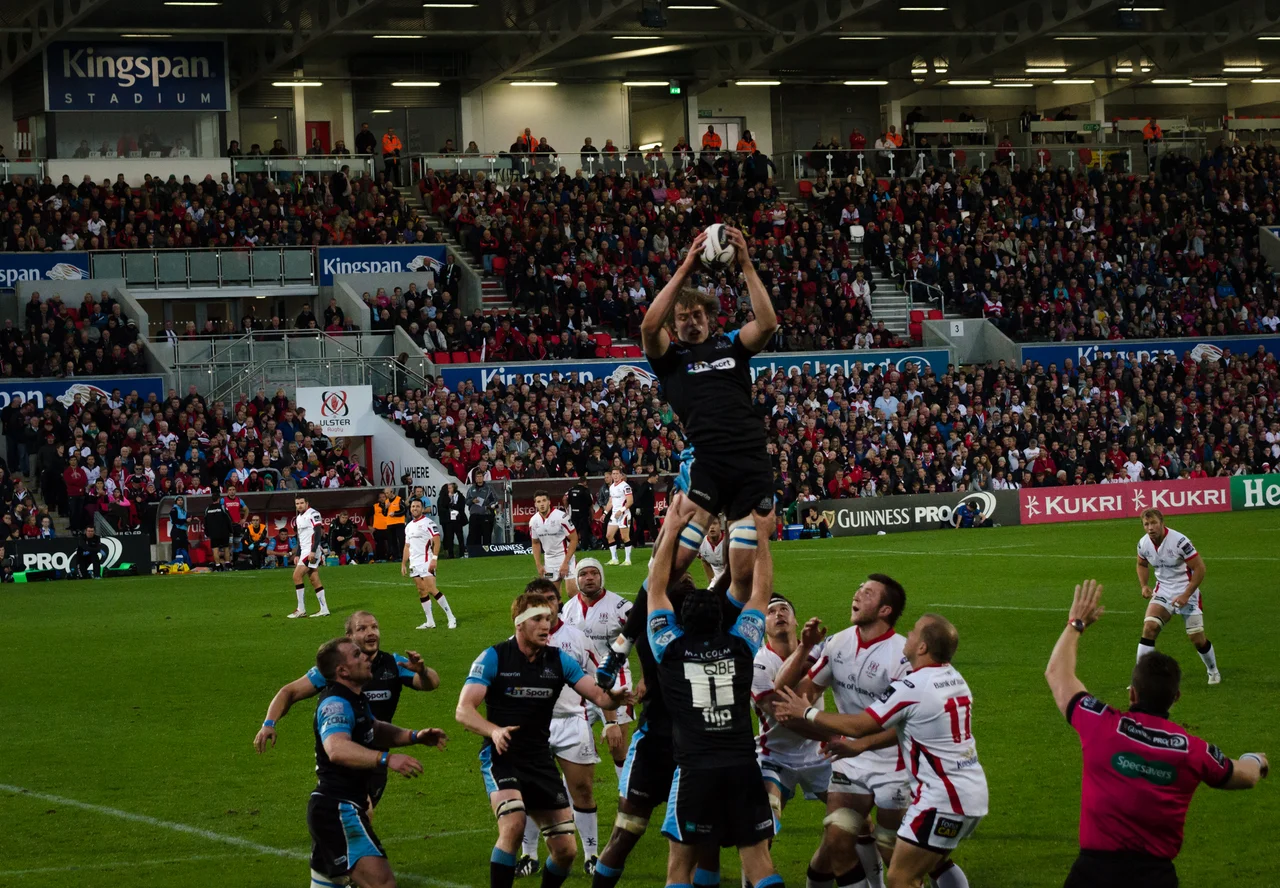

Ulster Rugby
On a January night in 1999, eight thousand Ulster fans piled onto buses and ferries and headed south to Dublin's Lansdowne Road for a final no one outside the province had predicted them to reach. They beat the French side US Colomiers 21-6 in the rain, and Ulster became the first Irish team ever to win the European Cup. The first team outside England and France, too. The Heineken Cup had existed for four years. In Belfast, where the Troubles had only formally ended the previous April, a rugby club from the city's south side had quietly become continental champions, and the trophy came home to Ravenhill.
Older Than the Union
Ulster Rugby is older than the body that governs it. North of Ireland F.C., founded in Belfast in 1868, was operating eleven years before the Irish Rugby Football Union came into being. Other clubs from that founding era - Dungannon, Queen's University - still play today. The first Irish inter-provincial game took place in 1875: Ulster beat Leinster. Eight Ulster-based players took the field in Ireland's first ever international that same year. The original organising body in Belfast was called the Northern Football Union of Ireland; it merged with its Dublin counterpart in 1879 and the four provincial branches were born. Connacht, the latecomer, joined in 1885. For more than a century after that, the provincial teams were essentially trial squads for the Ireland national team and competitive opposition for touring sides like the All Blacks. Then in 1995 rugby went professional, and everything changed.
The Golden Run
Ulster's amateur era had its dynasties. Under Jimmy Davidson, Harry Williams, and Davy McMaster, the province won or shared ten Irish Interprovincial Championships in a row through the 1980s. But it was the Williams squad, captained by David Humphreys at out-half, that made history. The Heineken Cup was launched in 1995 as a way for the new professional clubs and provinces to play across borders. In the 1998-99 season, Ulster did what no Irish team had done. The 1998-99 final at Lansdowne Road, against Colomiers from Toulouse, was a low-scoring grind in driving rain. Humphreys kicked the points. Ulster lifted the trophy. Five years later, under Alan Solomons and then Mark McCall, they extended an unbeaten home Heineken Cup record to four years and won the 2005-06 Celtic League with a 40-metre Humphreys drop goal against Ospreys on the final day.
Ravenhill
The team's home ground sits in south Belfast, off the Ormeau Road, and it has been there since 1923. For most of its life it was simply called Ravenhill, and that is still what the locals call it regardless of which corporate sponsor has its name on the side. From 2014 to 2025 it was the Kingspan Stadium; from 2025 onward it is the Affidea Stadium. The Northern Ireland Executive granted £14.5 million in 2011 toward a redevelopment that expanded capacity from 12,000 to 18,196. Three new stands went up, the old main stand came down, and the project finished in April 2014. The ground has since hosted two Rugby World Cup matches, Ireland internationals, the 2015 Pro12 Grand Final, and the 2017 Women's Rugby World Cup final.
Long Decline, Brief Returns
After the 2005-06 title, Ulster spent the better part of a decade chasing a second trophy that never came. They reached the Heineken Cup final in 2011-12 and lost to Leinster at Twickenham. They reached the Pro12 final in 2012-13 and lost to Leinster again at the RDS. They lost four consecutive Pro12 semi-finals to Leinster between 2010 and 2014. In 2017-18 Brian O'Driscoll, the former Ireland captain, called the province "a bit of a basket case". Two players were charged with rape that summer; both were acquitted but their contracts were not renewed. Coaches came and went. Dan McFarland took charge in 2018, lasted six years and got the team back into Champions Cup quarter-finals, before leaving mid-season in 2024. Richie Murphy stepped up to lead a club still rebuilding.
The Province That Plays
The geographic Ulster the team represents is not the same as Northern Ireland. The IRFU Ulster Branch covers all nine counties of the historical province - the six counties of Northern Ireland plus Donegal, Monaghan, and Cavan in the Republic. Rugby in this corner of the island has always crossed the political border without apology. Players have been picked from both jurisdictions throughout the Troubles and after. The club crest, redesigned in 2003, places the red hand of Ulster between two rugby balls. The red hand belongs to all nine counties, and the team has always belonged to anyone willing to travel to Ravenhill on a wet Friday night to watch them play.
From the Air
Ravenhill / Affidea Stadium sits at 54.58°N, 5.92°W in south Belfast, about 1.5 nm south of the city centre. Belfast City Airport (EGAC) is 2 nm northeast; Belfast International (EGAA) is 13 nm northwest. The stadium is identifiable from low altitude by its compact rectangular bowl with stands on all four sides and a green pitch visible against the surrounding red-brick terraced housing. Best viewed at 1,500-3,000 ft AGL on weekend match days.
Nearby Stories
- Larne 1.2 km away
- Ahoghill 3.5 km away
- Castleskreen 4.9 km away
- Lough Neagh 6.1 km away
- Kingsmill Massacre 14 km away
- Pasages (steam trawler) 23 km away
- Ballantrae Lifeboat Station 34 km away
- St Patrick's Isle 39 km away