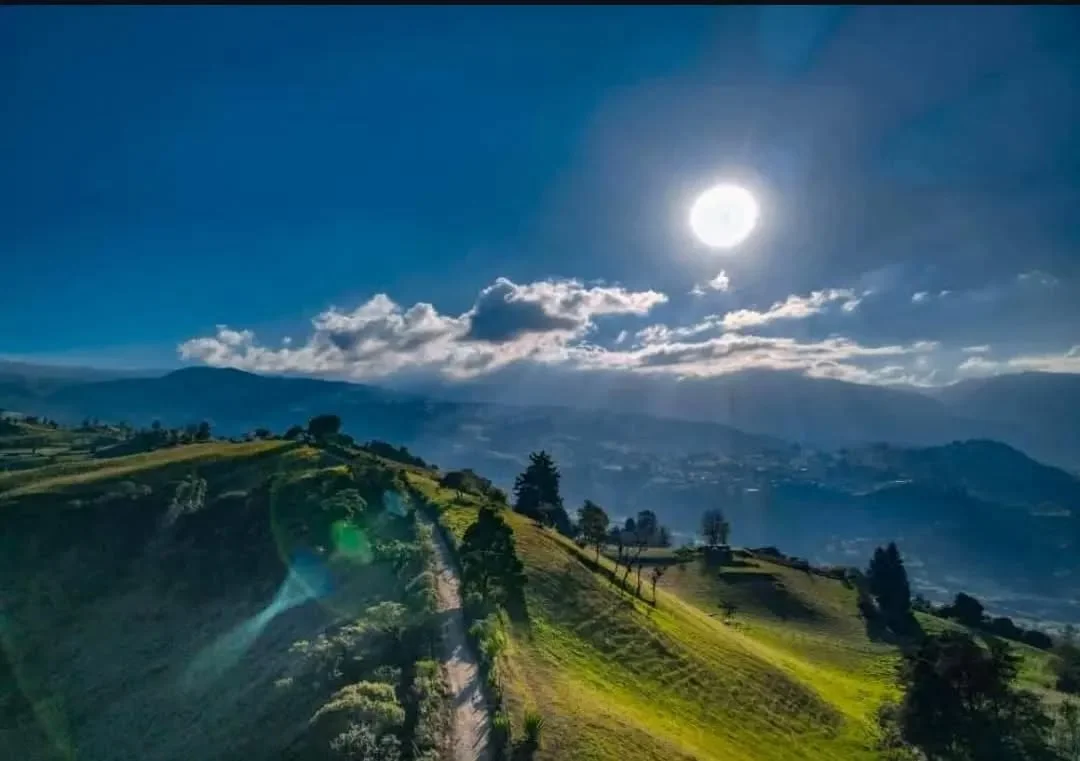

Une
Three letters. U-N-E. It is the shortest municipal name in all of Cundinamarca Department, and it belongs to one of the department's oldest places. The word comes from Muysccubun, the language of the Muisca. Depending on which source you trust, it means pot or meeting center of the Ubaque chiefdom, good thing, or sky - all three translations have survived in the ethnographic record because none of them quite won. That ambiguity feels appropriate. Une, forty-three kilometers southeast of Bogotá, has always held onto things other places let go.
A Liberal Town in a Conservative Sea
During Colombia's long and bloody period of Liberal-Conservative bipartisanship - a century of political polarization that exploded into civil wars, culminating most famously in the Thousand Days' War of 1899 to 1902 - Une was known by a nickname that announced its politics: the Red Star of the East. Red was the color of the Liberals. The eastern Cundinamarca hills were mostly Conservative. Une kept its liberal tradition through every round of partisan violence, and its location on the routes to the Eastern Plains gave it strategic importance when the Thousand Days' War swept through the region. The municipality sent men to fight; it sheltered fugitives; it paid the price. In the national imagination it became a place whose political identity was stubborn enough to get noticed even from the capital.
February 22, 1538
The municipality was founded on 22 February 1538 by Diego Romero de Aguilar, one of the members of Gonzalo Jiménez de Quesada's expedition into the Andes. That makes Une older than Bogotá itself, which Jiménez de Quesada founded on 6 August 1538, about six months later. The first church was built during the seventeenth century with the help of a mason named Juan Robles, and it was formally erected as a parish in 1692 with Juan de Dios Ramos as its first priest. For the next two centuries Une developed quietly, a rural Andean municipality growing potatoes and raising cattle on the steep ground between Chipaque to the north and Gutiérrez to the east. In 1898 the telegraph reached Une, pulling the municipality into modern national communications a generation after the coastal cities had arrived there.
Potatoes, Specifically
Sixty percent of Une's area is farmland, and potato is the dominant crop. According to the National Federation of Potato Growers - FEDEPAPA, the grower organization that speaks for one of Colombia's defining food industries - Une is among the Cundinamarca municipalities most suited to potato cultivation, especially the Diacol Capiro variety prized by the food-processing sector. The potatoes that feed Bogotá's breakfast arepa con huevo and its Sunday ajiaco soup, and much of the potato flour the industrial kitchens use, move through fields like Une's. Dairy and livestock round out the agriculture - Norman cattle, in particular, a French breed well adapted to the cold temperate mountain climate, are raised here and shown at the annual livestock fairs that animate the town calendar. Traditional handicrafts include sheep wool textiles, wood carving, leather work, and traditional jewelry - skills passed down through families who have often been on the same land for generations.
Rock Art in the Hills
The Muisca left more than a toponym at Une. The hills surrounding the municipality contain rock art and petroglyphs - carvings into stone that date to the pre-Columbian period and, in several cases, remain accessible to researchers and visitors in the villages of the municipality. Rupestre Web's 2003 survey documented the Cundinamarcan rock art tradition that includes Une's sites among others. The Chocolate Reservoir - the Embalse del Chocolate - sits in the municipality's landscape, a dark-water body surrounded by heavy vegetation, named for the color of its silty water rather than for any historical connection to cacao. The Negro River crosses the municipality, descending out of the hills toward the Meta River drainage that eventually carries its water east into the Orinoco basin. The climate is temperate mountain - average temperature of 61°F (16°C) - with two rainy seasons separated by dry spells, the rhythm every Cundinamarca farmer knows by heart.
Small, Specific, Alive
Population counts for Une are modest. The 2015 census registered 9,196 inhabitants; more recent estimates show a slight decrease. In a country that has urbanized as dramatically as Colombia, Une's population trajectory is typical of many small Andean municipalities - young people leaving for Bogotá's economic opportunities, older generations holding the farmland. What remains is a tight civic fabric: the Fidel Leal and Bernabé Riveros Departmental Educational Institution, named for two local benefactors who founded schools in 1941 and 1963 respectively and then agreed to merge them in 1968; the annual Norman Cattle Exhibition; the ox team parades; the Patron Saint Festival on 7 December in honor of the Immaculate Conception. Since 2024 the Cundinamarca Governor's Office has extended its Doctor in Your Territory program to Une, guaranteeing 24-hour medical coverage seven days a week with specialized consultations in gynecology, pediatrics, and internal medicine - a meaningful change for a place where getting to Bogotá for care has always meant winding mountain roads and several hours of bus travel. The motto on Une's coat of arms reads Tierra de Paz y Progreso - Land of Peace and Progress. For a municipality once called the Red Star of the East, surviving its wars to become a quiet potato town on the edge of the páramo, that is a fair summary.
From the Air
Located at 4.40°N, 74.03°W in the Eastern Cordillera hills of Cundinamarca Department, Colombia, at approximately 2,376 meters (7,795 ft) elevation. El Dorado International (SKBO/BOG) is 45 km northwest. No significant airport in Une itself. Best viewed from 8,000-12,000 feet AGL - the small town sits among green mountain pastures and potato fields with the Chocolate Reservoir as a landmark. The Eastern Cordillera rises sharply here; IFR conditions are common in wet seasons.
Nearby Stories
- Zipaquirá 31 km away
- Villavicencio 42 km away
- Tolima Department 82 km away
- Tunja 89 km away
- Valle de Cocora 104 km away
- Manizales 114 km away
- Battle of Vargas Swamp 147 km away
- Operation Jaque 266 km away