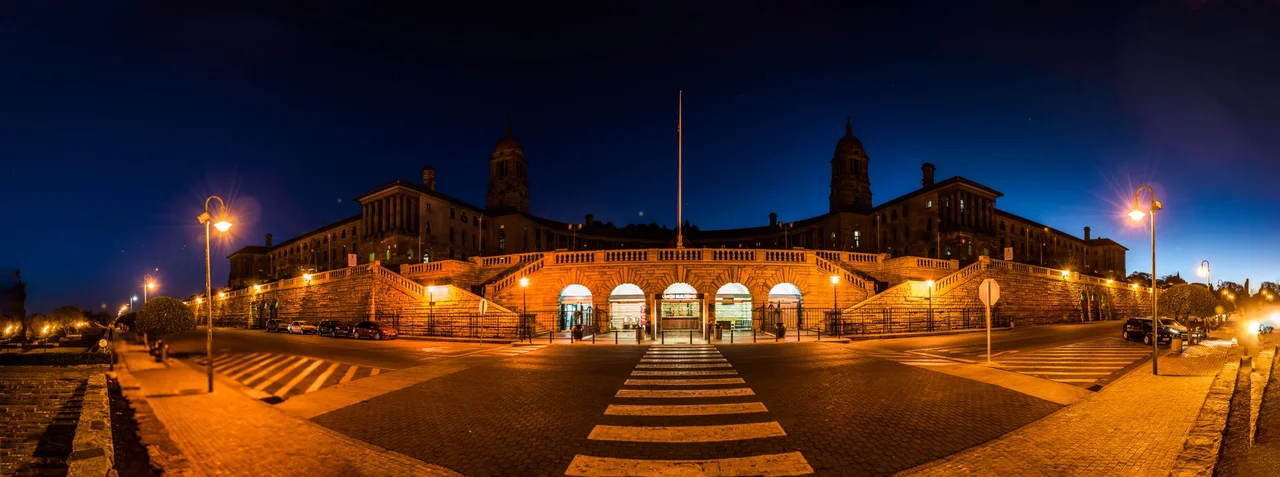

Union Buildings
Two curving wings reach out from the crest of Meintjieskop, and the gesture is the whole point. When the architect Herbert Baker laid out the Union Buildings on Pretoria's highest hill, he set the eastern and western wings like a pair of arms drawing together a people only just stitched into one country. One wing for the English, one for the Afrikaners, the two white communities that had been at war barely a decade before. The semicircle between them, open to the city below, was meant to embrace what their union had joined. Nearly a century later, that same open space would witness a far wider embrace, as a nation that had excluded most of its people finally turned to face them.
A Monument to a Fragile Union
The buildings rose for a specific moment in history. In 1910 the former Boer republics of the Transvaal and the Orange Free State were joined with the Cape and Natal colonies to form the Union of South Africa, and the new state needed a seat of government grand enough to signify that unity. Baker, the most celebrated architect of the British Empire's southern reaches, received the commission in 1909, and the cornerstone was laid in November 1910. Completed in 1913, the structure was carved from light sandstone and stretched 285 metres across the hilltop. Baker meant every detail to speak: the twin domed towers for the two languages, the inner court for the Union itself, even clock chimes tuned to match the famous bells of Big Ben in London. Many consider it his masterpiece.
The Architect's Tricks of Stone
Up close, the building rewards a careful eye. Because each level was designed differently, every block of sandstone had to be individually cut, the styles rising from a stately Edwardian base toward Cape Dutch detailing near the top, complete with shuttered windows. Baker shortened the windows floor by floor as the building climbed, a quiet optical trick that makes the structure seem taller than it is. The amphitheatre carved into the slope was once a disused quarry, repurposed into a stage. Atop the domes, matching statues of Atlas hold up the world, while in the courtyard the Roman messenger-god Mercury presides over what was conceived as a temple of administration. Inside, carved teak fanlights, dark ceiling beams, and white plaster walls carry the cool restraint of the Cape Dutch tradition.
The Hill Before the Buildings
The ground itself has a layered past. The farm on which Meintjieskop stands, once called Elandsfontein, was originally owned by Marthinus Wessel Pretorius, who would become the first president of the old Transvaal republic. In 1856 a portion changed hands for the price of a Basotho pony, acquired by Andries Francois du Toit, who named his piece Arcadia after the idyllic Greek countryside of classical imagination. Du Toit became Pretoria's first magistrate and laid out the young town's streets. The land later passed to Stephanus Jacobus Meintjies, whose name the hill still carries. The suburb of Arcadia that grew below now holds more embassies than almost anywhere on earth save Washington, a fitting neighbourhood for the address where presidents are made.
The Day Freedom Reigned
On 10 May 1994, the amphitheatre held the largest gathering in its history. Before the world's cameras and a sea of South Africans, Nelson Mandela was inaugurated as the country's first democratically elected president, the end of apartheid made flesh on the steps of a building raised by a white minority government. "Never, never and never again," he told the crowd, "shall it be that this beautiful land will again experience the oppression of one by another." He closed with two words that became a national memory: "Let freedom reign." The building that had embodied one kind of union now embodied another, immeasurably larger. In 2013 the amphitheatre was renamed in his honour, and a nine-metre bronze statue of Mandela, the tallest in the world, was unveiled with arms outstretched, echoing in a single figure the welcoming gesture Baker had built into the stone a century before.
Gardens, Memory, and the Protected View
Below the colonnades, terraced gardens of indigenous plants cascade down the hill, scattered with monuments that read like a timeline of the nation's shifting self. A mounted statue of General Louis Botha, the Union's first prime minister, dominates the lower lawn. Higher up, the Delville Wood memorial honours South Africans killed in the First World War, and Mandela's statue stands above a figure of an earlier prime minister it pointedly displaced. So central are these buildings to the national imagination that Pretoria law forbids any structure tall enough to block the sightline between the Union Buildings and the Voortrekker Monument across the city, two competing visions of South African history kept forever within view of each other. Each October the city's jacarandas bloom, washing the slopes below in purple while zebras sometimes graze, improbably, against the sandstone backdrop of the seat of state.
From the Air
The Union Buildings crown Meintjieskop, the highest point in Pretoria, at roughly 25.74 degrees south, 28.21 degrees east, on the Highveld plateau at about 1,350 metres elevation. The long sandstone facade with its twin domed towers and the terraced gardens below make an unmistakable landmark from the air; the protected sightline runs south across the city to the blocky Voortrekker Monument. The nearest field is Wonderboom Airport (ICAO FAWB, elevation about 4,095 feet) to the north; Lanseria (ICAO FALA, about 4,517 feet) lies southwest, and OR Tambo International (ICAO FAOR, about 5,558 feet) serves Johannesburg to the south. Skies are clearest in the dry winter months of June to August, while October brings the jacaranda bloom and the first summer thunderstorms.
Nearby Stories
- Little Foot 3.9 km away
- Hartebeesthoek Radio Astronomy Observatory 18 km away
- Boksburg explosion 23 km away
- Tswaing crater 24 km away
- Secunda CTL 69 km away
- Sun City 71 km away
- Bushveld Igneous Complex 87 km away
- Battle of Bergendal 127 km away