
Union Theological College
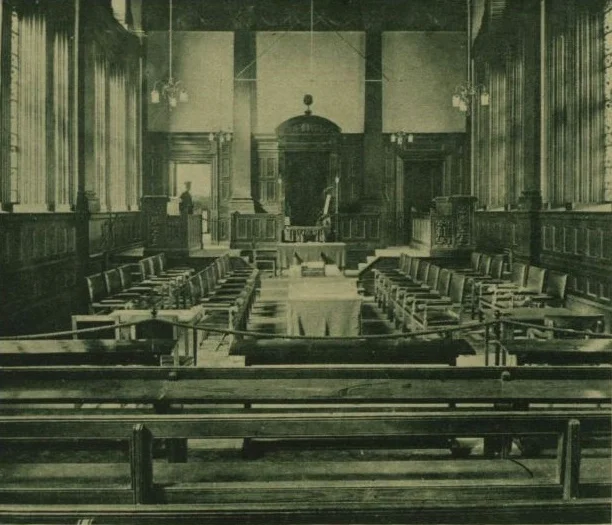
For eleven years between 1921 and 1932, the elected representatives of Northern Ireland did their parliamentary business inside a Presbyterian college library. The Gamble Library, a domed reading room designed in the 1870s for theology students, served as the chamber of the House of Commons; the wood-panelled chapel housed the Senate. Stormont was still being built across town, and the newly formed statelet had nowhere else to go. Today the same building, the Union Theological College on Botanic Avenue, trains ministers for the Presbyterian Church in Ireland - and has spent much of the last decade in news stories about heresy charges, professorial dismissals, and the slow severing of a 150-year relationship with Queen's University Belfast.
Lanyon's Stone
Sir Charles Lanyon designed the building in 1853, the same architect who gave Belfast the main quad at Queen's University across the road. He built it from Scrabo stone, the warm sandstone quarried in County Down, set in a Renaissance Revival style with a Doric porch grand enough for a small republic and a Baroque attic stage at the top. The whole thing cost £5,000. Originally called the Assembly's College, it opened on 5 December 1853 with Henry Cooke, the powerful Belfast preacher, as President of the Faculty. Five other professors sat beside him at the inaugural ceremony, attended by the Genevan Reformation historian Merle d'Aubigné. After the 1859 Ulster Revival sent a wave of new students to the college, a south wing was added in 1869 with a dining hall and student rooms called "Chambers."
The 1927 Heresy Trial
The college's most famous early controversy involved a professor named J. Ernest Davey, who in 1927 was put on trial for heresy. The General Assembly drew up five charges, each tied to a foundational doctrine. The first alleged Davey denied that Christ's righteousness alone makes humans righteous. The third charged him with teaching against the inspiration and infallibility of Scripture. The fifth charged him with denying that the Trinity is taught in the Word of God. Davey was cleared by the church courts, but a small group of Presbyterians broke away in disgust and went on to found what became the Evangelical Presbyterian Church. The college reopened in October 1932. In 1953, a quarter-century after his trial, the same J. Ernest Davey was elected Moderator of the General Assembly to mark the centenary year. The man once tried for heresy now presided over the church that had tried him.
Parliament in the Library
When Northern Ireland was carved off from the rest of Ireland in 1921, the new Parliament needed a temporary home. The Assembly's College agreed to host it. The Commons sat in the Gamble Library, a domed Victorian reading room founded in 1873 by Caroline Gamble in memory of her husband. The Senate met in the wood-panelled chapel completed in 1881. For eleven years, while Sir Arnold Thornely's Greek-classical Stormont rose on the hill east of the city, Northern Ireland's MPs voted on bills surrounded by 65,000 theological books. When Parliament finally moved to Stormont in 1932, the college reopened for its proper purpose. Some of the books moved with the politicians and then quietly came back. The Gamble Library is still the largest theological library in Northern Ireland.
Sacked on the Radio
In June 2018, Laurence Kirkpatrick - Professor of Church History and former Principal - went on BBC Radio Ulster's Talkback programme. He had taught at the college for twenty-two years. After the interview, the church disciplinary panel found that his comments on same-sex relationships did not align with the Presbyterian Church in Ireland's doctrinal position, and that he had failed to defend the college's reputation when interviewers questioned its link to Queen's. They dismissed him in 2019 for gross misconduct. The dismissal made international news. Ian Hazlett, who had supervised Kirkpatrick's doctorate at Glasgow, compared the proceedings to the Inquisition. The Clerk of the General Assembly said that in Christian discourse, the manner of disagreement matters. Kirkpatrick threatened, in his own phrase, "to sing like a canary" at his tribunal. The case settled in June 2025.
The End of the Queen's Link
The Kirkpatrick affair pushed Queen's University Belfast - which had run an Institute of Theology with the college and three others since 1926 - to review the relationship. A Quality Assurance Agency report flagged "weakness in the college's maintenance of academic standards." A separate review noted that all the full-time teaching staff were male, all Presbyterian, all required by statute to be ordained or eligible. In 2019, Queen's Senate ended the relationship. The financial shortfall to the college was projected at up to £700,000 a year. In 2020 the college announced an unusual new partnership: St Mary's University, Twickenham, a Roman Catholic institution, would validate Union's undergraduate degrees. "A positive sign," said the church's announcement, "for the new Northern Ireland where such sectarian divisions are perhaps a thing of the past."
From the Air
The college sits at 54.59°N, 5.93°W on Botanic Avenue in south Belfast, in the university quarter near Queen's. Belfast City Airport (EGAC) is 1.5 nm east-northeast; Belfast International (EGAA) is 12 nm northwest. The Scrabo sandstone Renaissance Revival building, with its prominent Doric porch and central dome over the Gamble Library, is identifiable from low altitude in the green strip between Botanic Gardens and University Road. Best viewed at 1,500-3,000 ft AGL.
Nearby Stories
- Larne 1.2 km away
- Ahoghill 3.5 km away
- Castleskreen 4.9 km away
- Lough Neagh 6.1 km away
- Kingsmill Massacre 14 km away
- Pasages (steam trawler) 23 km away
- Ballantrae Lifeboat Station 34 km away
- St Patrick's Isle 39 km away