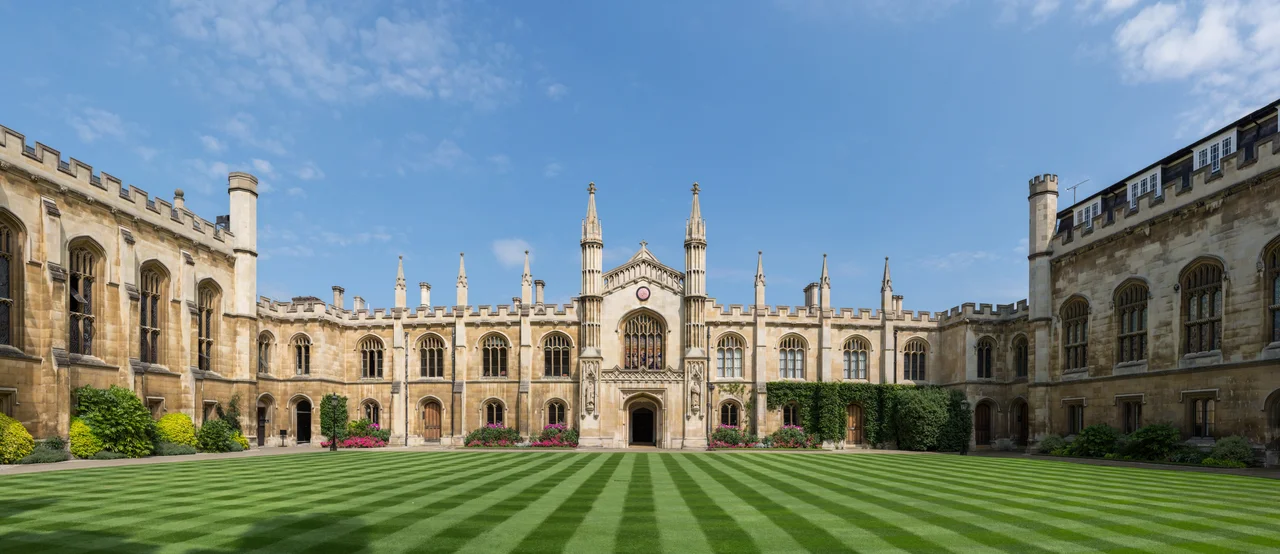

University of Cambridge
It started with a hanging. In 1209, three scholars at the University of Oxford were executed by the town's secular authorities following the death of a local woman. The local ecclesiastical authorities — who would normally have intervened on behalf of clergymen — were not consulted. With Oxford's town-gown tensions already running high, scholars began leaving for safer cities: Paris, Reading, and Cambridge. Enough of them arrived in Cambridge to join the scholars already gathered there around the scholarly atmosphere of nearby Ely Cathedral. The nucleus of a university formed. It has not stopped growing since.
Eight Centuries, Accumulated
In 1231, twenty-two years after its founding, King Henry III issued writs establishing Cambridge's first legal protections. A royal charter followed. By 1284, the university had its first college: Peterhouse, founded by the Bishop of Ely. More colleges followed across the centuries — there was a 204-year gap between Sidney Sussex in 1596 and Downing in 1800, then a slow steady expansion into the modern era. The most recent full college, Homerton, achieved that status only in 2010. Today Cambridge has 31 semi-autonomous colleges, each self-governing and responsible for its own teaching and welfare, all bound to a central university that awards degrees, maintains libraries, runs laboratories, and manages one of the oldest university presses in the world. The structure is medieval in origin but thoroughly modern in operation.
Where Ideas Were Born
Isaac Newton conducted experiments on Trinity College's grounds. Charles Darwin studied at Christ's College before his voyage on the Beagle. Francis Crick and James Watson worked out the three-dimensional structure of DNA at the Cavendish Laboratory, aided by crystallography data produced by Rosalind Franklin. Alan Turing devised the theoretical basis for modern computing here. The webcam was invented at Cambridge — its first subject was a coffee pot in the university's computer laboratory, monitored remotely so researchers could check whether it was worth the walk. The university is widely credited with launching Silicon Fen, a high-tech business cluster that added 1,500 companies and roughly 40,000 jobs around Cambridge between 1960 and 2010. Discovery is not incidental to this institution. It is the point.
The Punishing and the Playful
Cambridge traditions run the full spectrum. The Mathematical Tripos, the university's gruelling mathematics examination, was for centuries compulsory for all undergraduates seeking a Bachelor of Arts degree. The top scorer was called the Senior Wrangler — a position once described as "the greatest intellectual achievement attainable in Britain." The tradition of the wooden spoon, awarded to the student with the lowest passing grade, ended in 1909. May Week, despite its name, falls in June, and sees the college May Balls — all-night parties with food, drink, and entertainment — replace the exam season's anxiety with something closer to carnival. The Festival of Nine Lessons and Carols, sung by the Choir of King's College and broadcast globally on Christmas Eve every year since 1928, is perhaps Cambridge's most famous contribution to collective human ritual.
Town and Gown, Still
The phrase "town and gown" originated to describe Cambridge's uneasy relationship between residents and university members, who historically wore academic dress that made them instantly identifiable. During the Peasants' Revolt of 1381, local residents attacked and looted university properties, burning documents in Market Square to the cry: "Away with the learning of clerks, away with it!" The university chancellor was subsequently granted special powers to prosecute criminals in the city. Such open conflicts have largely disappeared — the university now employs enormous numbers of local people and drives much of the regional economy — but the phrase persists. Student life and city life remain distinct, occasionally overlapping worlds. University students make up roughly twenty percent of Cambridge's population of 145,674.
126 Nobel Prizes
The statistics are genuinely difficult to absorb. As of 2020, Cambridge alumni, academics, and affiliates had won 126 Nobel Prizes. Eleven Fields Medals in mathematics. Seven Turing Awards in computing. Fourteen British Prime Ministers studied here. At least thirty foreign heads of state or government. Nine monarchs, including three reigning British sovereigns. Three signatories of the American Declaration of Independence. By 2016, athletes associated with the university had won 194 Olympic medals, including 88 gold. The university's Cambridge University Press and Assessment — the largest department by income — serves 100 million learners annually and reports revenue above £800 million. The numbers accumulate the way centuries do: slowly at first, then all at once.
From the Air
The University of Cambridge occupies the historic centre of Cambridge, England, at approximately 52.205°N, 0.117°E. From the air, the university's signature landmarks are unmistakable: the long limestone roofline of King's College Chapel, the Bridge of Sighs at St John's, and the green ribbon of The Backs along the River Cam. Cambridge Airport (EGSC) is 3 miles to the northeast. At 3,000 feet the full sweep of the collegiate city is visible, from the older medieval colleges near the river to Churchill College's modernist courts to the northwest. The flat Fenland surrounding Cambridge makes the city's density particularly vivid from altitude.
Nearby Stories
- Kentwell Hall 2.5 km away
- Thetford Hoard 2.8 km away
- King's Ely 6 km away
- Bedford 7.8 km away
- White House Farm murders 13 km away
- Oundle 14 km away
- Hemel Hempstead 14 km away
- North Weald Airfield 15 km away