
University of Charleston
In 1975, the trustees of a struggling Methodist-affiliated college in Charleston, West Virginia tried to do something almost unheard of in American higher education: they offered the school to the state government for free. The state said no. What started in 1888 as Barboursville Seminary, an Appalachian outpost of the Southern Methodist church, sat across the Kanawha River from the gold-domed Capitol with falling enrollment, a draft-era recession hangover, and bills it could not pay. Half a century later, the school the state refused to take has Division II national championships, a pharmacy school, and a fifty-acre riverfront campus.
From Methodist Roots to Kanawha River
The school was founded in 1888 as Barboursville Seminary, then Morris Harvey College after a major benefactor. In 1935 it moved into downtown Charleston, affiliating briefly with the Mason College of Fine Arts and Music. The break from the Methodist Church came in 1942, when the newly merged Methodist Church chose to support only West Virginia Wesleyan rather than both institutions, and five years later the college crossed the Kanawha River to its present campus in Kanawha City, looking back at the state Capitol's dome from the south bank. In 1951 it bought the Young-Noyes House for the president's residence, an Italianate brick home that joined the National Register of Historic Places in 1978.
The Year the State Said No
The end of Vietnam-era draft deferments hit small private colleges hard. Young men no longer needed a campus to avoid the war, and Morris Harvey's enrollment slid. By 1975, trustees offered the entire institution to West Virginia as a gift. The state refused. In December 1978 the school renamed itself the University of Charleston, betting that the capital city's name carried more weight than a benefactor most students had never heard of. The transformation that followed was patient. President Edwin Welch arrived in 1989 and stayed nearly three decades, presiding over four new residence halls, a parking garage, a fitness center, a science and library building, and the launch of a pharmacy school in 2006 - the university's first doctoral program.
The Golden Eagles Find Their Sport
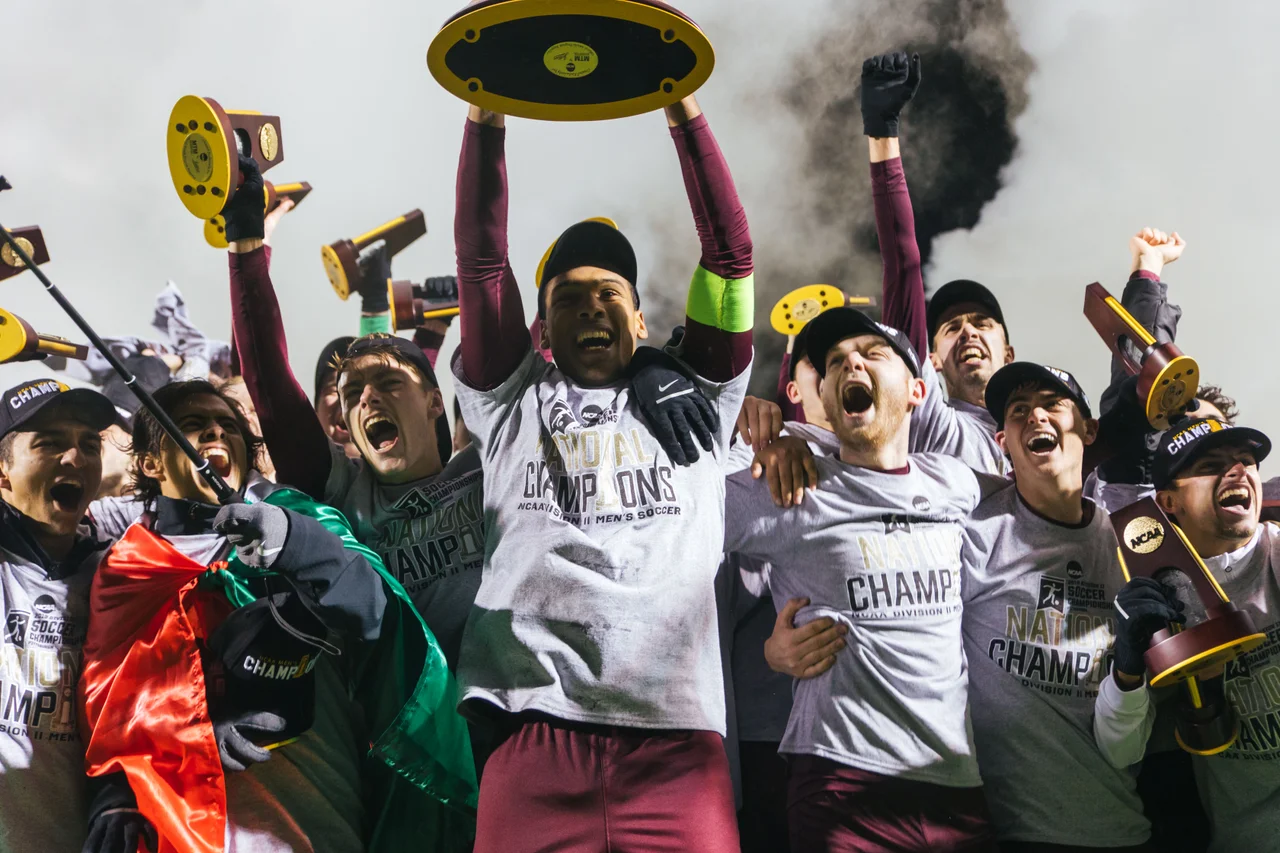
UC's athletic teams compete as the Golden Eagles, mostly in the Mountain East Conference at NCAA Division II. The men's soccer team gave the school its breakthrough national moment, winning the Division II championship in 2017 by defeating Lynn University, and repeating in 2019 with a 2-0 final over Cal State LA. Soccer is a game well suited to a small school - eleven players, a modest stadium, results that come down to discipline and the right run at the right time. Across the river from the Capitol, the Golden Eagles play on refurbished fields at the renamed University of Charleston Stadium, formerly Laidley Field.
A Capital City School
Today the university enrolls around 3,000 students, with the main campus in Charleston and a satellite in Beckley. The pharmacy school turns out graduates for the rural Appalachian counties that need them. Notable alumni include Tim Armstead, who served as Chief Justice of West Virginia's Supreme Court of Appeals, and Cynthia Rylant, the children's book author whose Newbery Medal-winning Missing May is set in West Virginia hill country much like the one she grew up in. A college that once asked the state to take it off their hands has settled into the role it could not have predicted in 1975: a quiet, durable institution braided into the life of the state that turned it down.
From the Air
Located at 38.33 N, 81.62 W in Kanawha City on the south bank of the Kanawha River in Charleston, West Virginia. The campus sits directly across the river from the gold-domed West Virginia State Capitol, a useful visual reference. Nearest airport is Yeager Airport (KCRW) about 4 miles northeast. Best viewed at 3,000-4,500 feet on clear days, when the Capitol dome glints opposite the campus and the river bends through the city.
Nearby Stories
- Mystery Hole 6.5 km away
- West Virginia Colored Children's Home 9.4 km away
- Clay, West Virginia 13 km away
- Staats Mill Covered Bridge 14 km away
- Hobet Coal Mine 23 km away
- Appalachia 23 km away
- Fred M. Vinson Museum and Welcome Center 30 km away
- Ponn Humpback Covered Bridge 43 km away