
University of Galway
It opened with sixty-eight students on 30 October 1849. The Tudor-Gothic Quadrangle they walked into - a Christ Church Oxford lookalike designed by John Benjamin Keane and built of local limestone - is still there at the centre of the campus, still cold in winter, still photographed by every prospective student's parents on open day. The name has changed four times in 180 years. Queen's College, Galway. University College, Galway. National University of Ireland Galway. And, since 1 September 2022, simply the University of Galway, or Ollscoil na Gaillimhe in the Irish that the 1929 Act made a working language of the place.
The Queen's Colleges
The 1845 founding was part of a tripartite settlement. Queen's College Belfast, Queen's College Cork, and Queen's College Galway - secular institutions designed by Robert Peel's Conservative government to provide higher education to the Catholic majority of Ireland without requiring religious tests. The Catholic Church opposed them as 'godless colleges.' Galway opened anyway in 1849. The first 68 students walked into Keane's Quadrangle, a deliberately Oxford-flavoured space that was both a reassurance to the imperial centre and an architectural challenge to the older Trinity College down in Dublin. The Queen's University of Ireland conferred its degrees from 1850. The Royal University replaced it in 1880. The National University of Ireland, created by the 1908 Irish Universities Act, gave Galway its second name - University College Galway, UCG, a constituent of the new federal NUI alongside Dublin and Cork. The 1997 Universities Act made it a university in its own right, awkwardly named National University of Ireland Galway. The 2022 rebrand finally cut the umbilical.
Along the Corrib
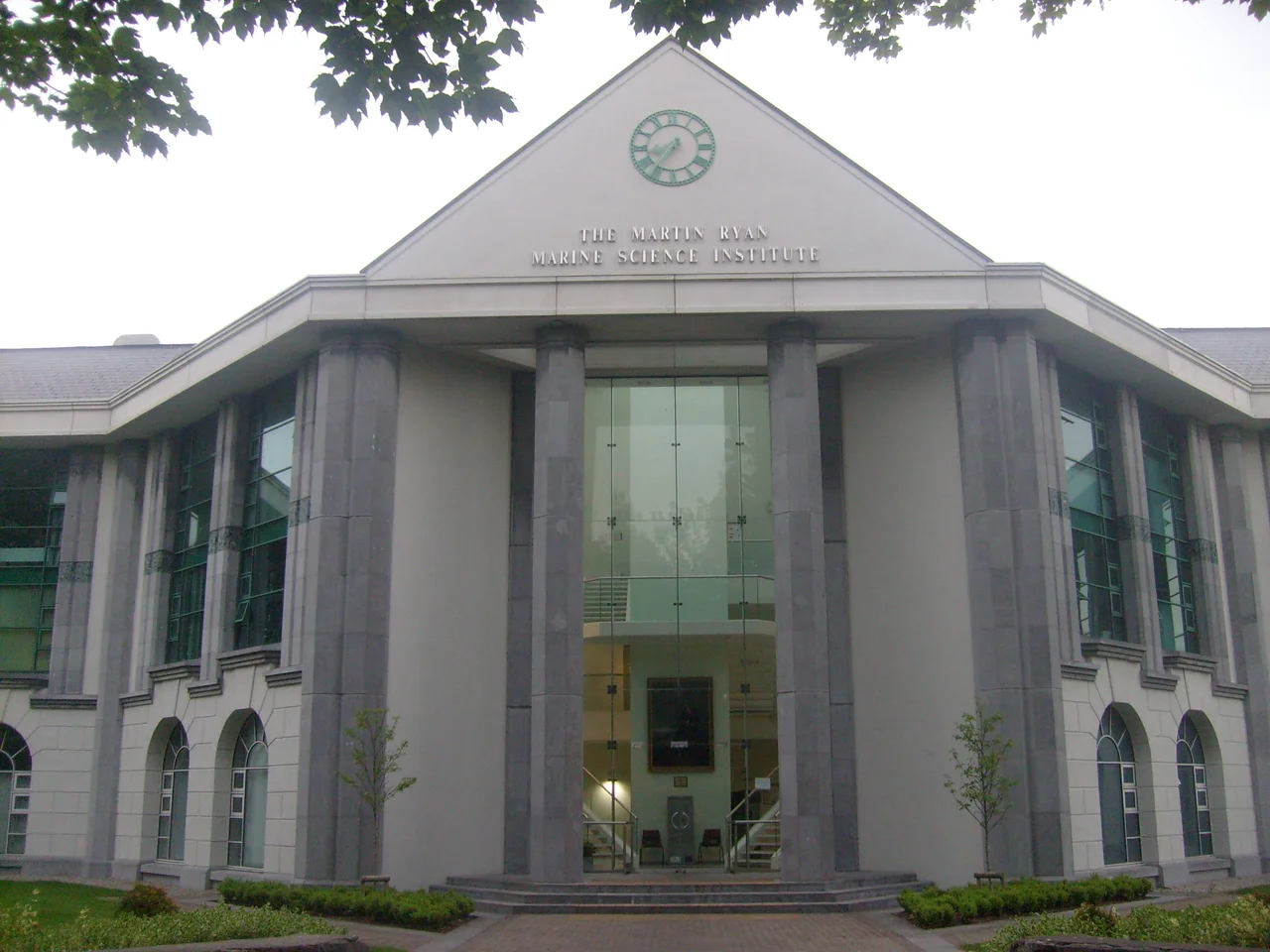
The campus runs along the western bank of the River Corrib, stretching from the city centre out toward Newcastle. The Quadrangle anchors the south end. The James Hardiman Library - named for the first librarian, who was a Gaelic-language scholar and the first published historian of Galway - is on the north side. In between, four decades of architectural experimentation: Scott Tallon Walker's 1970s buildings, the 1990s conversion of an old munitions factory into the student centre, then the early-2000s 'Campus of the Future' programme under President Iognaid G. O Muircheartaigh that put nearly 400 million euros into new buildings. The Alice Perry Engineering Building (named after the first woman in Britain or Ireland to graduate as an engineer, in 1906, from this same university). The Cairnes School of Business and Economics. The BioSciences Research Building. The Human Biology Building. The Lambe Institute for cancer research. The O'Donoghue Centre for Drama, Theatre and Performance.
Bilingual by Statute
The University College Galway Act of 1929 gave the institution a statutory responsibility for the Irish language as a working language. Acadamh na hOllscolaiochta Gaeilge - the Irish-medium 'Academy of the University' - runs courses in Irish out of campuses in Gaeltacht areas around Connemara. The bilingualism has been contested. In August 2025, a non-Irish-speaking president was appointed for the first time since Alexander Anderson took the chair in 1899, and the appointment generated significant controversy in Irish-language circles - the new president subsequently began learning Irish. The Cumann Gaelach and An Cumann Dramaiochta keep the language's social life going on campus. The university's older title - Ollscoil na Gaillimhe - sits above the rebranded English name on every official document, a constitutional fact rather than a stylistic flourish.
Mandela on the Quad
In 2003, Nelson Mandela visited the campus on what turned out to be his last trip to Ireland. The NUI Chancellor at the time was Garret FitzGerald, the former Taoiseach. Mandela received an honorary doctorate. He used the platform to condemn US foreign policy and the invasion of Iraq, which had begun seven months earlier. Famously, at a function afterward, the eighty-five-year-old Mandela got up and danced to The Corrs. The alumni list is itself a kind of small-nation portrait gallery. Michael D. Higgins, ninth President of Ireland (and former Galway sociology lecturer). Catherine Connolly, tenth President of Ireland. Enda Kenny, former Taoiseach. Maire Whelan, first female Attorney General. Aifric Keogh and Fiona Murtagh, Olympic bronze rowing medallists in Tokyo. Cardinal Wilfrid Napier, Archbishop of Durban. The actor Martin Sheen (an honorary degree, not a student attendance). Nicola Coughlan of Bridgerton and Derry Girls. The singer Enya.
The Equality Tribunal
The university's modern history includes a reckoning with its own institutional discrimination. In 2014 the Equality Tribunal ruled in favour of Dr Micheline Sheehy Skeffington - granddaughter of the campaigners Hannah and Francis Sheehy Skeffington, the latter murdered by a British army officer during the 1916 Rising - who had argued she was passed over for promotion on the grounds of gender in 2009. The university 'unreservedly accepted' that its hiring process had been flawed. In 2015 mandatory unconscious-bias training was introduced for senior staff. In 2017 the Labour Court promoted Dr Elizabeth Tilley after a similar finding. At that point the gender ratio among senior lecturers was 60:40 in favour of men; at professor level it was 87:13. In 2018 four more women who had applied for promotion in 2009 were promoted having settled amicably. The Athena SWAN bronze award followed in the same year. The institution that produced Alice Perry, Ireland's first female engineer, in 1906 had taken another century or so to learn the lesson properly.
From the Air
The University of Galway campus is centred at 53.28 N, 9.06 W on the western bank of the River Corrib in Galway city, running roughly north from the Salmon Weir Bridge to the Quincentenary Bridge. Galway Airport (EICM) lies about 7 km east. The Tudor-Gothic Quadrangle is the most distinctive single building - a stone quadrangle with corner turrets, clearly visible from altitude. The James Hardiman Library, the Cairnes Business School (the converted St Anthony's College), and the Engineering and Sciences buildings cluster across the rest of the campus. Best viewed in clear afternoon light. The Corrib running south to the bay, the cathedral dome immediately to the south-east, and the Galway city centre south of that complete the urban frame.
Nearby Stories
- Inis Oirr 3.9 km away
- Milltown, County Galway 4.2 km away
- Kilmacduagh Monastery 6.4 km away
- Ahascragh 8.9 km away
- Acadamh na hOllscolaíochta Gaeilge 12 km away
- Roscommon 17 km away
- Croagh Patrick 20 km away
- Lorrha 21 km away