.jpg)
Usina do Gasômetro
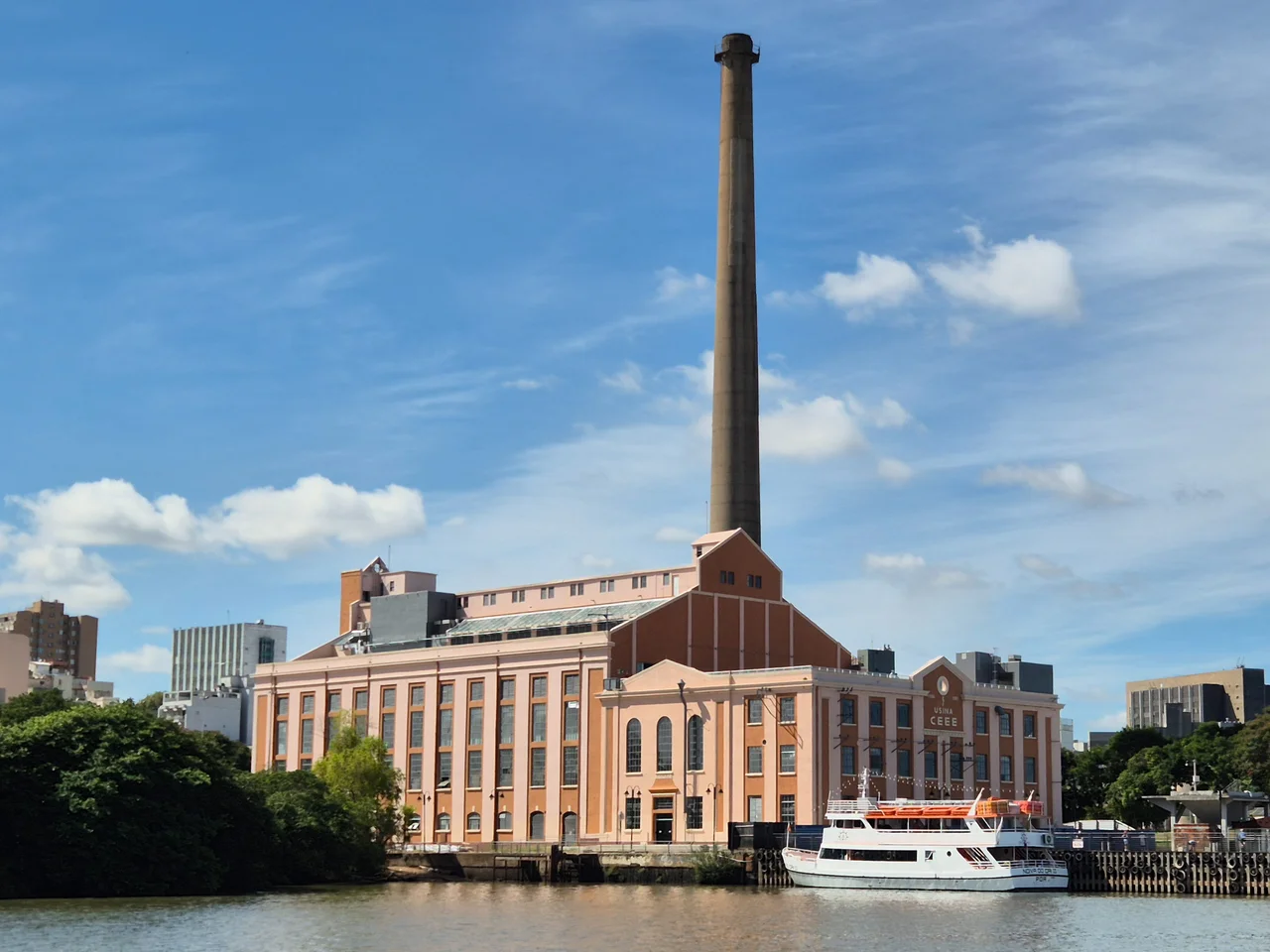
Every evening, a peninsula on the edge of Lake Guaíba fills with people who have come to watch the same thing: the sun sliding down behind the water, silhouetting a single soaring chimney against an orange sky. The chimney belongs to the Usina do Gasômetro, a power plant that the city once planned to knock down. Instead it became the most photographed postcard in Porto Alegre - a brick-and-iron survivor whose 117-meter smokestack now marks not industry but the best sunset in the south of Brazil.
A Name That Lies About Itself
Start with the name, because it is misleading. Usina do Gasômetro means roughly the gasholder plant, yet this station never ran on gas. It burned coal. The word gasômetro came from the neighborhood, an area called the Volta do Gasômetro that had taken its name from an older nearby factory, the Usina de Gás. So the building carries a borrowed name for a fuel it never used - a small accident of geography that stuck for a century. What it actually did was generate electricity, and for decades it powered the streetcars and streetlights of a growing capital.
American Power on a Brazilian River
The thermal power station was inaugurated on November 11, 1928, as the headquarters of the Companhia Brasil de Força Elétrica - a subsidiary of the American firm Electric Bond and Share Company, which controlled Porto Alegre's electricity and electric transport until 1954. The plant's most famous feature came later: in 1937 the company raised a monumental chimney, eventually standing some 117 meters tall, to carry the soot away from the city. That stack outlived the smoke. The generators ran until 1974, when the plant was finally deactivated, its furnaces cold and its purpose apparently spent.
Saved From the Wrecking Ball
What happened next nearly didn't. The municipal government wanted the plant gone, the land cleared to extend Perimetral avenue straight through the riverfront. A power station turned to rubble for a road - it would have been an ordinary fate for an old industrial hulk. But civil organizations fought to preserve it, and they won. In 1982 Eletrobras handed the land to the city; the building was listed for protection by the municipality that same year and by the state in 1983. Restored in 1988, the old plant reopened in 1991 with an entirely new life - not as a generator, but as a cultural center.
Where the City Comes to Watch the Light
Today the Usina do Gasômetro is six floors of galleries, theaters, and performance spaces wrapped inside its restored brick shell. But its true stage is outside. The plant sits on the tip of a peninsula jutting into Lake Guaíba, which faces west - and so each evening the building becomes Porto Alegre's grandstand for the sunset. Thousands gather on the esplanade to watch the sky catch fire over the water, the great chimney a black exclamation point against the color. An industrial relic the city tried to erase has become the place where the city most loves to simply stand and look.
From the Air
The Usina do Gasômetro stands at 30.03°S, 51.24°W, on a small peninsula at the western edge of Porto Alegre's historic center where the city meets Lake Guaíba. The nearest field is Salgado Filho International Airport (ICAO: SBPA), about 7 km to the north. From the air the landmark is unmistakable: a lone tall chimney at the point where the downtown grid runs out into the broad, lake-like Guaíba, whose far shore can sit more than a dozen kilometers away. A viewing altitude of 1,500 to 2,500 feet on the approach to SBPA frames the plant against the water. For the silhouette the building is known for, late afternoon offers the dramatic backlight as the sun drops toward the western shore; mornings give the clearest, haze-free detail.
Nearby Stories
- Itapuã State Park 22 km away
- Nova Petrópolis 37 km away
- Aparados da Serra National Park 77 km away
- Santa Cruz do Sul 77 km away
- Serra Geral National Park 111 km away
- 2009 Brasil de Pelotas Bus Disaster 161 km away
- Passo Fundo 176 km away
- Battle of the River Plate 446 km away