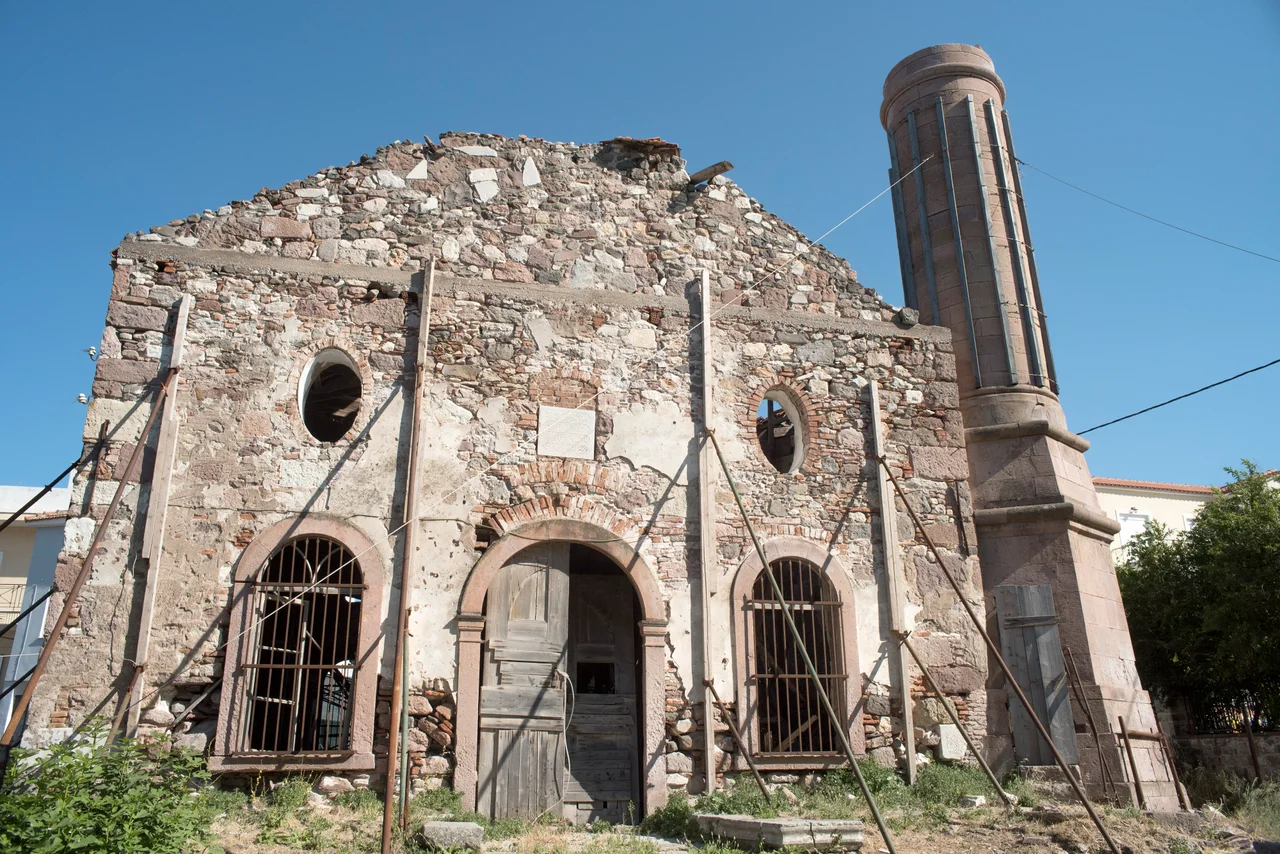

Valide Mosque, Mytilene
An inscription above the doorway gives the year as 1615, and if that stone tells the truth, this roofless shell has been standing for more than four hundred years. The Valide Mosque rises in Epano Skala, the old Turkish quarter at the edge of Mytilene, on the Greek island of Lesbos. Locals still call it the Valide Djami. For most of its life it was a working mosque; for the last century it has been a ruin, its prayers gone silent, its faithful long departed across the water.
A Disputed Birthday
The stone over the entrance is unambiguous, yet history rarely agrees with stone. The founder's inscription dates the mosque to 1615, which would make it the oldest on the island. But a second account complicates the story: it holds that the structure standing today was raised in 1780 over an older mosque, then renovated in 1867. Whichever date you trust, the building belongs to the Ottoman centuries, when Lesbos answered to Constantinople and Epano Skala was the Muslim heart of a mixed Aegean port. The competing dates are not a flaw in the record so much as a reminder of how long this corner of the city has been continuously rebuilt and reused.
When the Prayers Stopped
The mosque fell quiet in the 1920s, and the reason was not neglect but upheaval. The Balkan Wars redrew the map of the Aegean, and the 1923 population exchange between Greece and Turkey uprooted entire communities by treaty. Muslims who had lived on Lesbos for generations were compelled to leave for Turkey, just as Orthodox Christians were forced out of Anatolia in the other direction. Two peoples, two forced departures, one shared grief. The Valide Mosque emptied along with its congregation. There was no one left to climb the minaret, and so the building began its slow surrender to weather and time.
What the Walls Remember
For decades the mosque simply stood, its roof failing, its rooms open to the sky. Recognition came in 1981, when the Hellenic Ministry of Culture designated the building and its minaret as protected monuments, a Greek state choosing to safeguard an Ottoman one. In early 2018 the structure was earmarked for restoration under the Lesbos Ephorate of Antiquities, though the work has moved slowly and the mosque remains closed and partly ruined. Its survival is itself a quiet statement: that a place of worship can outlast the empire that built it and the community that filled it, and still be worth saving.
A Stone in the Larger Story
Lesbos sits closer to the Turkish coast than to the rest of Greece, and the Valide Mosque is one reason the island's identity feels layered rather than simple. Walk Epano Skala today and you move through streets that were Ottoman commercial lanes, past a minaret that once called the faithful five times a day. The mosque is not a monument to conquest or loss alone. It is a record of coexistence and rupture both, the kind of building that asks visitors to hold two histories at once and refuse to flatten either one.
From the Air
Located at 39.112°N, 26.554°E in Epano Skala on the northeastern shore of Mytilene, Lesbos. The roofless mosque and its minaret sit in the dense old quarter near the harbor. Recommended viewing altitude 1,500–3,000 ft for the townscape of Mytilene wrapping its bay. Nearest airport: Mytilene International Airport (ICAO LGMT), about 7 km south. The Turkish coast and Ayvalik lie just across the strait to the east. Best visibility in the clear, dry light of an Aegean summer morning.
Nearby Stories
- Eresos 9.6 km away
- Lyrnessus 15 km away
- Battle of the Oinousses Islands 17 km away
- Antandrus 31 km away
- Volissos 41 km away
- St. Helena Church 44 km away
- Akhisar Museum 70 km away
- Battle of Imbros 96 km away