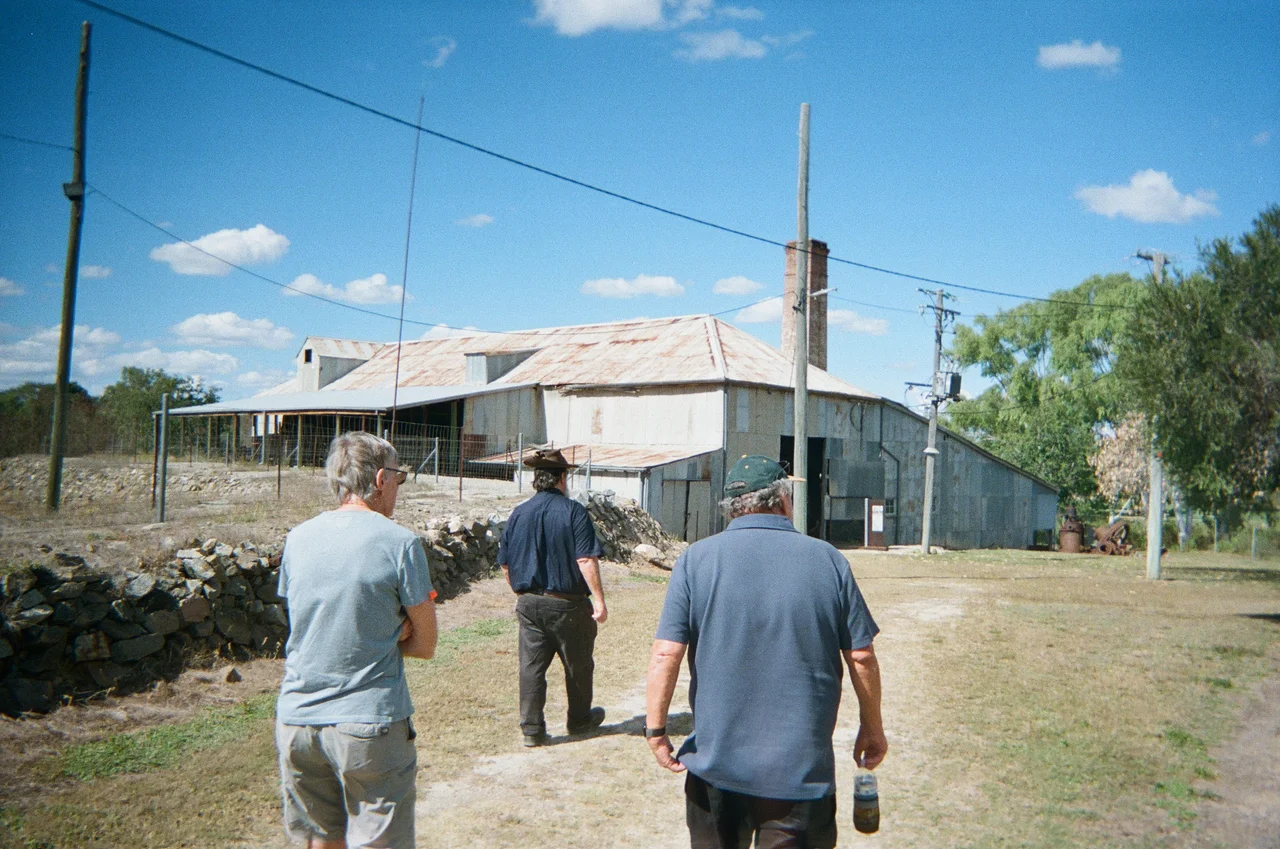

Venus State Battery
Stand inside the Venus Battery and try to imagine the noise. Twenty iron stamps, each a heavy shod boot of metal, lifting and dropping in relentless sequence onto ore-filled mortar boxes - a thunder so constant that the people of Millchester slept to it, worked to it, raised children to it, for the better part of a hundred years. This timber-and-iron shed on the banks of Gladstone Creek is the oldest surviving battery in Queensland and the largest and most complete stamp battery anywhere in the state, the place where the gold of Charters Towers was beaten out of stone. It opened within weeks of the field's first rush, in July 1872, and it did not fall finally silent until 1973. Today the stamps are still, but they are still here, and so is everything around them.
Crushing the World's Gold
A goldfield is only as rich as its ability to free gold from rock, and on the Charters Towers field that work was done by stamp batteries - the machines locals simply called 'mills.' The Venus was among the very first, operating by July 1872 under Edmund Harris Thornburgh Plant and his partner Jackson, who fired their own bricks on site to build it. It began with just five heads of stamps; a second five came almost at once, a third in August 1872, a fourth the next September. By the field's peak the building held twenty heads pounding away beside eighty berdan pans, settlers, and buddles, all driven by a thirty-horsepower engine. It was one of seventeen mills working the field in 1897. The principle was brutal and simple: feed in ore, crush it to slurry, and let the heavy gold separate out across blanketed tables and amalgamating pans while the worthless sand washed away.
The People's Mill
By 1917 the great reefs of Charters Towers were worked out, and most of its seventeen mills closed forever. The Venus did not. In 1919 the Queensland Government bought it and ran it as a state enterprise - a public crushing plant kept alive so that small, independent miners across the north had somewhere to bring their ore. And bring it they did, by rail and by truck, from astonishing distances: from Chillagoe, from the Woolgar River, from Iron Range on the far tip of Cape York Peninsula. The mill never turned a profit. An exasperated Inspector of Mines wrote in 1935 that 'a State Mill must be kept here even if it only averages 100 tons per month,' conceding the Venus had only ever delivered 'a steady loss.' It was kept anyway. The cyanide plant added in the 1950s let it treat lower-grade ore, and as late as 1958 brand-new stamps were ordered from the original Maryborough makers, Walkers Brothers - new machinery for a Victorian mill still doing Victorian work.
Frozen at the Moment It Stopped
What makes the Venus extraordinary is not just its age but its completeness. When the National Trust of Queensland took it over in 1975 - after the Charters Towers council had been offered the site and declined it - they inherited not a ruin but a working plant that had simply switched off. The battery shed still holds its ore bins, its rock breaker, four five-head stamp batteries, three Wilfley concentrating tables, six berdan pans, a forge, a workshop, an office. Beyond it stand the cyanide sheds with their seven agitator vats, the assay office where ore was tested, the weighbridge where it was weighed, the gold room where the prize was finally gathered. A Cornish boiler sits adapted upside-down as a water tank; a concrete weir still spans the creek. Nowhere else in the state survives this whole chain - battery, cyanide plant, assay office, weighbridge, weir, and miner's cottage - assembled in one place.
Walking the Crushing Floor
On a guided tour today, the silence does the storytelling. A guide leads you across the crushing floor and explains the sequence the way it actually ran: rock into the breaker, ore into the hoppers, the long fall of the stamps, the run of slurry over the tables where flecks of gold lodged in the blankets. You see the marks of repair everywhere - the roof replaced in 1952 after white ants got into it, the boiler pulled out in 1946 when electric mains power finally reached Millchester, the patient bodging of a plant that was rebuilt at least four times across its life. It is industrial heritage you can stand inside rather than read about: not a polished museum of objects behind glass, but the genuine, grimy, ingenious apparatus that turned North Queensland stone into the gold that built a city its own people called 'The World.'
From the Air
The Venus State Battery sits at 20.086 degrees south, 146.293 degrees east, in Millchester on the eastern edge of Charters Towers, on the banks of Gladstone Creek. From the air it reads as a cluster of corrugated-iron-clad sheds with a square brick chimney, set in cleared ground beside the creek line, just east of the main town grid - look for the chimney and the tailings tanks. Towers Hill (421 m) stands as the obvious nearby landmark a few kilometres to the west. Charters Towers Airport (ICAO YCHT) is close by to the southwest; Townsville (YBTL) is the nearest major airport, about 130 km northeast. Best viewed below 3,000 ft AGL. Clear, dry winter visibility is excellent over this inland country.
Nearby Stories
- Bindal People 44 km away
- Herveys Range Heritage Tea Rooms 57 km away
- Bowen River Hotel 65 km away
- Radar Station, Charlie's Hill 71 km away
- Strathmore Homestead 126 km away
- Porcupine Gorge 153 km away
- Undara Volcanic National Park 230 km away
- Lake Dunn 276 km away