
Ver-o-Peso
The smell arrives before the building does. Walk down Boulevard Castilhos Franca in the early morning and the river has already started releasing the day's cargo into the air: fish brought upriver overnight, the bitter grass scent of acai from the islands, smoke from cookstoves where tacaca is simmering in clay pots, and the unmistakable tang of thousands of medicinal herbs tied in bundles and hung from makeshift poles. This is Ver-o-Peso in the morning, before the tourists arrive and after the fishermen have stacked their best catch on ice. The market is said to be the largest street market in Latin America. It was elected one of the Seven Wonders of Brazil. It opened in 1901. Its name is a contraction of haver-o-peso, meaning to have the weight, a reminder that this place started as a tax scale.
The Name and What It Measured
In 1625, Portuguese administrators needed to collect duties on goods arriving from the Amazon interior. They built the Casa de Haver-o-Peso, a wooden weigh station at the mouth of the Igarape do Piri tidal channel, where canoes from upriver could tie up and offload. Goods came down the rivers: dried fish, turtle eggs, cacao beans, cinnamon, cloves, copaiba oil, sarsaparilla root, urucum, and the hundreds of other forest products that colonial Portugal lumped under the category drogas do sertao, the backland drugs. Everything was weighed before taxes were assessed. The weighing gave the building its name. Eventually the tax office became simply the Ver-o-Peso, the place where you see the weight, and the name stuck to the neighborhood long after the weighing had ended.
A Market of Iron and Zinc
In 1897, the Belem city government issued Municipal Law 173, authorizing construction of a new municipal fish market. La Rocque Pinto and Cia won the public tender. The architect Henrique La Rocque designed a twelve-sided dodecagonal hall in the French art nouveau style of the Belle Epoque. Construction began in 1899, and the old Casa de Haver-o-Peso that had stood since 1625 was demolished to clear the site. The 1,197-square-meter pavilion was built of veille-montaine zinc and iron structural components manufactured in England and New York and shipped by sea and river to Belem. Inauguration came in 1901. The Iron Market, or Mercado de Ferro, or Mercado Municipal Bolonha de Peixe, or simply Ver-o-Peso, opened as a working fish market that looked out from the Amazon estuary in the architectural dialect of Paris.
What You Can Buy
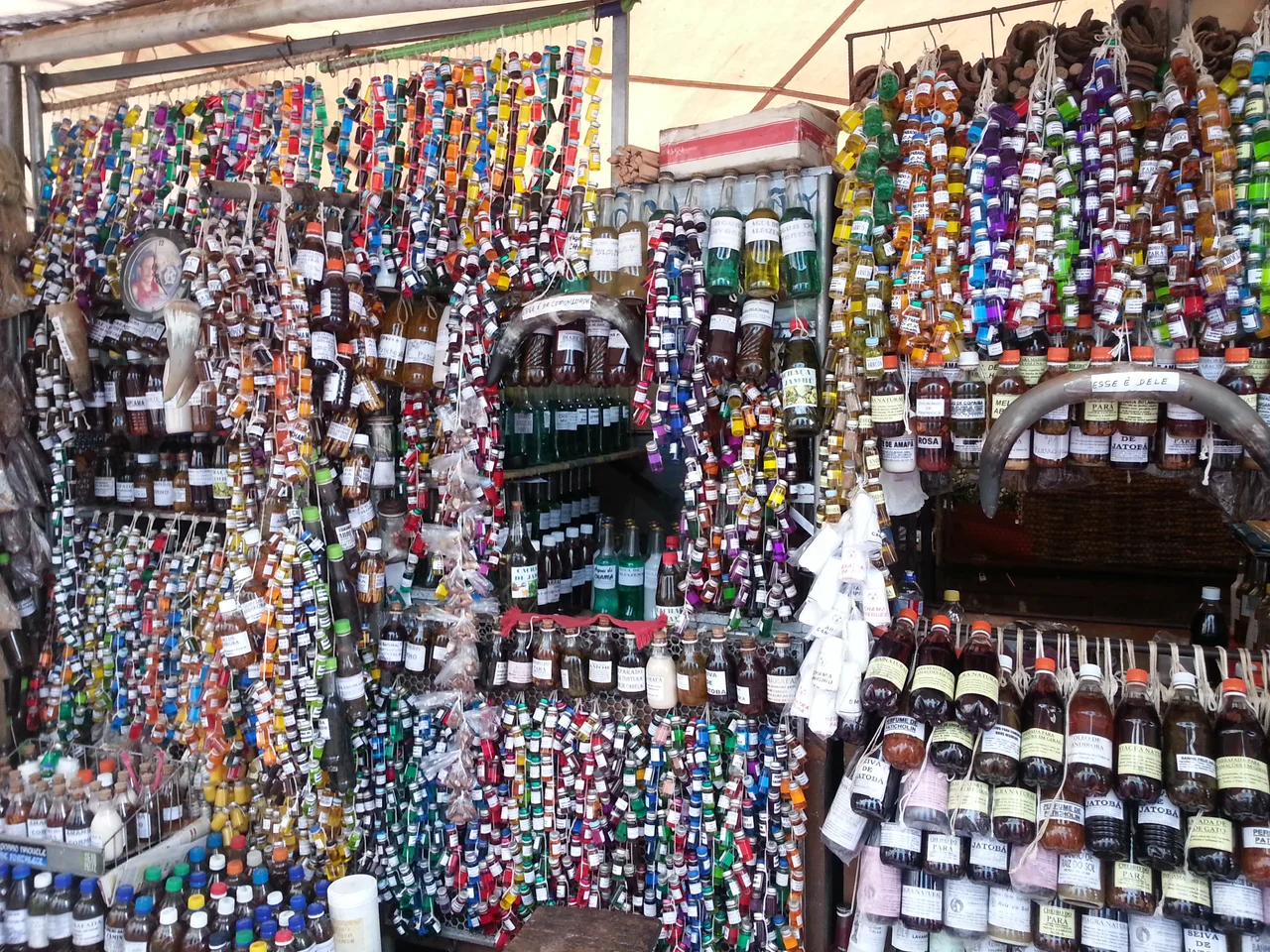
The open-air fair that surrounds the iron pavilion is where the supply chain of the lower Amazon goes public. Fish is the anchor. The catch from Guajara Bay and the islands around Belem comes in every night and sells at dawn: tucunare, pirarucu, tambaqui, dourada, pescada, filhote, and a dozen other Amazonian species whose English names are mostly approximations. Past the fish stalls, the market opens into fruit, roots, and spices. Jambu with its tingling leaves. Tucupi, the fermented cassava juice that forms the base of tacaca soup. Piles of bright yellow tropical fruits most non-Amazonian Brazilians have never tasted. Deeper in, the herb vendors hang bundles of plants dried and fresh, with handwritten cards describing what each is good for: leaves for fevers, roots for stomach pain, barks for kidney complaints. The herb section is a working pharmacy of traditional Brazilian medicine. Clothing, ceramics, and tourist souvenirs fill the remaining stalls. The fair supplies Belem with everything it wants to buy outside a supermarket.
The Renovations
By the 1980s, a century of use had taken its toll on the Iron Market and the surrounding stalls. In 1985, during the administration of mayor Almir Gabriel, the complex underwent its first major renovation. The Iron Market was refurbished. The Solar da Beira, a neoclassical building on the waterfront, was converted into a restaurant and cultural space. Pescador Square was rebuilt. Velames Square was constructed. Standardized stall structures replaced ad hoc booths along the fair. A second renovation came in stages during 1998 and 2002 under mayor Edmilson Rodrigues, this one focused on landscape integration and formalization of relationships with market vendors. The updates preserved the market's chaotic working character while installing infrastructure to keep it sanitary and functioning.
A Working Monument
Ver-o-Peso was listed by IPHAN in 1977 as part of a 35,000-square-meter heritage complex that includes the Meat Market, Pescador Square, Clock Square, the Dock, the Acai Fair, the Castle Hill, and the Solar da Beira. The listing is formal. The market is not. Unlike preserved historical sites that have retired into pure tourism, Ver-o-Peso is a monument that still works for a living. Fishermen at four in the morning do not care that they are unloading boats under the heritage iron roof of a Belle Epoque pavilion. The women selling jambu and tucupi have done so since before the building was listed and will continue regardless of what future designations arrive. The tourist visits Ver-o-Peso as a cultural destination. The residents of Belem visit it as the place they buy dinner. That overlap, between the monument and the workaday market, is what gives Ver-o-Peso its particular life.
From the Air
Located at 1.45 degrees south, 48.50 degrees west, on the shores of Guajara Bay in Belem's Campina neighborhood. Visible from low-altitude approaches as the twelve-sided Iron Market roof beside the waterfront docks. Nearest airport: Val de Cans International (SBBE), about 10 kilometers north. Best viewed at dawn when the fish fleet returns and the market is at peak activity.
Nearby Stories
- São Miguel do Guamá 40 km away
- Santa Inês 344 km away
- Parcel de Manuel Luís Marine State Park 390 km away
- Xingu-Tocantins-Araguaia Moist Forests 396 km away
- Baixada Maranhense Environmental Protection Area 410 km away
- Marabá, Pará 432 km away
- USS Chiron 448 km away
- Oyapock 621 km away