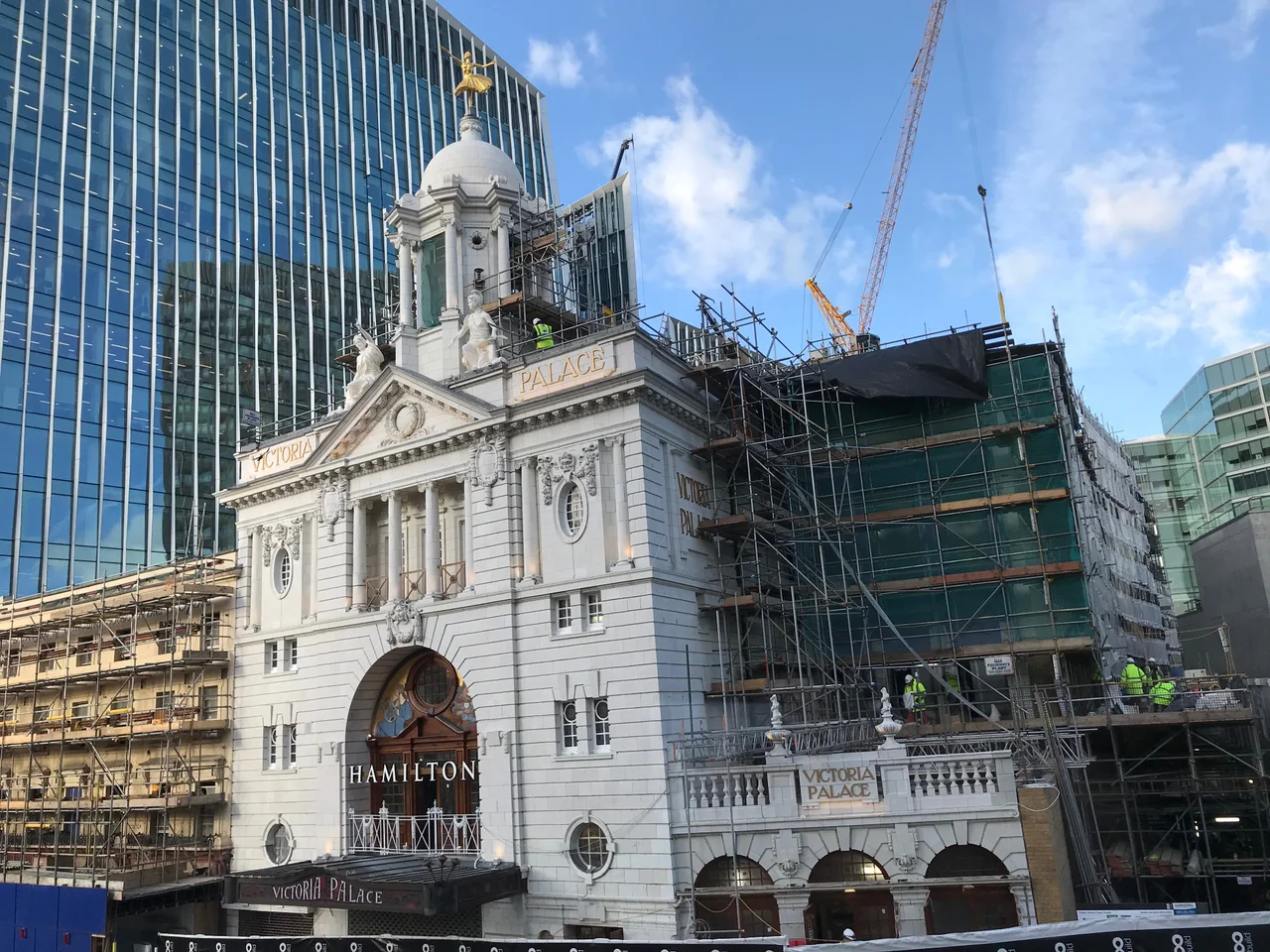

Victoria Palace Theatre
In 1934, a patriotic play by an 83-year-old clergyman opened at the Victoria Palace Theatre. The Reverend Walter Reynolds had written Young England as a serious work celebrating the moral triumph of the Boy Scout movement. The audience, however, found the script accidentally hilarious. Within weeks, audience members had memorised the worst lines and were chanting them along with the cast. The scoutmistress could not say 'I must go and attend to my girls' water' without fifty voices joining in. The play ran 278 performances at the Victoria Palace before transferring to two other West End theatres - a cult hit by mockery, in a building that has always taken its own measure of London entertainment.
From Stables to Variety
The site began in 1832 as a concert room above the stables of the Royal Standard Hotel, at what was then 522 Stockbridge Terrace. The proprietor, John Moy, enlarged the upstairs room until by 1850 it was advertised as Moy's Music Hall. In 1863 Alfred Brown took over and renamed it the Royal Standard Music Hall. By 1886 the area around it had been transformed by the arrival of Victoria Station and the building of Victoria Street, and the music hall was rebuilt on more ambitious lines, keeping the name. It was demolished again in 1910 to make way for something altogether grander.
Frank Matcham's Last London Theatre
The Victoria Palace Theatre opened on 6 November 1911. It cost twelve thousand pounds. The architect was Frank Matcham, the most prolific theatre designer Britain has ever produced - the man behind the London Coliseum, the London Palladium, the Hackney Empire, the Buxton Opera House, and dozens more. The Victoria Palace was the last London theatre Matcham designed before his retirement. His distinctive touch was everywhere: the ornate plasterwork, the warm acoustics, the box-and-tier arrangement that put the audience close to the stage. The original design included an unusual practical flourish - a sliding roof, which could be opened during intervals on hot summer evenings to cool the auditorium. Above the cupola, a gilded statue of the Russian ballerina Anna Pavlova was installed for the opening. The statue was taken down for safekeeping during the Blitz, and lost. A replica was finally restored to its perch in 2006.
Lambeth Walks and Crazy Gangs
Under impresario Alfred Butt, the Victoria Palace specialised in variety. Then in 1937, a new musical comedy opened starring the diminutive comic Lupino Lane: Me and My Girl. The show was the original incarnation of a piece that would be revived and rewritten for decades to come, and its showpiece number, 'The Lambeth Walk,' became one of the songs of the late 1930s - so much so that in 1939 it was broadcast live from the Victoria Palace stage, the BBC's first live transmission of a theatrical performance, with listeners across the country joining in. By the end of the Second World War, with variety returning to Britain's stages, the Victoria Palace hosted bills with Will Hay and his schoolboy retinue Charles Hawtrey and John Clark, Stainless Stephen, and Victor Barna, then the world table tennis champion, who would invite audience members up to play him for ten points. From 1947 through 1962 came The Crazy Gang - Flanagan and Allen, Nervo and Knox, Naughton and Gold - in a long run of comedy revues.
Elizabeth Taylor, Buddy Holly, Billy Elliot
The Black and White Minstrel Show played through the 1960s into 1972, a long-running variety entertainment whose blackface tradition belongs firmly to the history of British television and stage that the modern era has reckoned with rather than celebrated. In 1982 the Victoria Palace hosted Elizabeth Taylor's London stage debut, in The Little Foxes. From 1989 to 1995 the theatre hosted Buddy - The Buddy Holly Story, a thirteen-year London run before it transferred. Stephen Waley-Cohen bought the theatre in 1991 and refilled it with revivals. Then in 2005, the West End premiere of Billy Elliot the Musical opened at the Victoria Palace and stayed for eleven years, winning Olivier Awards and drawing audiences who had not been in a theatre for years.
Hamilton at the Victoria Palace
Delfont Mackintosh Theatres bought the Victoria Palace in 2014. After Billy Elliot ended its run in April 2016, the theatre closed for a multi-million-pound refurbishment that took eighteen months. On 21 December 2017, the doors reopened with the West End premiere of Hamilton, Lin-Manuel Miranda's musical about Alexander Hamilton - founding father, immigrant, treasury secretary, duellist. The show has played at the Victoria Palace ever since. The pairing has its own poetry. Hamilton's Hamilton is a man building institutions out of language. The Victoria Palace's history is also a history of language - the chant of the audience for Young England, the broadcast singalong to the Lambeth Walk, Elizabeth Taylor's first London entrances, Buddy Holly's catalogue reborn. Sit in the auditorium during Hamilton's opening number and the building rings with the music of a different revolution. Above the cupola, the gilded Anna Pavlova still poses on one leg, looking down on the West End that has changed and changed again beneath her.
From the Air
Victoria Palace Theatre lies at 51.4969 N, 0.1425 W on Victoria Street in the City of Westminster, immediately south of Victoria Station. View from 1,500-2,000 ft AGL with Buckingham Palace and Westminster Cathedral as principal landmarks. Central London restricted airspace applies. Nearest airports: London City (EGLC) 6 nm east, Heathrow (EGLL) 13 nm west.
Nearby Stories
- Battle of Britain, Northfleet 1.1 km away
- Bayham Old Abbey 5.4 km away
- Catharine Macaulay 6.4 km away
- Hatfield rail crash 8.8 km away
- Chequers 8.9 km away
- Chelmsford Cathedral 10 km away
- Queen Victoria Hospital 13 km away
- Fishbourne Roman Palace 36 km away