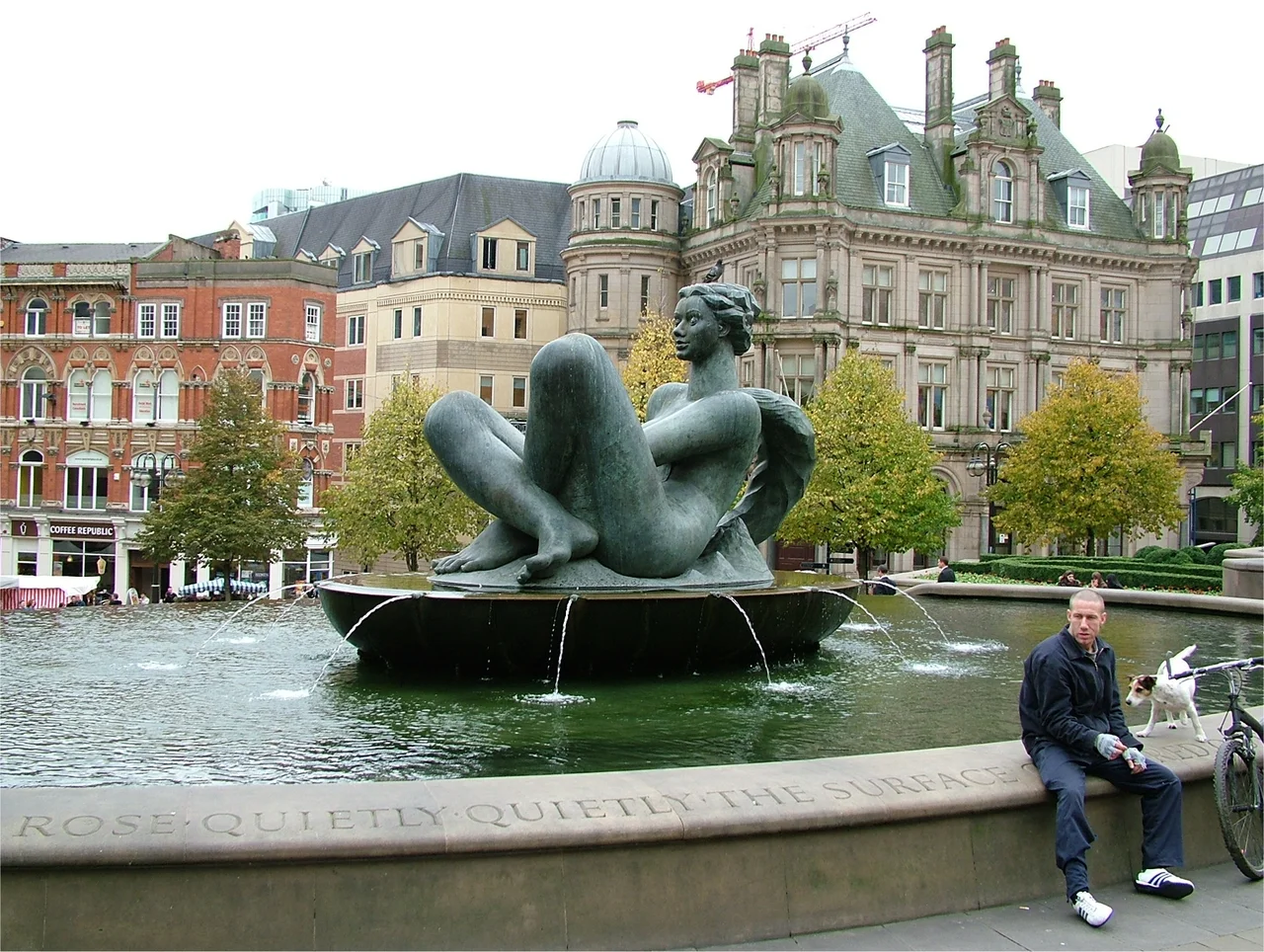

Victoria Square, Birmingham
Birmingham measures all its road-sign distances from Victoria Square. If a sign in Edgbaston says three miles to the city centre, that is three miles to the spot where the pedestrians cross between the Town Hall and the Council House, give or take. The square was renamed in honour of Queen Victoria on 10 January 1901. She died twelve days later. The marble statue Henry Barber commissioned, sculpted by Thomas Brock, was unveiled at her diamond jubilee and outlasted her by half a century before being recast in bronze in 1951. For most of the 20th century the place was a roaring traffic junction; in 1992 the council pedestrianised it, ran an international design competition for a water feature, and ended up with a fountain so absurdly camp that locals nicknamed it the Floozie in the Jacuzzi. The square is, in other words, perfectly Birmingham: serious civic ambition wrapped around an enormous reclining nude.
The Bodies Under Christ Church
Part of the square was once a churchyard. Christ Church, built between 1805 and 1813 on the site, was demolished in 1899 as the city centre redeveloped. The catacombs beneath the church held around six hundred bodies, including that of John Baskerville, the great Birmingham printer and type designer whose elegant Roman face still bears his name on every list of canonical English fonts. The remains were moved to Warstone Lane Cemetery. The font, the bell, and the foundation stone of Christ Church travelled out to Sparkbrook and became part of the new St Agatha's, paid for with the proceeds of the sale. An office and retail block called Christ Church Buildings then occupied the site until 1970, when they too were demolished and the slope was grassed over. Two churches and a commercial block, all gone; only the name Christ Church Passage remembers them now.
A Statue, A Sceptre, and a Recasting
The 1901 marble statue of Victoria became a fixture of the square almost as quickly as the queen had become a fixture of British identity. After half a century of soot and weather, Birmingham decided in 1951 that the marble had degraded too far to save. The sculptor William Bloye took a cast and recast the queen in bronze, mounting her on a new plinth of composite Cornish marble. Somewhere in the moves the sceptre at the top of the original sceptre had been lost. For decades the queen stood holding a stub. In 2011, thanks to research by the Victorian Society, the missing piece was reconstructed and the queen got her full regalia back, more than a century after she sat for Brock. The statue Edward VII used to share the square with her was moved to Highgate Park in 1951 and eventually re-erected outside Baskerville House in Centenary Square in 2010 - a quiet symmetry, since Baskerville's bones had been moved from under Christ Church a century before.
The Floozie in the Jacuzzi
When the council ran an international competition in 1992 for a new central water feature, they wanted something dramatic. The Indian-born British sculptor Dhruva Mistry won. His piece, formally titled The River, depicts a reclining bronze female nude in a great rectangular pool, water cascading over the lip. Construction took until 1994. Diana, Princess of Wales, performed the official opening. The nickname appeared more or less immediately and stuck so hard that even the council uses it now. The fountain ran for nearly twenty years, then sprang persistent leaks that proved impossible to fix economically. It was shut off in 2013, filled with plants and flowers from 2015 to 2022, then properly restored in time for the 2022 Commonwealth Games. The marathon events ended in Victoria Square that summer, runners turning the last corner past Mistry's bronze figure with water once again pouring around her.
The Iron Man and the Trustee Savings Bank
Antony Gormley's Iron: Man stands six metres tall on the south side of the square, a single rusting body cast in his characteristic slim, slightly leaning form. The Trustee Savings Bank donated the sculpture to the city in March 1993 when the bank's headquarters were located alongside the square. When TSB merged with Lloyds, there was a brief debate about whether the Iron Man should be moved to Lloyds' headquarters in Bristol. Birmingham kept him. He has been there for more than three decades, his iron slowly accumulating a russet patina, his stance slightly off vertical as Gormley intended. The square also once held statues of Joseph Priestley (now in Chamberlain Square), Robert Peel (now at a police training centre in Edgbaston), and John Skirrow Wright (moved, then put in storage, then scrapped). A statue of George Dawson, the great Victorian Birmingham preacher whose ideas helped shape the city's municipal reformist tradition, sits in storage at the Birmingham Museum Collections Centre.
Where the City Gathers
Every November the square fills up for the Frankfurt Christmas Market, the largest authentic German market outside Germany and Austria, with wooden huts selling glühwein and bratwurst and ornaments. The city's official Christmas tree, donated each year by the Swedish engineering firm Sandvik, stands in front of the Council House. In summer the marathon runners come through. On royal occasions and big civic moments, this is where the cameras set up. The Town Hall, finished in 1834 and modelled on the Temple of Castor and Pollux in Rome, anchors the western side; the Council House, opened in 1879, holds down the north; 130 Colmore Row sits to the east; Victoria Square House, the former Post Office, occupies the south. Four buildings, one queen, one bronze nude, one iron man, the bones of a printer somewhere underneath. The whole thing measured to the inch by every distance marker for fifteen miles around.
From the Air
Victoria Square sits at 52.480 degrees north, 1.903 degrees west, in central Birmingham at roughly 140 metres elevation. Best viewed from 2,500 to 4,000 feet AGL, the square shows as a small pedestrianised open area bracketed by the Greek-revival Town Hall on the west and the domed Council House on the north, all set into the dense Victorian and modern fabric of the city core. Birmingham Airport (EGBB) is about 7 nautical miles east-southeast. Look for Centenary Square just to the west with its open lawns and the metallic facade of the Library of Birmingham; Colmore Row runs east to St Philip's Cathedral and its surrounding green square.
Nearby Stories
- Shepshed 8.5 km away
- Battle of Evesham 11 km away
- Hixon rail crash 12 km away
- Battle of Cropredy Bridge 12 km away
- Wenlock Priory 15 km away
- RAF Shawbury 16 km away
- Market Bosworth 17 km away