
Voco Point
The name is a fossil. Voco Point takes its odd title from the Vacuum Oil Company, a pre-World War I American fuel outfit that ran a depot here when the British had not yet handed New Guinea to Australia and nobody expected an airline industry at all. Vacuum Oil would eventually rebrand as Mobil. The depot is long gone. But the name stuck to this little nub of Lae coastline, where coastal freighters still tie up and the busiest sea trade in Papua New Guinea runs its quiet daily business. Locals have their own name for the area, older than any oil company: Asiawi - a point, they say, that the evil spirit Yaayaa once bit off and made shorter than it used to be.
Where the Boats Come From
Stand at the Voco Point wharves on a busy morning and the scale of Papua New Guinea becomes something you can count in hulls. Passenger boats and small freighters line up to run routes that would take weeks to drive, even if there were roads. Ships bound for Finschhafen, 80 kilometers east across the Huon Gulf. Boats for the Siassi Islands, scattered north toward the Vitiaz Strait. Longer hauls to Kimbe on the north coast of New Britain, Rabaul further east still, the Lihir gold mines in the Bismarck Sea. Other boats run south to Alotau on Milne Bay, or up to Madang, Wewak, Vanimo on the Sepik coast. For communities cut off from PNG's road network - which is most of them - Voco Point is how you get in and how you get out.
The President and the B-26
On the morning of 9 June 1942, eleven B-26 Marauders from the U.S. 22nd Bomb Group lifted off from Port Moresby and turned north across the Owen Stanley Range toward Lae. The mission was called TOW 9. Aboard one of the aircraft, Heckling Hare, sat a 33-year-old Texan congressman who had talked his way into a combat observer's seat: Lieutenant Commander Lyndon B. Johnson of the U.S. Naval Reserve. The raid hit Lae's airfields and Voco Point's Japanese shipping. Johnson's bomber took fire on the way in and lost an engine. The pilot nursed it back to Australia. Nine days later the future 36th President was awarded the Silver Star for his participation - the only combat decoration he would ever receive, and one that would follow him into every campaign of his long political career.
Mount Lunaman
At 96 meters, Mount Lunaman is not quite a hill - but in the flat delta country of Lae it is tall enough to matter. The Germans who ran this coast before 1914 called it Fortress Hill. Locals call it Lo' Wamung, first hill. The Japanese, during their occupation of Lae from 1942 to 1943, turned the inside of Mount Lunaman into a warren of tunnels housing munitions, aviation fuel, and - if a 1970 Japanese television interview is to be believed - defenders who refused to come out even after the rest of Lae had fallen. When Australian troops took the town in September 1943, the story goes, they sealed the tunnel entrances. A Japanese tomb believed to hold the remains of hundreds of soldiers is said to lie under the hill still. A radio tower stands at the summit today, its red obstruction lights warning aircraft.
The Sea Takes Back
Voco Point sits on a precarious shelf. The continental drop-off falls away steeply just offshore, and every fifty years or so a chunk of the point simply slides into the depths. In the mid-1950s the entire wading pool at Stewart Park - a concrete basin of shallow water the kids of colonial Lae had splashed in - disappeared underwater in a single undersea landslide. The Rotary Club, not easily discouraged, rebuilt the wading pool at the Botanical Gardens instead. Geologists who have studied the Lae coast say the slides are a product of plate tectonics - the same collision between the Australian and Pacific plates that built the Finisterre Range. Local clan lore has older explanations involving spirits and appetites. Both accounts describe the same reality: the sea here is hungry, and always will be.
Everyday Working Coast
Between the wharves and Mount Lunaman runs Chinatown, a neighborhood established when German colonials brought Chinese boatbuilders and carpenters to Lae and Rabaul before World War I. Trading stores still operate there. At the base of the hill, the 68th Australian Women's Army Service barracks once stood behind high barbed wire that prompted its residents to sing Don't Fence Me In often and loudly. The site now holds the Sir Ignatius Kilage Stadium. Lutheran Shipping runs its headquarters from Voco Point, continuing a mission shipping tradition that began in 1908 when a Lutheran named Samuel Jericho sailed in on a boat called Bavaria. The Lae Yacht Club started here in 1950 with two men named Bill, relocated in 2003, and now counts over 1,100 members. It is, on any given afternoon, the most prestigious yacht club in Papua New Guinea, which is not a competitive category but a real one all the same.
From the Air
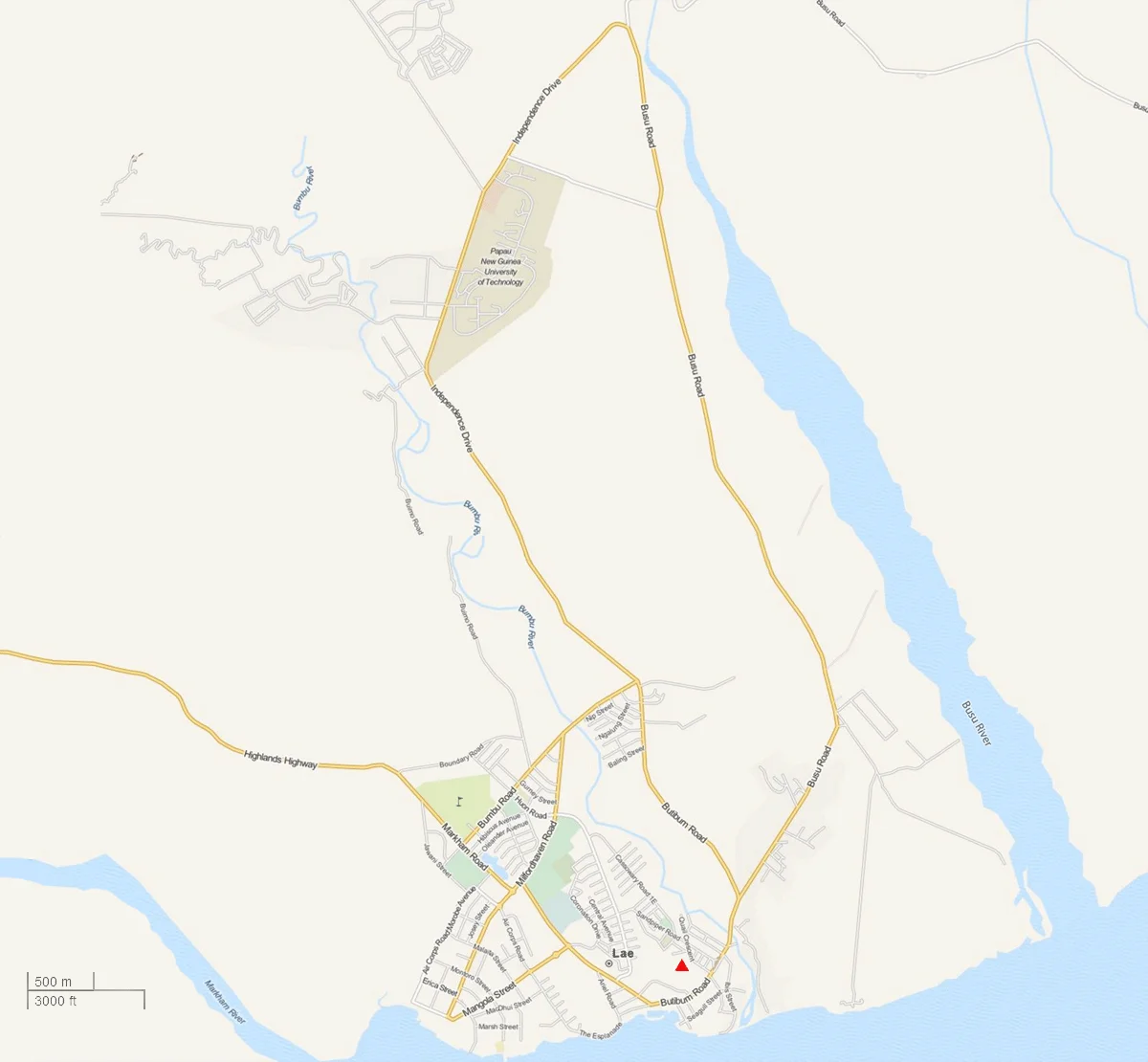
Voco Point lies at 6.74°S, 147.00°E, immediately south of Lae city center on the north shore of the Huon Gulf. The point is about 1 km east of Lae's main port, at the foot of Mount Lunaman (96m), which bears a radio mast with red obstruction lights. Nadzab (AYNZ), Lae's airport, is 40 km northwest inland. From low altitude the neighborhood appears as a small industrial nub of wharves and warehouses with the dark waters of the Huon Gulf to the south and the radio tower-topped hill just north.
Nearby Stories
- Black Cat Track 10 km away
- Battle of Sattelberg 12 km away
- Battle of Finschhafen 28 km away
- 2022 Papua New Guinea Earthquake 31 km away
- Huon Peninsula 37 km away
- Battle of Kaiapit 70 km away
- Battle of the Bismarck Sea 70 km away
- Strathallan Estate 185 km away