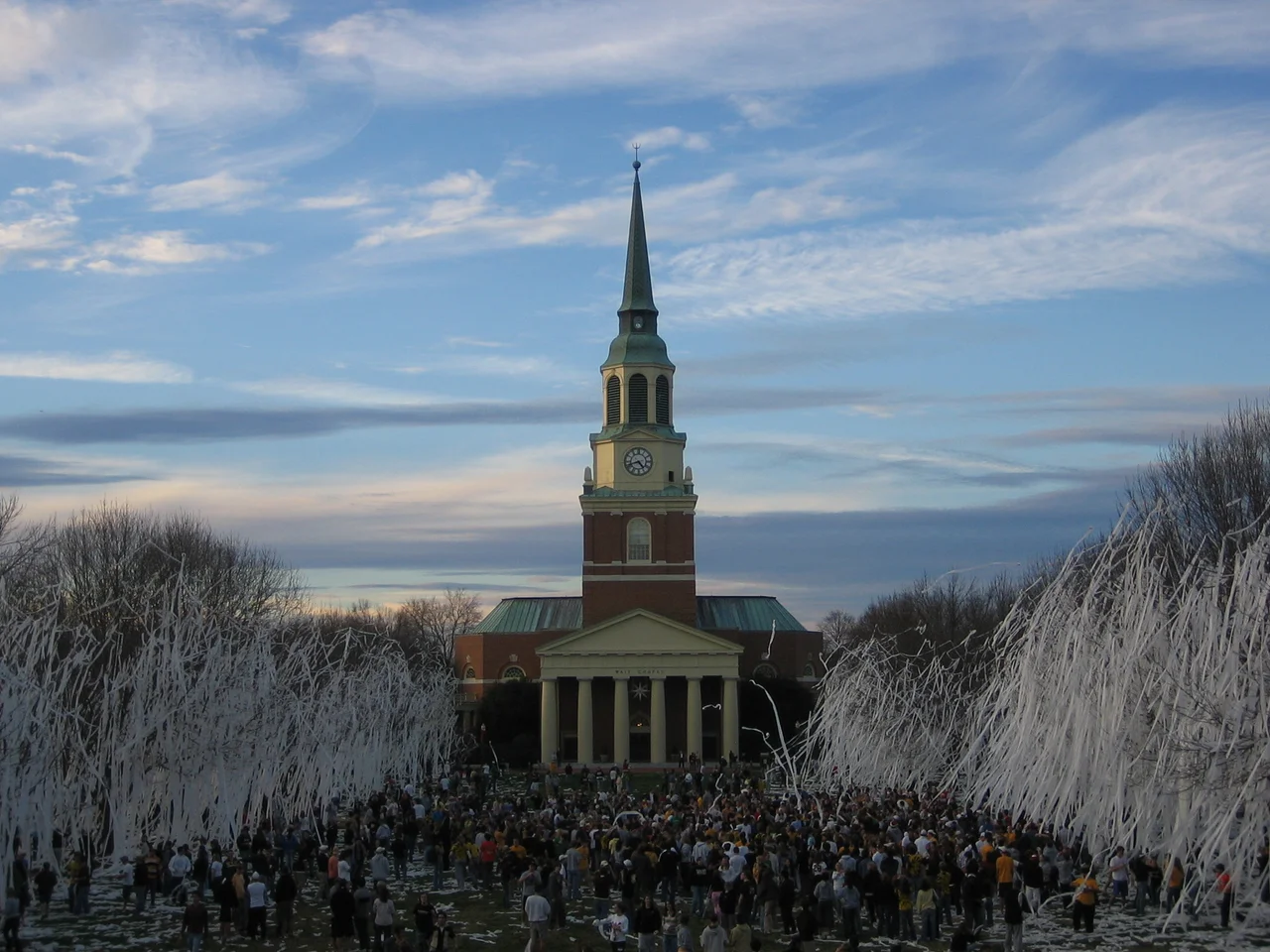

Wake Forest University
The name doesn't fit the city. Wake Forest is in Winston-Salem, not in any wake or any forest. The college was founded on February 3, 1834, on a 615-acre plantation owned by Calvin Jones in Wake County, north of Raleigh, in a wooded area locals called the Forest of Wake. The new institution was called the Wake Forest Manual Labor Institute - the North Carolina Baptist State Convention's idea of how to make ministers and laymen out of farm boys, with students required to spend half of each day doing actual labor on the plantation. The manual-labor system was abandoned in 1838 when the school renamed itself Wake Forest College. A town grew up around it called, naturally, Wake Forest. Then in 1946 a tobacco heiress wrote a check that moved the whole school 110 miles west.
The Babcock Gift
Mary Reynolds Babcock was the daughter of R.J. Reynolds, founder of the tobacco company whose Camel cigarettes had built much of modern Winston-Salem. In 1946, she and her husband Charles offered Wake Forest about 330 acres of their Reynolda estate - the same Reynolda where her brother Smith had died under disputed circumstances in 1932 - if the college would move to their city. The Z. Smith Reynolds Foundation, named for that dead brother, agreed to fund the move. There was talk of renaming the place Smith Reynolds University; the name was dropped. From 1952 to 1956 fourteen Georgian-style buildings rose on the new campus. In the fall of 1956 Wake Forest opened in Winston-Salem, leaving its original town behind. The town of Wake Forest, North Carolina is still there, two and a half hours east, with a university-shaped hole in its center.
Layers of Quiet Change
Wake Forest has always carried its history in layers. The first female undergraduates arrived in 1942 because the Second World War had drained the male student body. Konsukie Akiyama, a Japanese student, had become the first Asian graduate way back in 1909. Edward Reynolds, a transfer from Shaw University, became the first Black graduate in 1964; he went on to a Ph.D. in African history from the University of London and a long career teaching at UC San Diego. On February 23, 1960, ten Wake Forest students joined eleven students from Winston-Salem State Teachers College for a sit-in at the Woolworth's lunch counter downtown. Martin Luther King Jr. spoke in Wait Chapel on October 11, 1962. In 1982 the university hired Maya Angelou as the Reynolds Professor of American Studies; she taught at Wake Forest from then until her death in 2014. In February 2020 the university formally apologized for benefiting from enslaved people during slavery.
Demon Deacons
Athletic teams at a Baptist institution called the Demon Deacons - the name itself is a joke about the contradiction. The school is a founding member of the Atlantic Coast Conference, has won eleven NCAA team championships, and its men's soccer program reached four consecutive Final Fours from 2006 to 2009, winning the NCAA championship in 2007. Wait Chapel, looming over Hearn Plaza, has hosted two presidential debates - Bush versus Dukakis in 1988 and Bush versus Gore in 2000 - along with President Jimmy Carter's 1978 national security address. The football team plays at Truist Field, formerly Groves Stadium. Basketball plays at the Lawrence Joel Veterans Memorial Coliseum, which the university bought from the city of Winston-Salem in 2013 along with 33 surrounding acres.
Reynolda Lives On
Walk south from the academic quad and you walk through what used to be a tobacco fortune's country estate. The Reynolda House, built in 1917 by Katharine Smith Reynolds and her husband R.J., is now a museum of American art - Cassatt, Frederic Church's Andes of Ecuador, Georgia O'Keeffe, Jacob Lawrence, Gilbert Stuart. The 129 acres of Reynolda Gardens are open to the public. Reynolda Village, the old service buildings of the estate, modeled after an English village, now holds shops and restaurants. The university owns Casa Artom on Venice's Grand Canal (purchased 1974, formerly the American Consulate), Flow House in Vienna (purchased 1998), and Worrell House in Hampstead, London (acquired 1977). The medical school, now Atrium Health Wake Forest Baptist, is the largest employer in Forsyth County with about 13,000 workers. The school the Baptists started on a Wake County plantation in 1834 with manual labor and Calvinist scripture is now a research university with a $191 million annual research budget and an opera-quality conference center.
From the Air
Wake Forest University's main Reynolda Campus is centered at 36.13 degrees N, 80.28 degrees W, about 2.5 miles north of downtown Winston-Salem at roughly 980 feet elevation. The Georgian quad, Wait Chapel's bell tower, and the Reynolda House sit just east of Reynolda Road. Nearest airport: Smith Reynolds (KINT) 4 nm southeast; Piedmont Triad International (KGSO) 16 nm east in Greensboro. Recommended viewing altitude 2,500-3,500 feet AGL. Z. Smith Reynolds Library and the Manchester Quad sit at the south end; the Lawrence Joel Coliseum is about 2 miles southwest near University Parkway. The Bowman Gray medical campus is in the Ardmore neighborhood, 3 miles south.
Nearby Stories
- Battle of Wetzell's Mill 5 km away
- Hanging Rock State Park 5.9 km away
- Mebane's Bridge 11 km away
- 2025 North Carolina Cessna Citation II Crash 13 km away
- Wil-Cox Bridge 16 km away
- North Wilkesboro Speedway 19 km away
- Galax, Virginia 31 km away
- Deep River Camelback Truss Bridge 60 km away