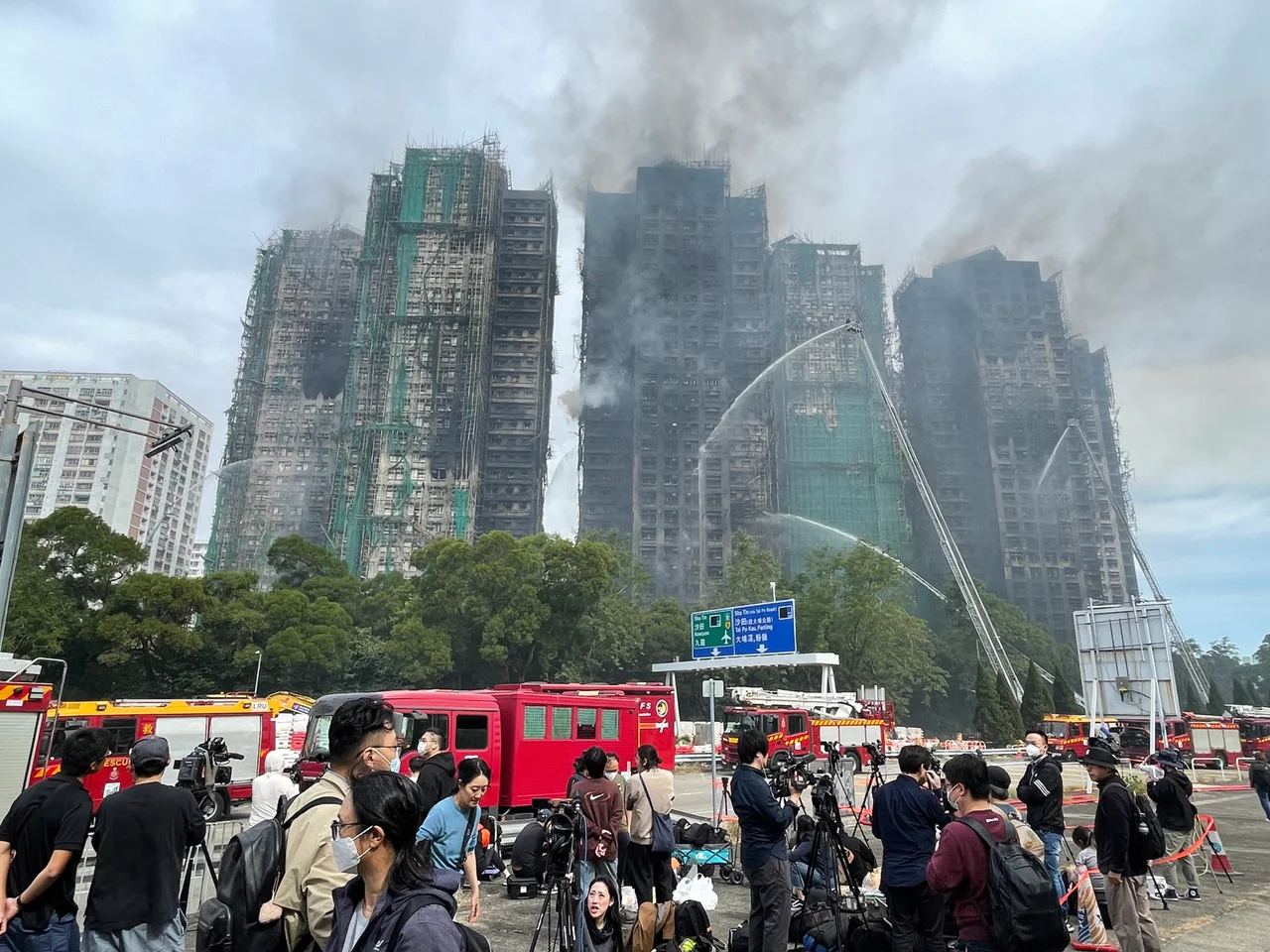

Wang Fuk Court Fire
At two o'clock on the afternoon of 26 November 2025, a resident at Wang Shing House in Tai Po caught the smell of smoke through her window and spotted a small flame burning in a neighbouring block. She tried to reach the property management office. She could not get through. She went down to the ground floor, where a security guard confirmed there was a fire, and she returned to her apartment and sheltered in place until she was rescued. Her experience — the slow recognition, the failed warning, the waiting — was shared by thousands of residents that day. By the time the fire was over, 168 people were dead. They were neighbours, domestic workers, construction workers, children, and elderly residents who had lived in Wang Fuk Court for years. One of them was a firefighter named Ho Wai-ho, 37 years old, a nine-year veteran of the Hong Kong Fire Services Department who fell while trying to save others. This is an account of what happened to them.
The Building and the Renovation
Wang Fuk Court is a subsidised Home Ownership Scheme housing complex in Tai Po, in Hong Kong's New Territories — eight residential towers, each 31 storeys tall, built in 1983 and home to nearly 2,000 units. In early 2024, the owners' corporation selected a HK$330 million plan to completely rebuild and re-tile the exterior walls of all eight towers. This required erecting bamboo scaffolding to the full height of every building, covering the entire exterior with construction safety nets and tarps. The windows of every elevator room and many exterior windows were sealed with polystyrene foam boards to allow workers to move between the exterior and interior. The contractor was Prestige Construction and Engineering Company. In the months before the fire, residents had raised concerns: there were reports of workers smoking throughout the site, and a former security staff member later stated that the fire alarm system had been intentionally disabled as early as May 2025 to allow workers to move in and out more freely.
The Day of the Fire
The conditions on 26 November 2025 were dangerous before anything ignited. Hong Kong was in the northeast monsoon season. The weather was dry, humidity in the Tai Po area that afternoon measured between 40 and 50 percent, and a Red Fire Danger Warning had been issued by the Hong Kong Observatory two days earlier and remained in effect. The first signs of fire appeared at Wang Cheong House, Block F, at around 14:00. By 14:45, eyewitnesses were reporting that bamboo scaffolding on the building's exterior walls had caught fire. The fire department received its first report at 14:51. Firefighters arrived within ten minutes, but the blaze had already escalated rapidly. The construction safety netting wrapped tightly around the buildings created a chimney effect, pulling flames upward with force. The polystyrene foam sealing the windows provided ready fuel for fire to breach the building interiors. None of the fire alarms in any of the eight towers activated. Residents learned of the fire from neighbours knocking on doors and from community messaging groups.
A Night of Rising Alarms
The emergency level was raised from 1 to 4 by 15:34 that afternoon, and to the highest level — 5, a five-alarm fire — by 18:22. Over the course of the response, 128 fire engines, 57 ambulances, and 767 firefighters were deployed; by the following afternoon that number had grown to 304 fire and rescue vehicles and 1,250 firefighters. Many residents remained trapped in their apartments, unable to escape through a burning exterior. Firefighters could not enter the buildings due to intense heat. Authorities instructed trapped residents to shelter in place, to seal gaps under doors and around windows, and to wait. Some received help; others did not. The fire spread from Block F to six of the remaining seven towers. A secondary wildfire broke out across the Tai Po River at 22:13 that evening. The main fire was not brought under control until early on 27 November. It was not fully extinguished until 10:18 on 28 November — 43 hours and 27 minutes after the first alarm.
The People Who Were Lost
Of the 168 people who died, 147 were found at the scene. Most were inside their apartments. Others were found in stairwells and corridors. Their ages ranged from six months to 98 years old. Among the dead were at least ten foreign domestic workers — nine from Indonesia and one from the Philippines — and five construction workers who had retreated indoors when they could not control the fire. Ho Wai-ho, the firefighter killed in the line of duty, was based at Sha Tin Fire Station. The inquiry later found that he most likely fell to his death as the chimney effect sent flames racing upward through the scaffolding. Twelve other firefighters were injured. Approximately 56 people were rescued from the fire. Around 79 others were injured. Some bodies were so severely burned that identification required DNA analysis; the final death toll of 168 was confirmed in the weeks following, as remains were matched to missing persons. As of 3 December, nearly 300 animals had been rescued from the affected buildings, including cats, dogs, fish, and turtles.
Inquiry, Response, and What Remains
The Hong Kong government activated its Emergency Monitoring and Support Centre and established three working groups to coordinate investigations, emergency support, and housing. Over 2,000 temporary housing units were made available. Hotels, including Regal Hotels International and Hong Kong Gold Coast Hotel, provided more than 320 rooms to affected residents at no charge. Relief funds raised more than HK$860 million in public and government contributions by early December; families of those who died received compensation of HK$200,000 per deceased person, with additional allowances for funeral costs. An independent public inquiry convened in March 2026, and at its first hearing, lead counsel presented evidence that the fire was most likely ignited by a discarded cigarette landing on flammable debris accumulated in a lightwell — the accumulated weight of small failures over many months. Charges of involuntary manslaughter and conspiracy were filed against seven individuals and two companies. Wang Fuk Court is the deadliest fire in Hong Kong since the 1948 Wing On warehouse fire in Shek Tong Tsui, which killed 176 people. The people who died at Wang Fuk Court lived in their homes. They were not spectacles of disaster. They were residents of Tai Po, and this is their memorial.
From the Air
Wang Fuk Court is located in Tai Po, in Hong Kong's New Territories, at approximately 22.45°N, 114.17°E. VHHH (Hong Kong International Airport) lies roughly 25 km to the southwest on Lantau Island. The Tai Po district is visible to the northeast of Kowloon on approach from the west, situated along Tolo Harbour. The Wang Fuk Court towers were among the tallest buildings in Tai Po at 31 storeys. The nearest MTR station is Tai Po Market on the East Rail Line.
Nearby Stories
- Chapel of St. Francis Xavier 3.5 km away
- Cuiheng 4.1 km away
- 2015 Shenzhen Landslide 16 km away
- Shunde 31 km away
- Wanshan Archipelago 37 km away
- Nanxiong Formation 96 km away
- Heyuan 149 km away
- Checheng Fu'an Temple 629 km away