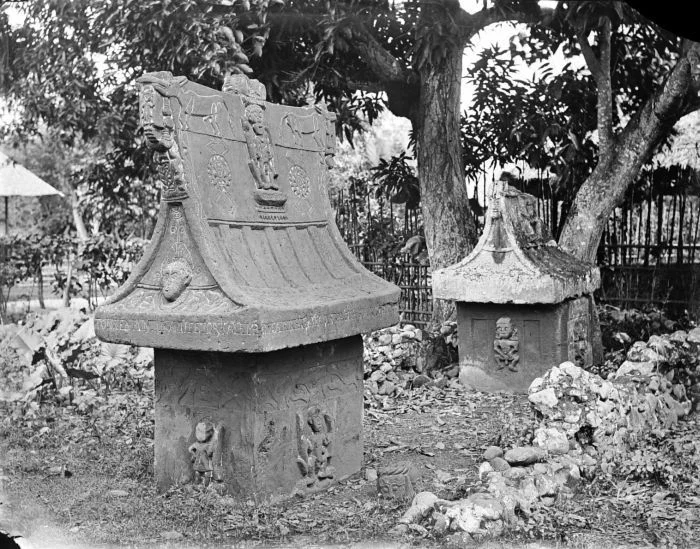

Waruga
The dead do not lie down in a waruga. They sit, knees drawn up to the chest, heels touching buttocks, head bowed forward as if kissing the knees. They face north. The Minahasa people of North Sulawesi believed their ancestors came from the north, and so the dead were positioned to gaze toward the origin of everything, sealed inside stone sarcophagi with ridged lids that resemble the rooflines of traditional houses. These are the waruga, and roughly 370 of them still stand in the highlands of North Sulawesi, monuments to a burial practice that endured for nearly a thousand years.
The Posture of Return
Before the waruga, the Minahasa wrapped their dead in woka, the broad leaf of the Livistona fan palm, and placed them in wooden coffins. Sometime in the 9th century, the practice shifted to stone. The word itself varies by dialect: waruga in Tontemboan, warugha in Tondano, baruga in the Tonsea and Tombulu languages. Each dialect names the same thing: a two-part stone tomb, box-shaped on the bottom, ridged on top, sized to contain a single person in the seated position. The craftsmanship required was considerable. Each waruga had to be carved from local stone, shaped to fit a human body bent into the fetal posture, and sealed well enough to endure centuries of tropical rain.
Carved Stories on Stone
The waruga in the Tonsea region carry their history on their surfaces. Carvings and reliefs depict how the bodies were placed inside, illustrating the burial posture with a directness that serves both as instruction and as memorial. Other reliefs show scenes of daily life: farming, fishing, the livelihoods that sustained the Minahasan villages. The sarcophagi became a kind of stone autobiography, recording not just death but the life that preceded it. At Taman Purbakala Waruga-Waruga, an archaeological park near Airmadidi, sarcophagi collected from surrounding areas sit alongside a museum displaying porcelain, armbands, stone axes, and bone fragments found within the tombs.
When the Dutch Said No
In 1828, the Dutch colonial government banned the use of waruga. The reasons were practical and ideological. Tropical diseases, including typhoid and cholera, were spreading, and colonial administrators feared the above-ground tombs contributed to outbreaks. Christianity, spreading rapidly through the Minahasa highlands under Dutch missionary influence, also demanded underground burial. The Minahasa adapted, returning to coffins and earthen graves. But the waruga already standing were largely left in place, too heavy and too deeply embedded in the landscape to easily remove. Time and neglect did what colonial decree could not: many were looted for the valuables buried alongside the dead.
What the Numbers Tell
Today, approximately 370 waruga survive across three main concentrations. Sawangan holds 144, Airmadidi Bawah contains the largest collection at 211, and Rap-Rap preserves 15. The sites draw tourists and scholars alike. In 1995, the waruga were placed on UNESCO's World Heritage Site Tentative List, a recognition that they represented something globally significant. Twenty years later, in 2015, they were quietly removed from the list. The reasons remain unclear, but the waruga themselves remain, indifferent to bureaucratic categories. Most have been looted for their valuable contents over the centuries, but their stone shells endure, still facing north.
From the Air
Located at 1.420N, 124.976E near Airmadidi, in the highland interior of North Sulawesi, approximately 25 km south of Manado. Sam Ratulangi International Airport (ICAO: WAMM) is the nearest major field. The waruga sites are scattered across the Minahasa highland plateau. From altitude, look for the volcanic terrain around Mount Klabat and Lake Tondano. Best viewed below 3,000 ft to spot the archaeological park clearings. Tropical climate with afternoon cloud buildup common.
Nearby Stories
- Battle of Kendari 16 km away
- Bangka Island (North Sulawesi) 19 km away
- Gorontalo 173 km away
- Otanaha Fortress 192 km away
- USS Shark (SS-174) 196 km away
- Fort Kastela 207 km away
- Japanese Minelayer Tsugaru 278 km away
- Indonesia-Malaysia Border 576 km away