
West Norwood Cemetery
Walk the hilltop paths and you pass an oak that was a sapling when Henry VIII was on the throne. A tree survey in 2005 dated it to somewhere between 1540 and 1640. Fourteen other oaks predate the cemetery's founding in 1836, planted while the land was still part of the Great North Wood that gave Norwood its name. Beneath these trees lie 164,000 people in 42,000 plots. The headstones range from the very simple - Isabella Beeton's grave, just a slab for the woman whose cookery book sold more copies in Victorian England than almost anything except the Bible - to the spectacular: Sir Henry Doulton's mausoleum, made of pottery and terracotta because that was his business; Sir Henry Tate's neoclassical pile, paid for by the sugar trade that built the Tate Gallery; the Greek necropolis in the northeast corner, 19 listed monuments to families who fled the Ottoman Empire and built empires of their own.
Christopher Wren's Idea, Eventually
The cemetery exists because of a slow-burning Victorian public-health emergency. London's churchyards had become catastrophically full - in some parishes corpses were buried inches below the surface and the resulting stench and disease was, in the language of the time, "prejudicial to the health of the inhabitants." As far back as 1711, Sir Christopher Wren had argued for burial grounds outside the city walls, enclosed by brick walls and planted with yew trees. It took Parliament more than a century to listen. In 1830, George Frederick Carden - editor of The Penny Magazine - successfully petitioned for legislation. Over the following years a series of acts allowed companies to buy land in the open country around London and create cemeteries on a new model. Seven were eventually built. They became known as the Magnificent Seven. West Norwood was the second, consecrated by the Bishop of Winchester on 7 December 1837.
The First Gothic Cemetery in Britain
Architect William Tite, who was a director of the South Metropolitan Cemetery Company, designed the landscaping and many of the monuments. He chose the Gothic Revival style - the first cemetery in the UK to be designed that way. Pointed arches, traceried windows, asymmetric spires. The entrance gates and railings, painted a historically accurate spice brown, were built high to dispel fears of body snatchers - the men who, in the early decades of medical schools, dug up fresh corpses to sell for dissection. The whole site lies on a gently rolling south London hill, with views across the city. Tite was eventually buried there himself, in the cemetery he had designed. The architectural significance is now formally recognised: 69 buildings and structures are Grade II or Grade II* listed.
Two Hundred Lives in the Dictionary of National Biography
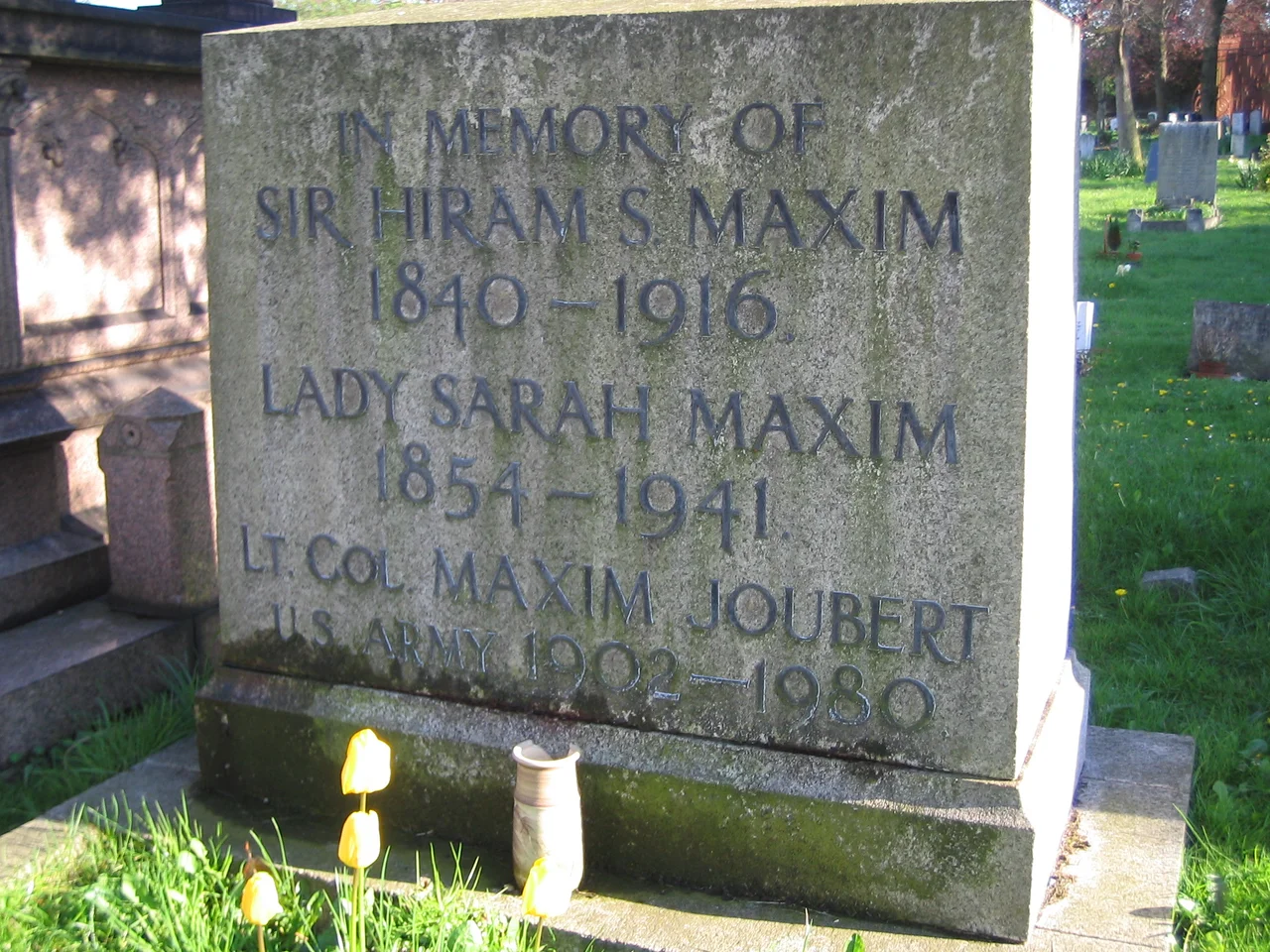
More than 200 people buried at West Norwood are recorded in the Dictionary of National Biography. The Friends of West Norwood Cemetery have biographed many more. Sir Hiram Maxim, inventor of the automatic machine gun, lies here. Sir Henry Bessemer, whose steel-making process transformed industry. James Henry Greathead, who tunnelled most of the London Underground. The Reverend Charles Spurgeon, the Baptist preacher who could fill a hall of ten thousand. Paul Julius Baron von Reuter, who founded the news agency. Arthur Anderson, co-founder of P&O. Charles William Alcock, who invented Test cricket and the FA Cup. Dr Gideon Mantell, the surgeon-palaeontologist who first described the iguanodon. Isabella Beeton, the cookery writer, who died at 28 in childbirth and was buried under a stone modest by Norwood standards but immortal in cultural memory.
The Greek Quarter
In 1842, just five years after the cemetery's founding, London's Greek community acquired a section in the northeast for an Orthodox necropolis. The diaspora had come from Smyrna, Constantinople, Chios - merchant families building shipping and trading empires in nineteenth-century London. The Ralli Brothers, Vagliano, Rodocanachi, Michalinos - names that ran the eastern Mediterranean grain trade and much of the wider Levantine commerce. They built mausoleums to match: 19 listed monuments dense with neoclassical detail, presided over by St Stephen's Chapel, sometimes attributed to John Oldrid Scott. Princess Eugenie Palaeologue is here too, claiming descent from the last Byzantine emperors. The Cathedral of St Sophia in Bayswater oversees the trustees. Walking through this corner today, surrounded by Doric columns and Greek inscriptions, you are in a small piece of Athens transplanted to suburban Lambeth.
Lost and Recovered
The cemetery's modern history is more complicated. By the inter-war years burial space had run out, and the cemetery company struggled to maintain the grounds. World War II damaged the Dissenters' chapel with a V-1 flying bomb in 1944. Lambeth Council compulsorily purchased the cemetery in 1965 and, controversially, began "lawn conversion" - clearing at least 10,000 monuments, including some of the listed ones, and reselling existing plots for new burials. Consistory Court cases in 1995 and 1997 found this illegal. New burials were stopped, some monuments restored, and Lambeth was required to publish an index so descendants could identify and reclaim their families' plots. The cemetery now operates under joint management between Lambeth, the Diocese of Southwark, the Friends, and Historic England. The Friends - volunteers, mostly - tend the graves of the famous and the unknown, walk the historic trees, and continue to discover stories beneath the moss. A Cross of Sacrifice near the gate commemorates 136 Commonwealth war dead from World War I and 52 from World War II, including two Greek civilians who died on the Lusitania.
From the Air
West Norwood Cemetery sits at 51.4330°N, 0.0981°W on a gently rolling hill in south London, in the London Borough of Lambeth. Forty acres of green among the dense Victorian terraces of West Norwood. From altitude the cemetery appears as a roughly rectangular wooded area south of central London, with the prominent dome of Crystal Palace transmitter ridge visible just east. Nearest major airports: London City (EGLC) 9nm northeast, Heathrow (EGLL) 14nm west, London Gatwick (EGKK) 21nm south. West Norwood railway station is on the cemetery's east boundary, with Brixton tube station about a mile and a half north.
Nearby Stories
- Battle of Britain, Northfleet 1.1 km away
- Bayham Old Abbey 5.4 km away
- Catharine Macaulay 6.4 km away
- Hatfield rail crash 8.8 km away
- Chequers 8.9 km away
- Chelmsford Cathedral 10 km away
- Queen Victoria Hospital 13 km away
- Fishbourne Roman Palace 36 km away