
Westminster School
In 1658, during Oliver Cromwell's funeral procession through Westminster, a schoolboy named Robert Uvedale managed to dart in and snatch the white satin Majesty Scutcheon draped on the Lord Protector's coffin. He kept it. Three hundred years later his family gave it to Westminster School, where it now lives in the library. That a boy could pull this off, and that the school still has the souvenir, says almost everything about Westminster: a thousand-year-old institution where the curriculum sometimes seems incidental to the proximity of history. The pupils have been a few hundred yards from Parliament, the Abbey, and the throne for so long that they have come to consider those institutions part of the furniture.
Older Than the Conquest
The Croyland Chronicle and a charter of King Offa both record a charity school run by the Westminster Benedictines before the Norman Conquest. Continuous documentation begins in the 1340s, with records held in the Abbey's Muniment Room. Parts of the school buildings date to the tenth-century Anglo-Saxon abbey. In 1540, when Henry VIII dissolved the monasteries and the powerful Abbots of Westminster lost their house, he personally guaranteed the school's survival by royal charter. The Royal College of St Peter continued with forty King's Scholars financed from the royal purse. Twenty years later, in 1560, Elizabeth I refounded the school with new statutes - the date now generally taken as the official foundation. Elizabeth visited her scholars often, watched them perform Latin plays in College Hall, and never quite got round to signing the statutes or endowing her scholarships.
Richard Busby, Birch and Pardon
The reputation of Westminster for the next two centuries was largely the work of Richard Busby, headmaster from 1638 to 1695 and one of the most formidable schoolmasters in English history. He was an Old Westminster himself and ran the place with classical learning and the birch in equal measure - Alexander Pope satirised him in the Dunciad. On the morning of Charles I's execution in 1649, Busby gathered the boys for prayers for the King's safety, then locked them inside the school to keep them from running to watch the spectacle a few hundred yards away. He thrashed Royalist and Puritan boys with equal severity, served through the Civil War, the Commonwealth, and well into the Restoration. In 1679 a group of scholars killed a bailiff who had violated the Abbey's traditional right of sanctuary by arresting someone connected to the College. Busby obtained a royal pardon for them from Charles II - and added the cost to the school bills.
Inside the Abbey Precincts
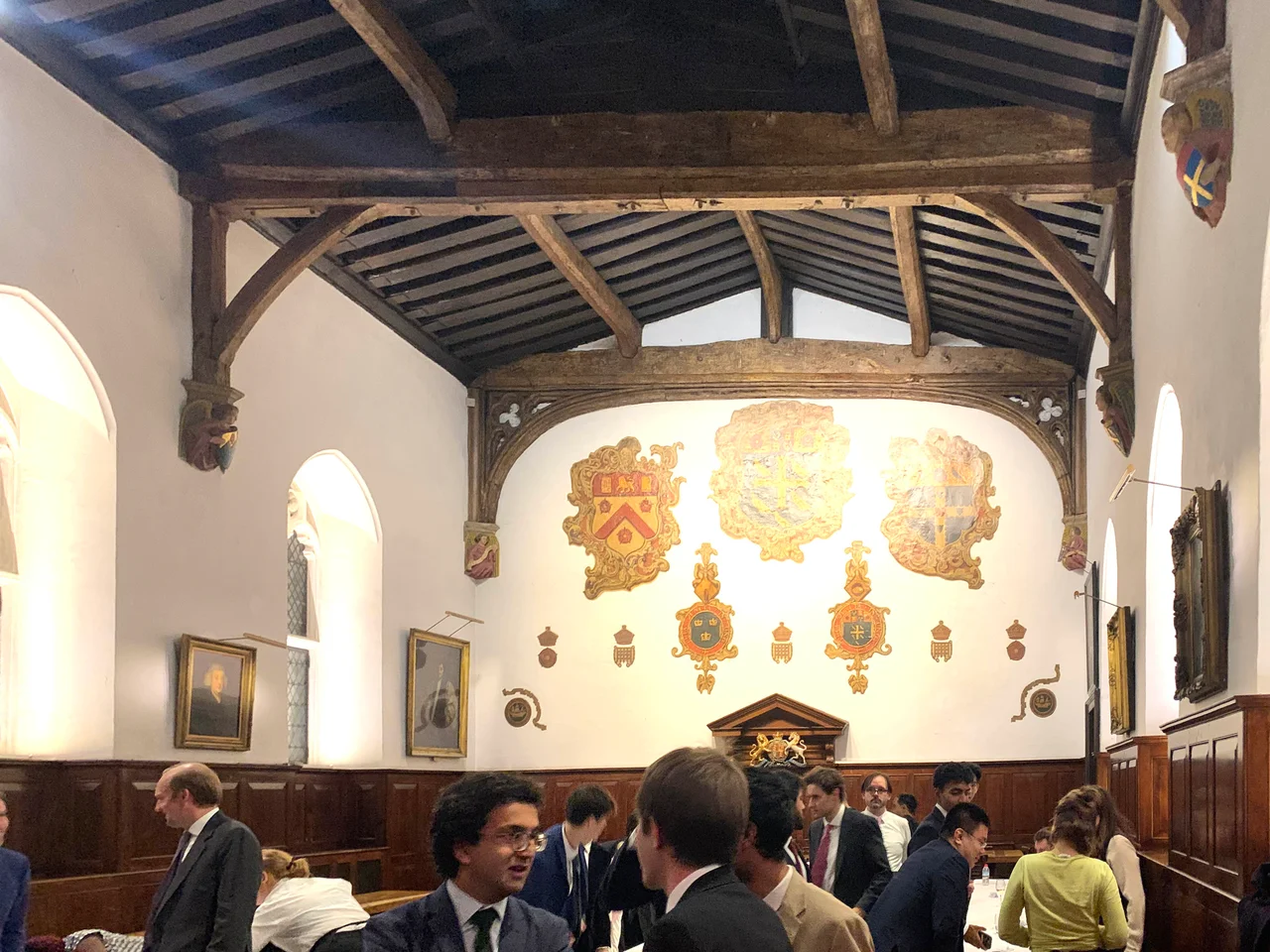
Westminster School stands in the precincts of Westminster Abbey, inside the UNESCO World Heritage Site that also contains the Palace of Westminster and St Margaret's Church. The main buildings cluster round Little Dean's Yard - known simply as Yard - off Dean's Yard, where Church House, the headquarters of the Church of England, also stands. The medieval dining hall, College Hall, has been in continuous use for meals for over six hundred years. Queen Elizabeth Woodville took sanctuary there in 1483 with her five daughters and her son Richard of Shrewsbury, the younger of the two Princes in the Tower whose fates she could not finally prevent. School Hall - 'up School' - was built in the 1090s as the monks' dormitory and bears the largest piece of pig iron in the world, the 16th-century bar from which a curtain once divided the Upper and Lower Schools. College Garden, just to the east, is believed to be the oldest continuously cultivated garden in England, under cultivation for about a millennium.
Locke, Gibbon, Bentham, Nobels
John Locke went to Westminster in the 1640s, when Busby's birch still ruled. Edward Gibbon arrived at age 11. Jeremy Bentham at 8. Three Nobel Prize laureates have been Old Westminsters: the physiologist Edgar Adrian (1932), Sir Andrew Huxley for nerve impulse research (1963), and Sir Richard Stone for economics (1984). Seven UK prime ministers attended, all of them Whig or Liberal in political affiliation: Henry Pelham and his brother Thomas Pelham-Holles; Charles Watson-Wentworth; James Waldegrave; Augustus FitzRoy; William Cavendish-Bentinck; and John Russell. Sir Christopher Wren was an Old Westminster - his designs formed the basis for the College building, completed in 1729 by the Earl of Burlington. Around half of each year's leavers now go on to Oxford or Cambridge, giving Westminster the highest Oxbridge acceptance rate in the country.
Blitz, Greaze, and the Future
In the Blitz of 1941, incendiary bombs destroyed the roofs of both School Hall and College. Westminster, unlike Charterhouse and St Paul's, refused to evacuate London - the pupils dispersed but the school did not move. Westminster Under School was created in 1943 in the city as a distinct preparatory school. George VI reopened the rebuilt halls in 1950. The school's customs survive in remarkable detail. Every Shrove Tuesday, the Greaze ceremony involves the cook tossing a horsehair-reinforced pancake over a 16-foot-high iron bar in School, while pupils scrum below for the largest piece. In 1967 the first female pupil was admitted; girls became full members in 1973. By 2030 the school plans to be fully co-educational at every year group. The buildings remain in the abbey precincts, the Latin Prayers still take place weekly, and the King's Scholars still hold their unusual right of access to the House of Commons. For a school nearly a thousand years old, change is not avoided - it is digested at its own pace.
From the Air
Westminster School lies at 51.4992 N, 0.1276 W within the precincts of Westminster Abbey in central London. View from 1,500-2,500 ft AGL with the Abbey, the Houses of Parliament, and Big Ben as principal landmarks. Central London restricted airspace applies. Nearest airports: London City (EGLC) 6 nm east, Heathrow (EGLL) 14 nm west.
Nearby Stories
- Battle of Britain, Northfleet 1.1 km away
- Bayham Old Abbey 5.4 km away
- Catharine Macaulay 6.4 km away
- Hatfield rail crash 8.8 km away
- Chequers 8.9 km away
- Chelmsford Cathedral 10 km away
- Queen Victoria Hospital 13 km away
- Fishbourne Roman Palace 36 km away