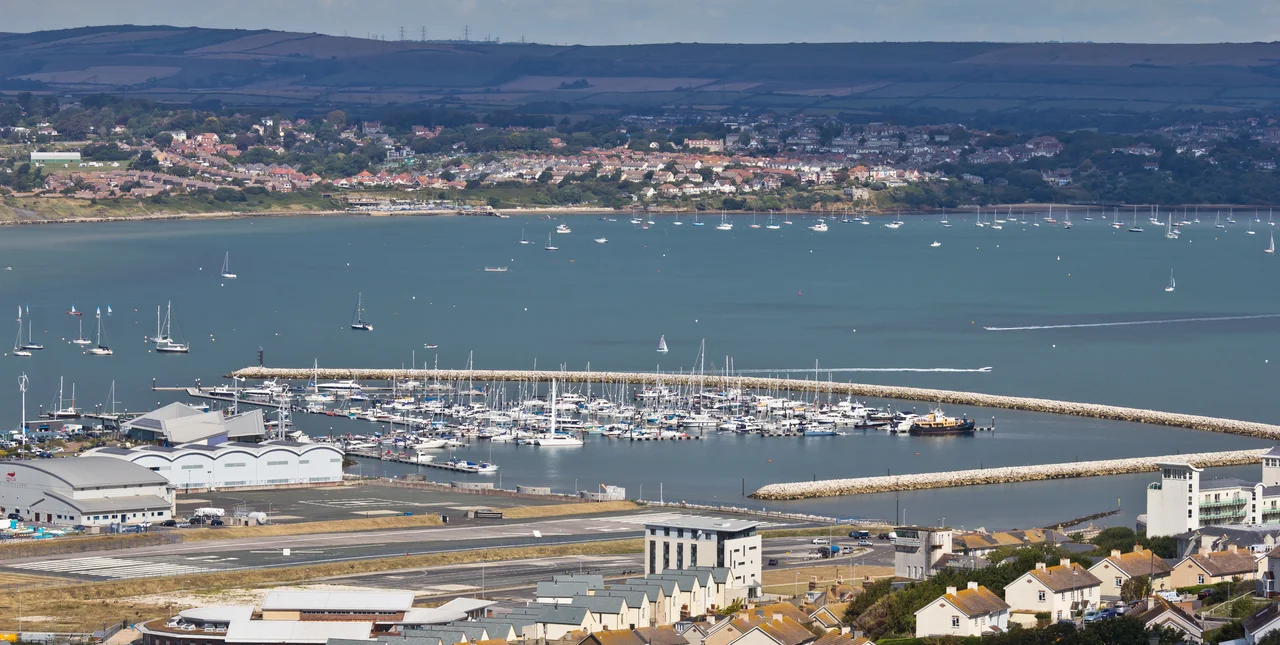

Weymouth and Portland National Sailing Academy
The Royal Yachting Association had been eyeing Portland Harbour for decades. Wind from every direction. Eight and a half square kilometres of sheltered water. Chesil Beach and four Victorian breakwaters keeping the worst of the Channel chop out. There was only one problem: the Royal Navy owned it. When the Navy sailed away for the last time on 21 July 1995 and the harbour was sold the following March, the lock came off. A non-profit company formed in 1999. By 1 April 2000 the Weymouth and Portland National Sailing Academy was open, working out of old naval buildings on Osprey Quay. Five years after that, London 2012 announced where its sailing events would be held.
Why This Water
Sailors talk about Portland Harbour in terms that border on reverence. The 8.6-square-kilometre basin sits open to the prevailing winds but protected from ocean swell - the four breakwaters built by Victorian convicts have been doing their secondary job, calming the racing surface, for a century and a half. Just outside, Weymouth Bay offers deeper water and longer courses. The two together gave the 2012 Olympic regatta what it needed: one course inside the harbour for lighter wind classes, four in the bay for the rest. Sailors flying in from every continent rated the conditions among the best they had ever raced. Reliable breeze, manageable current, and the rare luxury of being able to choose between sheltered and open water depending on what the regatta required.
Building the Clubhouse
For the first five years the academy ran out of converted naval premises. The new clubhouse opened in June 2005, opened by the Princess Royal, paid for with 7.85 million pounds donated by charities, individuals and local councils. It is a working sailing centre, not a yacht club for the leisured classes - the kind of place where Olympic squads train alongside school-age dinghy sailors having their first capsize. Inside, a gymnasium, seven meeting rooms for 260 people, an event hall, a lounge bar and cafeteria for 350. Outside, a 40-metre slipway, two deep-water slipways, thirty pontoons with disabled access, hoists, cranage, dinghy parks. The clubhouse generates 15 to 20 percent of its electricity from solar cells and washes boats with rainwater collected from its own roof.
London Calls
On 6 July 2005, the day London won the 2012 Games, Weymouth went up too. WPNSA had been chosen as the sailing venue. The Olympic Delivery Authority added a new 220-metre slipway accessible at any state of tide or wind, seventy more marina berths, and a dinghy park big enough for 600 boats. There was a logistical worry: 190 kilometres separate Weymouth from the Olympic Zone in central London, and Dorset has no motorway. The Borough Council lobbied the Department for Transport to double-track the line between Moreton and Dorchester South and increase services on the South West Main Line. From December 2007, trains to London Waterloo started running every thirty minutes. The Weymouth Relief Road opened in 2011, taking 84.5 million pounds and the better part of a decade of campaigning.
Two Weeks in 2012
Olympic sailing ran from 29 July to 11 August 2012. Paralympic events followed from 31 August to 5 September. Sailors from every continent fought for thirty Olympic medals and eighteen Paralympic ones across courses laid out in the harbour and the bay. A cruise liner berthed at Portland Port served as the athletes' village - an arrangement made necessary by the lack of nearby hotels and the difficulty of shipping competitors back and forth to London each evening. Britain's sailors had a famously good Games, but the venue itself drew the strongest reviews. Conditions, in the words of more than one Olympic medallist, were as fair and as testing as any in the world. The academy still hosts the British Olympic Sailing Team's training base.
After the Olympics
The medals went home with the sailors, but the infrastructure stayed. Sail for Gold, the RYA Youth National Championships, the J/24 Worlds, the Moth Worlds in 2008, the 2006 ISAF Youth Sailing World Championships, the BUCS Fleet Racing Championships - the calendar fills itself, year after year. Weymouth Speed Week runs every October, drawing windsurfers, kitesurfers and skiff sailors trying to hit raw velocity numbers on a measured course. In October 2021 the academy was announced as host of the 2023 29er World Championships. Local schools run sailing lessons here as extra-curricular activity. A child taking her first dinghy out on these waters is racing on the same lines an Olympic gold medallist crossed in 2012. Few sports venues anywhere maintain that kind of continuity between elite competition and entry-level participation.
From the Air
WPNSA at 50.57045 N, 2.45605 W on Osprey Quay, the northern tip of the Isle of Portland. From altitude the academy shows as a low modern complex on a finger of reclaimed land jutting into the south-west corner of Portland Harbour. The marina lies immediately east of the clubhouse; the breakwaters of Portland Harbour fan out to the north and east; Chesil Beach sweeps away northwest. Nearest controlled airfields are Bournemouth (EGHH) about 50 km east and Exeter (EGTE) roughly 95 km west. Portland Heliport sits a short distance northeast of the academy, so check for active rotary traffic. Recommended cruise 2,500-4,500 ft for a clear view of the harbour layout.
Nearby Stories
- Needles Lighthouse 18 km away
- Lyme Bay Canoeing Disaster 19 km away
- HMS Formidable (1898) 19 km away
- National Motor Museum, Beaulieu 22 km away
- Sherborne Castle 22 km away
- Muchelney Abbey 24 km away
- German Submarine U-672 29 km away
- Battle of Cherbourg (1864) 58 km away