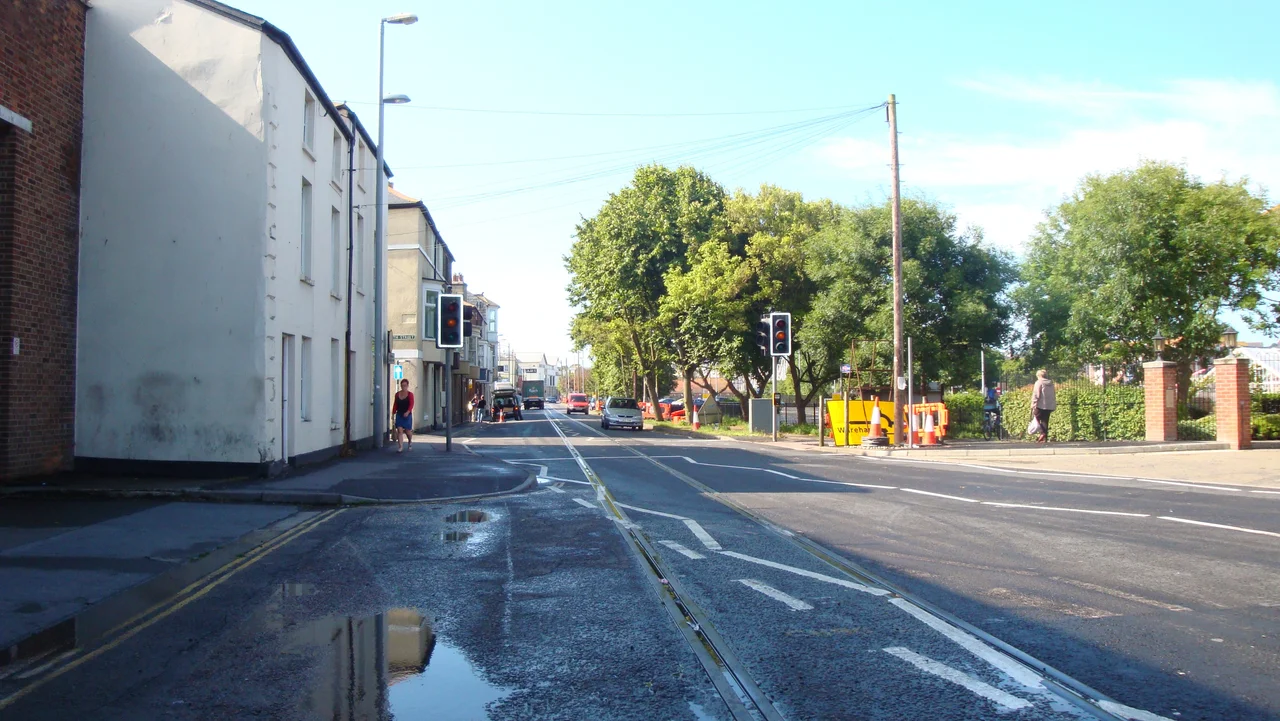

Weymouth Harbour Tramway
Imagine a six-carriage British Rail train, pulled by a Class 33 diesel locomotive, easing slowly down a Dorset shopping street. A railwayman walks ahead waving a red flag, knocking on car windows, asking parked motorists to move out of the way. An amber beacon rotates on top of the locomotive and a bell rings, controlled by a switch in the driver's cab. This was the Weymouth Harbour Tramway, every working day from 1865 to 1987 - a full-size main-line railway that ran through public streets for more than a century, with the train guard physically walking the route ahead of his own train.
Built for the Boats
The Great Western Railway opened the harbour tramway in 1865 to connect Weymouth station with the Channel Islands ferries at Weymouth Quay. Goods came first; the line was built primarily to move freight between mainline trains and waiting ships. Passenger services were added in 1889, and from then until the late 20th century travellers bound for Guernsey or Jersey could board a train at London Paddington and ride right onto the quayside where the ferry waited. The tramway ran from a junction north of Weymouth station, then threaded through the streets adjacent to the Backwater and the inner harbour, to Weymouth Quay station at the end of the line. Sidings and loops grew along the route to serve the businesses crowded along the quay.
Walking the Train
Trains on the tramway needed special handling because the rails crossed roads, ran along streets, and shared space with pedestrians and parked cars. Two warning units were built specifically for the Class 33 locomotives that worked the line: a yellow box that clipped onto the lamp bracket on the cab front, carrying an amber rotating beacon and a bell. A socket on each Class 33/1 and on the matching TC stock drew power from the train. Before any movement down the tramway, the train would halt at the station throat, the warning gear would be fitted and tested, and then the work began. Railway staff walked the train down to the quay carrying red flags, clearing the route. Badly parked cars were a constant problem. On occasion the British Transport Police escorted the convoy. At the quay terminus, the train guard would carry the warning gear to the other end of the train for the return journey.
The Town Bridge
The tramway had to cross the harbour itself at the Town Bridge, and the bridge dictated the geometry of the line. When the bridge was rebuilt in 1930, the tramway initially used its northern arch. Between 1938 and 1939 the tight curve on the south side - the one between the Backwater and the harbour - was replaced with a new curve on a newly-infilled section of quayside, and the tramway was rerouted through the outer arch of the bridge. That alignment held until the end. The track layout at Weymouth Quay grew over the decades from a single track to a double-track arrangement by 1961, then to three tracks, before contracting back to a truncated layout in 1973 when freight traffic was already in steep decline.
The Slow Ending
Regular goods traffic ended in 1972. Fuel oil deliveries to the pier carried on until 1983. Passenger services - the boat trains for the Channel Islands ferries - ran until 1987, when the South West Main Line was electrified with third rail south of Bournemouth. Third rail and street running are incompatible: live conductor rails running through pavements are not a thing the rail safety regulations will permit. Diesel locomotives would have had to be permanently stationed at Weymouth to take over from the electrics, and the operational case collapsed. In September 1996 there were experiments with a flywheel-powered Parry People Mover, but nothing came of them. The very last train ran on 2 May 1999 - a Pathfinder Tours charter, the first train on the line since 1995, and as it turned out the final one.
The Tracks Come Up
Calls to preserve the tramway for heritage tourism ran into hard practical objections: no dedicated right of way, multiple crossings of opposing traffic, no intermediate stations, sleepers unsuitable for heritage railway use, no power supply, no safety infrastructure. A petition campaign in 2014 and 2015 wanted the line reopened to reduce car traffic in town. In 2016 Weymouth and Portland Borough Council bid to have the tramway formally classified as permanently out of use, a status the Office of Road and Rail granted in 2017. The Campaign for Better Transport in 2019 listed the line as priority 2 for potential reopening - meaning it would need new housing developments or a major change in circumstances to justify the cost. In February 2020 the Department for Transport funded removal of the track. The first sleepers came up on 5 October 2020. By 2021 most of the rails were gone. Sections off the carriageway have been left in the cobbles as a quiet kind of memorial, and the junction with the mainline still survives at street level - the end of a connection that no longer goes anywhere.
From the Air
The route of the former Weymouth Harbour Tramway, centred at roughly 50.6147 N, 2.4562 W in Weymouth, Dorset. From altitude the line of the tramway is largely invisible - most of the track has been lifted - but the geometry survives in the street pattern leading from Weymouth station down the western edge of the inner harbour to the Town Bridge, then along the quayside. Look for the rectangular inner harbour of Weymouth and the Backwater immediately west of it. Nearest airfields are Bournemouth (EGHH) about 45 km east and Exeter (EGTE) roughly 90 km west. Recommended cruise 2,000-3,500 ft for a view of the town centre and harbour layout.
Nearby Stories
- Needles Lighthouse 18 km away
- Lyme Bay Canoeing Disaster 19 km away
- HMS Formidable (1898) 19 km away
- National Motor Museum, Beaulieu 22 km away
- Sherborne Castle 22 km away
- Muchelney Abbey 24 km away
- German Submarine U-672 29 km away
- Battle of Cherbourg (1864) 58 km away