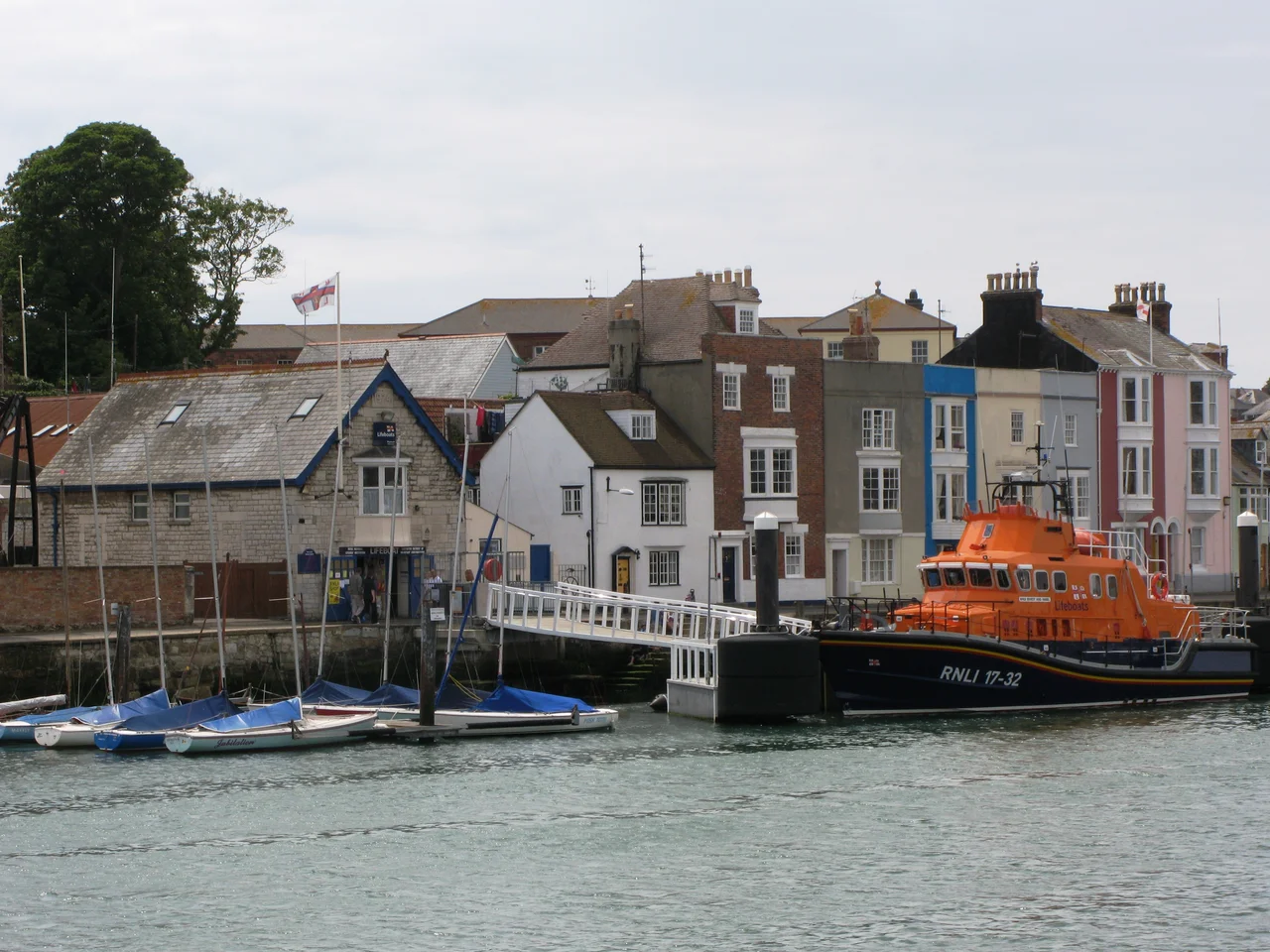

Weymouth Lifeboat Station
Two hours, fifty miles, in good weather. That is the operational promise of the Royal National Lifeboat Institution - any casualty within that range must be reachable in that time. From Weymouth, where the RNLI has been stationed since 26 January 1869, the all-weather lifeboat Ernest and Mabel can range 250 nautical miles at 25 knots. She does not live in the boathouse, because she is too big for it. Instead she rides at moorings in the harbour, reached by a metal bridge and a floating pontoon, ready to slip lines and run for the Channel whenever the radio crackles.
Earl Strafford's Request
The first attempt to base a lifeboat in this corner of Dorset came at Portland in 1826, under the original name of the institution - the Royal National Institution for Preserving Life from Shipwreck, a mouthful that mercifully became the RNLI. The Portland station was withdrawn in 1851 and the coast went unguarded for nearly two decades. In 1868 the Earl of Strafford petitioned the RNLI to base a boat at Weymouth instead. The request was granted, and the new station opened on 26 January 1869. A stone boathouse went up facing the inner harbour, with a slipway running down into the water and a bay-window lookout above the boat doors. The crew watched for distress signals from that window. Some of them still do.
When the Boats Got Too Big
The 1869 boathouse worked perfectly for pulling and sailing lifeboats - boats that men rowed and sailed to the casualty. It was rebuilt in 1921 to take the new generation of motor lifeboats, and the Samuel Oakes arrived in 1924 to make the building's modifications worthwhile. A date stone carved 1924 sits at the top of the gable to commemorate that moment. Then in 1930 the RNLI sent Weymouth a Barnett-class lifeboat, larger and more powerful than anything that had come before. The Barnett would not fit in the boathouse. The crew kept her at moorings out in the harbour - an arrangement that began as a workaround and has continued for nearly a century. The Ernest and Mabel, Weymouth's current 17-32 class all-weather lifeboat on station since 2002, still moors afloat. The 1869 boathouse now serves as crew facilities, kit room and changing space.
The Inshore Lifeboat
Since 1995 the all-weather boat has been supported by a smaller, faster inshore lifeboat - an inflatable B-class designed for closer-in rescues, capsized dinghies, swimmers in trouble, casualties on rocky shores where the deeper-draught all-weather boat cannot go. The ILB lives in its own boathouse, built in 1996 nearer the harbour entrance. The building is long and low, opening immediately onto a wide concrete slipway, and the boat is pushed out on a carriage when the call comes in. The current ILB is the Jack and Phyl Cleare, on station since 2021 - the same boat names appearing again as new vessels arrive, a quiet RNLI tradition that honours the donors who paid for the boats decades or generations earlier.
Where the Boat Goes
Weymouth's area of operation interlocks with neighbouring stations - Swanage to the east, Lyme Regis to the west, and the inshore lifeboat at Exmouth filling the western gap. The Channel here is not a quiet stretch of water. The Shambles sandbank lies three miles east of Portland Bill, breaking ships since records have been kept. The Portland Race - a tidal disturbance off the Bill where currents from either side of the island meet at speed - throws up steep, confused seas that have killed small-boat sailors who underestimated it. To the south, deep-water shipping lanes thread through the western approaches to the Channel, where freighters and ferries push through fog at speeds that leave little room for error. The crew at Weymouth answer the call for any of it.
The People in the Boats
Every RNLI crew in Britain is made up of volunteers. The coxswain who takes Ernest and Mabel out of Weymouth harbour at three in the morning is the same person who fitted your boiler or taught your children that day. The pager goes off and they leave whatever they are doing - a meal, a meeting, sometimes the sleep they desperately need - and they head for the harbour. The station has handed out medals and awards over its 156 years, but the daily work is quieter than that. Most launches end with someone brought home safely, or sometimes with the recovery of someone who was beyond saving by the time the call came in. The crew remembers both. The bay window above the boat doors still looks out at the same water. The lifeboat still rides at her moorings, waiting.
From the Air
Weymouth Lifeboat Station at 50.6071 N, 2.4508 W on the inner harbour at Weymouth, Dorset. The 1869 boathouse sits on the south side of the inner harbour with the all-weather lifeboat Ernest and Mabel moored at a floating pontoon opposite. The 1996 inshore lifeboat boathouse is closer to the harbour entrance, where the inner harbour opens into Weymouth Bay. From altitude the harbour shows as a rectangular basin opening east into the bay; the lifeboat station occupies the south quay. Nearest airfields: Bournemouth (EGHH) about 45 km east, Exeter (EGTE) roughly 90 km west. Recommended cruise 2,000-3,500 ft for a view of the harbour entrance and bay.
Nearby Stories
- Needles Lighthouse 18 km away
- Lyme Bay Canoeing Disaster 19 km away
- HMS Formidable (1898) 19 km away
- National Motor Museum, Beaulieu 22 km away
- Sherborne Castle 22 km away
- Muchelney Abbey 24 km away
- German Submarine U-672 29 km away
- Battle of Cherbourg (1864) 58 km away