
White Swan Hotel
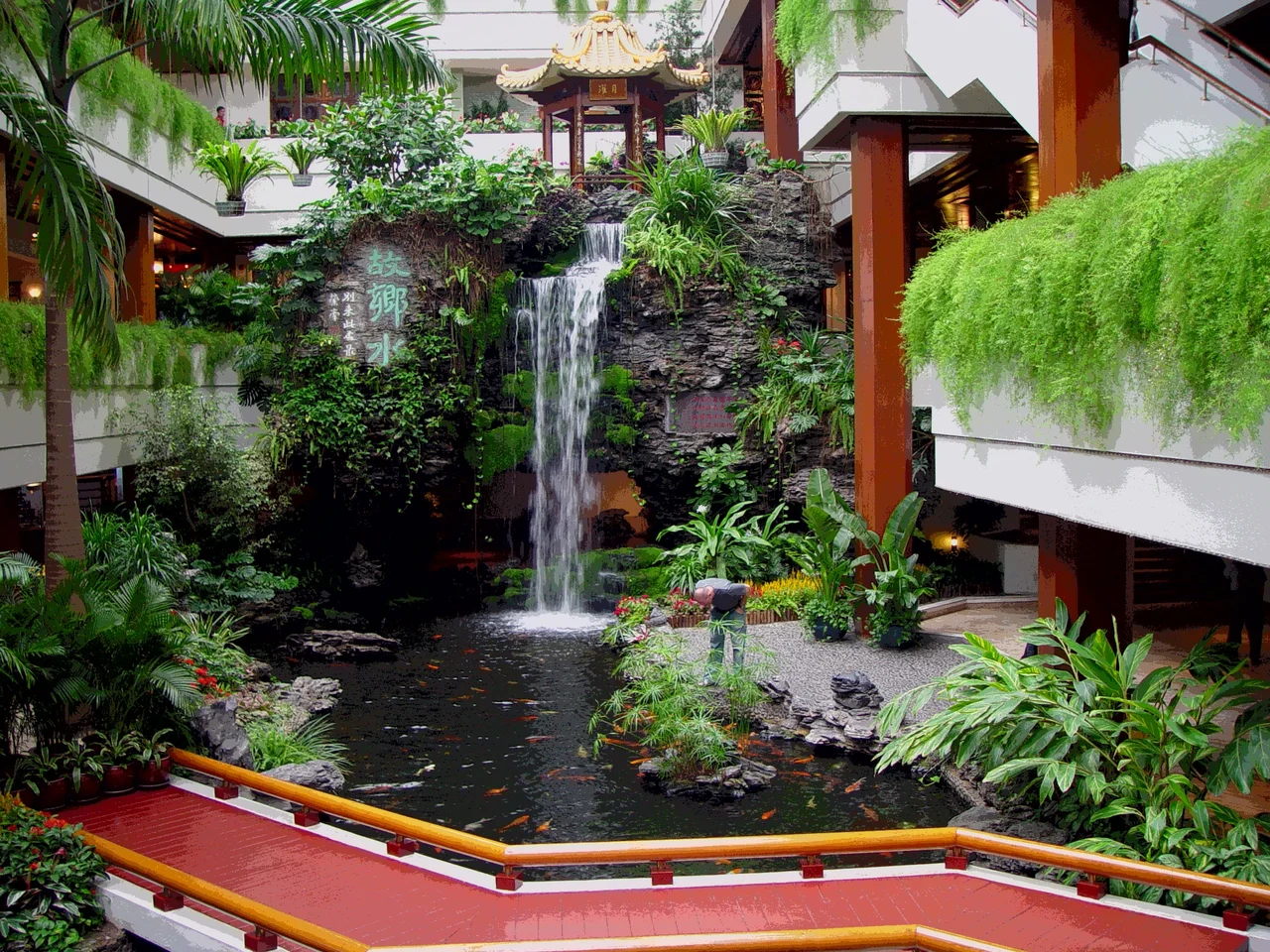
For decades, families arriving at the White Swan Hotel in Guangzhou had come from the other side of the world to complete paperwork. American couples waited in the hotel's lobby with children newly adopted from Chinese orphanages, filling out visa forms while a waterfall cascaded through the atrium and the Pearl River glittered outside. The hotel's role as the gathering point for international adoptions from China — a bureaucratic necessity that became an emotional landmark — is one of the more unexpected chapters in the story of a building that was already carrying several unusual ones.
Shamian Island and the Weight of History
The White Swan Hotel stands on Shamian Island, a narrow sandbank in the Pearl River that served as Guangzhou's foreign concession during the colonial era. British and French merchants lived here from the mid-nineteenth century onward, separated from the rest of Canton by small bridges that closed at night. The island's European-style buildings — banks, consulates, churches — survive largely intact, their neoclassical facades incongruous in the subtropical heat.
It was into this layered setting that Hong Kong businessman Fok Ying-tung built the White Swan, which opened on February 6, 1983. The 28-story tower was China's first large-scale joint-venture luxury hotel, rising above the colonial architecture of the island and facing the Pearl River across the White Swan Pool. A private 635-meter causeway connects it to the mainland. The combination of imperial-era treaty-port geography and post-Mao economic opening concentrated into a single address on Shamian Island produces a building with more history per square meter than most cities manage per block.
A Guest List That Reads Like a History Textbook
The White Swan's famous guests list spans the full range of twentieth-century power. Queen Elizabeth II stayed here, as did Deng Xiaoping, Margaret Thatcher, Richard Nixon, George H. W. Bush, Fidel Castro, and Kim Jong-il — figures whose presence in the same building underscores just how central Guangzhou remained to Chinese foreign relations during the reform era. Lee Kuan Yew came. Henry Kissinger came. Helmut Kohl, Norodom Sihanouk, and King Carl XVI Gustaf of Sweden all passed through.
The hotel became a member of The Leading Hotels of the World in 1985 — just two years after opening — and received a five-star rating from the Chinese government in February 1990. For foreign visitors arriving in a China that was still cautiously opening, the White Swan offered the particular comfort of reliable luxury in unfamiliar territory. Guangzhou, as China's southern trading gateway, had always been the city where outsiders entered first. The White Swan formalized that role in marble and glass.
Cantonese Cuisine and the Jade River Restaurant
The hotel's Jade River Restaurant has become one of Guangzhou's recognized culinary destinations in its own right. Decorated in garden style — plants, natural light, the sense of being outdoors while remaining sheltered — it serves Cantonese cuisine and has earned a Michelin star. That recognition places it in a tradition of serious Guangdong cooking that stretches back centuries: dim sum, roast meats, seafood prepared with the precision and restraint that distinguish Cantonese cooking from the bolder flavors of other Chinese regional cuisines.
Eating at the Jade River is, in a small way, participating in one of Guangzhou's oldest roles. The city has been feeding outsiders since the Arab and Persian merchants arrived by sea during the Tang dynasty. The Portuguese came in the sixteenth century. The British trading houses of the colonial era maintained entire culinary departments. The White Swan's Michelin-starred restaurant is the current expression of a city that has been practicing hospitality to foreigners for over a thousand years.
Renovation, Return, and the Adoption Corridor
The White Swan closed in the early 2010s for a major renovation, reopening on July 15, 2015. The hotel had by then passed from private operation to state management under China's Ministry of Natural Resources (formerly the Ministry of Land and Resources). The renovation preserved the landmark atrium waterfall that guests had photographed for decades.
The role the hotel played during China's international adoption era — roughly 1992 through the mid-2000s, when China processed thousands of international adoptions annually and Guangzhou was a required visa stop — generated its own literature. A children's book was written about the experience. Families who returned to Guangzhou years later with their now-grown daughters often came back to Shamian Island, standing in the same lobby, retracing the days when the hotel held them in a kind of loving suspension between leaving China and starting home. The White Swan didn't ask to be that place. It simply happened to be there, on its island in the Pearl River, as so many chapters of modern China played out around it.
From the Air
The White Swan Hotel sits on Shamian Island at approximately 23.109°N, 113.237°E, in the Pearl River southwest of central Guangzhou. From the air, Shamian is easily visible as a slim, tree-lined island connected by bridges to the Liwan district north bank. The Pearl River here splits around several islands before rejoining south of the city. ZGGG (Guangzhou Baiyun International Airport) lies about 20 kilometers north; a visual approach from the north at 2,000–3,000 feet reveals the full geography of the Pearl River system, the Canton Tower marking the east end of the waterfront, and the compact green oval of Shamian Island tucked against the north bank. The 28-story hotel tower is one of the taller structures on the island's western end.
Nearby Stories
- Shunde 12 km away
- 2015 Shenzhen Landslide 15 km away
- Mount Luofu 23 km away
- Qingyuan Maglev Tourist Line 32 km away
- Kaiping 56 km away
- Heyuan 90 km away
- Chikan, Kaiping 92 km away
- Erlitou Site Museum of the Xia Capital 1257 km away