.jpg)
Wimbledon Championships
On 19 July 1877, in front of about two hundred spectators who had each paid a shilling, an Old Harrovian rackets player named Spencer Gore defeated William Marshall 6-1, 6-2, 6-4 in 48 minutes. The prize was a silver challenge cup worth twenty-five guineas, donated by the sports magazine The Field, and twelve guineas in cash. The match was the final of the inaugural Wimbledon Championship, held by the All England Croquet and Lawn Tennis Club to raise money for a broken-down pony roller. It was the world's first lawn tennis tournament. A hundred and forty-eight years later, the Championships remain the oldest, the most prestigious, and the only Grand Slam still played on its founding surface.
Croquet, a Pony Roller, and a New Game
The All England Croquet Club was founded on 23 July 1868 on Nursery Road off Worple Road in Wimbledon. Eight years later, in 1876, lawn tennis - then a new outdoor game devised by Major Walter Clopton Wingfield with the unwieldy original name Sphairistike - was added to the club's activities. By spring 1877 the club had renamed itself the All England Croquet and Lawn Tennis Club, drawn up a new code of laws that became the basis of the modern rules, and held its first Championship. The principal court was placed in the middle of the lawns with the others arranged around it. They called it Centre Court. The name stuck even when, in 1922, the club moved to its current Church Road site half a mile away, where Centre Court was no longer in the middle of anything at all. The new ground cost about £140,000 and seemed a financial gamble. The old Worple Road ground became the Wimbledon High School playing field, which it remains.
Forty-Eight Hours of Suffragette Plans
Wimbledon's history holds one almost-disaster that the records preserve carefully. On the night of 27 February 1913, in the middle of the suffragette bombing and arson campaign, a groundsman spotted a woman climbing over a hedge into the All England Club at around midnight. She was arrested, described as 'between the ages of 30 and 35,' and found to be carrying paraffin and wood shavings. She had come to set the grounds alight. The First World War interrupted the tournament between 1915 and 1918. The Second World War interrupted it again from 1940 to 1945, and on 11 October 1940 a German bomb destroyed a corner of the Centre Court competitors' stand, removing 1,200 seats. The championships resumed in 1946 amid the damage, with full restoration taking until 1949. In 2020, for the first time since the war, the tournament was cancelled altogether - this time by the COVID-19 pandemic, an event covered by an annual insurance premium the club had been paying since 2003 as a precaution after the SARS outbreak.
Strawberries, Whites, and Royalty
Wimbledon traditions are precise. Players wear white - a rule formally enforced in 1963, although the convention is older. In 2023, after years of complaint from female players, the rule was modified to permit non-white undershorts for women during their menstrual cycles, 'provided they are no longer than their shorts or skirt.' Spectators eat strawberries and cream, allegedly because of Cardinal Wolsey's cook serving them to Henry VIII at Hampton Court six miles up the river. In 2019 the tournament served 191,930 portions of them. Slazenger has supplied the official tennis balls every year since 1902 - the longest-running sponsorship in sports history. Royal patronage runs deep: until 2003 players bowed or curtsied to any royal in the Royal Box on entering or leaving Centre Court. Prince Edward, Duke of Kent, then president of the club, discontinued the convention. The bow is now reserved for the monarch and Prince of Wales.
Famine, and Then Murray
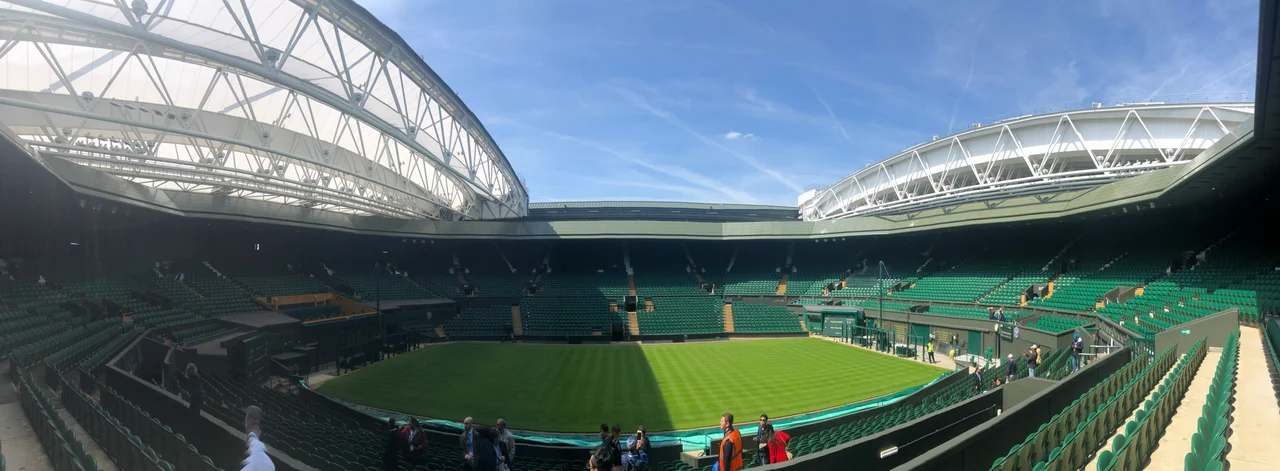
British tennis at Wimbledon went through one of the great competitive droughts of any major sport. Fred Perry won the men's singles in 1936. No British man won again until Andy Murray in 2013 - a 77-year wait. Virginia Wade won the women's singles in 1977 and remains, as of 2025, the last British woman to do so. Wimbledon's Centre Court got a retractable roof in 2009 - the first match completed under it was a women's fourth-round match between Dinara Safina and Amelie Mauresmo on 29 June. The same evening, Andy Murray beat Stanislas Wawrinka in the first complete match played under the closed roof. In 2012 Murray played the latest finish in the tournament's history, beating Marcos Baghdatis at 11:02 pm. The 11 pm curfew was a planning condition imposed by Merton Council when the roof was built, to protect local residents. Other Slams play through the night; Wimbledon does not.
Henman Hill, Hawk-Eye, and the End of the Line Judges
Outside the show courts, on a grassy slope below a giant television screen at the northern end of the grounds, sits the area officially called Aorangi Terrace. The press call it Henman Hill, after Tim Henman, and have intermittently tried Murray Mound, but Henman Hill remains the name that has stuck. In 2007 Hawk-Eye electronic line-calling arrived as a player challenge system. In 2025 it took over entirely. For the first time in 147 years, there were no line judges at Wimbledon - the chair umpire and the automated system between them ran the calls, ending one of the longest-running visual traditions in any sport. The 2025 championships also produced a small British triumph in the historical ledger: Julian Cash and Lloyd Glasspool became the first all-British men's doubles champions since 1936. The next championships, the 140th edition, will run from 29 June to 12 July 2026.
From the Air
The All England Lawn Tennis Club lies at 51.4344 N, 0.2144 W in Wimbledon, southwest London, in the London Borough of Merton. View from 2,000-3,000 ft AGL to see the distinctive ring of show courts and the practice grounds in Aorangi Park. Nearest airports: London Heathrow (EGLL) 9 nm northwest, Biggin Hill (EGKB) 9 nm southeast. Note Heathrow's controlled airspace; the club sits well inside the London TMA.
Nearby Stories
- Battle of Britain, Northfleet 1.1 km away
- Bayham Old Abbey 5.4 km away
- Catharine Macaulay 6.4 km away
- Hatfield rail crash 8.8 km away
- Chequers 8.9 km away
- Chelmsford Cathedral 10 km away
- Queen Victoria Hospital 13 km away
- Fishbourne Roman Palace 36 km away