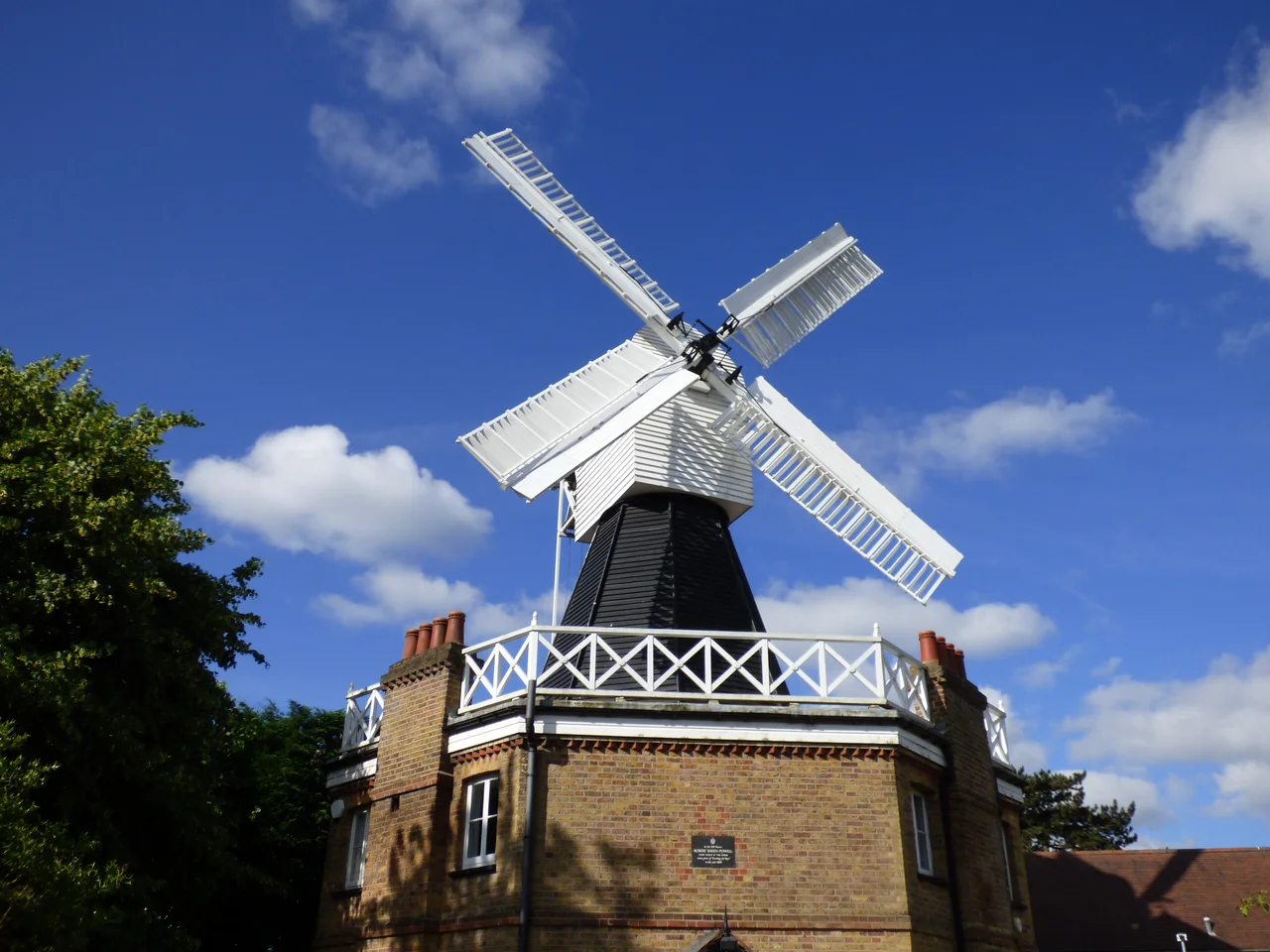

Wimbledon Windmill
John Watney's request to build a windmill on Wimbledon Common was turned down in 1799 because he could not be bothered to produce the plans. Sixteen years later, a Roehampton carpenter named Charles March tried again, with proper drawings this time, and got his permission. The mill that went up in 1817 has been milling, ceasing to mill, decaying, restored, recamouflaged for war, restored again, and finally turned into a small but stubborn museum - all while standing on the same patch of windswept common land for more than two hundred years.
An Unusual Design Choice
March chose a hollow post mill, an uncommon design even at the time. In a hollow post mill the entire upper structure rotates on a single central post, and the drive shaft running down to the millstones passes through the hollow centre of that post. It is an elegant trick, but a fragile one - if water gets in, the post rots, and rotting posts in a windmill are not a small problem. By 1864 the mill had stopped working. The miller had been evicted by the Lord of the Manor, Earl Spencer, who wanted to enclose the common for himself. The miller responded by ripping out most of the machinery so that nobody else could use the building to compete with his other mills at Kingston. What remained was bricked up as living quarters and left to brood.
The Common Fights Back
Earl Spencer's enclosure scheme did not go down well with the locals. They organised, lobbied, and pushed the Wimbledon and Putney Commons Act through Parliament in 1871, wresting the common away from aristocratic appetite and placing it under elected and appointed conservators. The mill, by then in poor shape, became their problem. In 1892 the conservators sought tenders for repair. Messrs Sanderson and Sons of Louth, Lincolnshire, won the work for £240. The Royal Wimbledon Golf Club, perhaps wishing to keep the view across their fairways picturesque, contributed £50. When the Sandersons opened up the structure they found the main post and crosstrees rotten through, and proposed converting the whole thing to a smock mill - an octagonal wooden tower on a brick base, the post no longer load-bearing. The job came in at £350. The new sails turned in November 1893.
The War and the Quiet Years
During the Second World War the mill was painted drab green to make it less visible from the air, and one of its sails was removed to break up its silhouette. Army camps had been pitched on Wimbledon Common and the mill was a navigation landmark too useful to enemy bombers. The camouflage came off after 1945, but the gearing was so worn that the sails were stopped for good in 1946. A public appeal in 1954 raised enough to restore the mill, and on 25 May 1957 the sails turned once more. Another restoration followed in 1975, and the building reopened as a museum. A Heritage Lottery Fund grant in 1999 restored the patent sails to working order, until a sail collapsed in 2015 - the cause was eventually traced to long-term water seepage, the same enemy that had taken out the original post in 1864. The sails were rebuilt in 2016.
Inside the Octagon
Today the windmill rises from a two-storey brick octagon, with a conical wooden tower above housing the mechanism the Sandersons installed. The cast-iron windshaft turns four double patent sails, automatic shutters that open and close with the wind. A six-foot brake wheel with about sixty wooden cogs once drove the wallower, then the upright shaft, then the spur wheel that turned the millstones on the floor above. A fantail - a small wheel at the back - keeps the cap pointing into the wind without anyone needing to lift a finger. Visitors can wander through the museum at weekends and bank holidays from March to October. There are push-button models, grain to grind by hand, and the chance to stand inside a working windmill and feel the small thunder when the brake comes off.
Cameos and Cuckoos
The mill has had its moments on screen. It appears in the 1952 British film Hammer the Toff and turns up briefly in Hoffman, the strange 1970 Peter Sellers picture in which Sellers plays a creepy office-worker holding a young woman hostage. The mill is just there in the background, doing what windmills do, being old and dignified and unbothered by celebrity. It sits between open grassland and beech woods, with a small cafe nearby and dog-walkers tramping past in every season. From the air the common reads as a green wedge driven into south-west London; the mill is the bright punctuation mark in the middle of it. From the ground, with its sails turning in a light breeze, it is the rare London landmark that has lasted because the locals refused to let it go.
From the Air
Located at 51.438 N, 0.232 W on Wimbledon Common in the London Borough of Merton. From altitude, look for the broad green wedge of the Common against the dense fabric of south-west London; the mill stands on the open western section with the V-shaped pond and woodland to its south. Nearest airports: London Heathrow (EGLL) approximately 8 nautical miles west; London City (EGLC) approximately 13 nautical miles east-north-east. Best viewed at 2,500 to 4,000 feet.
Nearby Stories
- Battle of Britain, Northfleet 1.1 km away
- Bayham Old Abbey 5.4 km away
- Catharine Macaulay 6.4 km away
- Hatfield rail crash 8.8 km away
- Chequers 8.9 km away
- Chelmsford Cathedral 10 km away
- Queen Victoria Hospital 13 km away
- Fishbourne Roman Palace 36 km away