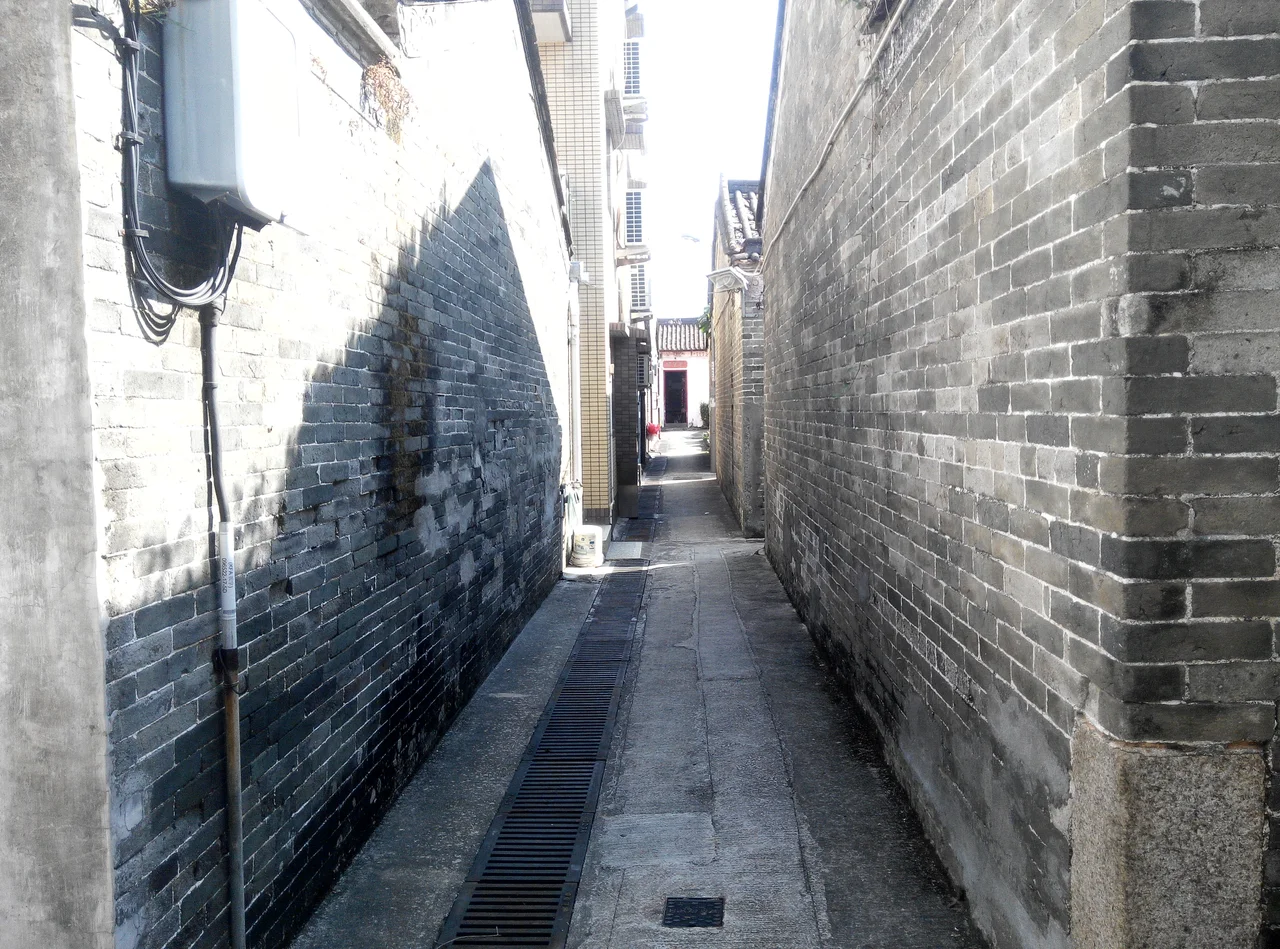

Wing Lung Wai
The entrance gate of Wing Lung Wai does not face the direction you might expect. When the neighbouring village of Tai Hong Wai was established nearby, the elders of Wing Lung Wai consulted the principles of feng shui and concluded that the gate needed to move — so they relocated it to the south, breaking the classical central-axis symmetry that most walled villages maintain. It is a small detail, but it says something important about how these communities operated: every feature of the village, from the alignment of the gate to the placement of the shrine, was understood as a living arrangement subject to change. Wing Lung Wai has been adapting since the Tang Clan first settled here in the 1400s, and it is adapting still.
The Tang Clan's Foothold
Wing Lung Wai was founded by Tang Siu-kui and his clansmen during the Chenghua reign of the Ming dynasty — that is, sometime between 1465 and 1487. The village originally went by the name Sha Lan Mei, a name it held for centuries before the present name was formalised in 1905. Three other walled villages sit nearby — Kat Hing Wai, Tai Hong Wai, and Kam Hing Wai — all built around the same period, making the Kam Tin area one of the densest concentrations of Tang Clan settlement in Hong Kong. The Tang were Punti people, among the first Chinese settlers to establish themselves in what is now the New Territories, and their walled villages represent the physical expression of that early claim on the land.
Walls Built for a Dangerous Age
The enclosing wall that gives Wing Lung Wai its defining character was added later than the village itself — built during the Kangxi reign of the Qing dynasty, between 1661 and 1722, to protect the settlement from bandits, pirates, and rival enemies. By the time the wall went up, the Tang Clan had already been in Kam Tin for two centuries; they were defending an established community, not a new one. The fortifications served their purpose well enough that the village survived the turbulent centuries of the late Qing period intact. The moat that once surrounded the walls was reclaimed — filled in and built over — in the 1960s, a practical concession to modernisation that many Hong Kong villages made around the same time.
The Ancestral Hall and the Study Hall
Inside the walls, the most significant surviving structure aside from the gate is Kang Sam Tong, an ancestral hall built in the 1880s. Ancestral halls in Chinese villages are not simply places of worship — they are the institutional heart of clan life, where genealogies are kept, major decisions are made, and the connection between living members and their forebears is ritually maintained. Kang Sam Tong served a second function as a study hall until 1926, providing education for the village's children within the same walls that housed the clan's memorial tablets. That dual purpose — honoring the ancestors while preparing the next generation — captures something essential about how these walled villages understood themselves: as projects extending across time, not just across space.
What Remains
The watchtowers that once guarded Wing Lung Wai's corners are gone, though the base of the northeast tower survives as a low remnant in the ground. The Chung Shing Temple still stands at the end of the village's central axis — the traditional position for a village shrine, where the spiritual anchor of the community faces the entrance gate. The Antiquities Advisory Board has documented and assessed the entrance gate, the Chung Shing Temple, and Kang Sam Tong, recognising their historical significance in the broader catalogue of Hong Kong's built heritage. Wing Lung Wai remains a recognised village under the New Territories Small House Policy, meaning the Tang descendants who live here today retain legal continuity with the people who first raised these walls more than five centuries ago.
From the Air
Wing Lung Wai lies in the Kam Tin valley of Yuen Long District at approximately 22.44°N, 114.07°E, in the flat agricultural plain north of the main Kowloon ridge. VHHH (Hong Kong International Airport) is the nearest major airport, about 12 km to the southwest on Lantau Island. On approach or departure over the New Territories, the Kam Tin area is visible as a patchwork of low-density settlement and farmland between the hills of Tai Mo Shan to the east and the border with Shenzhen to the north. The rectangular walled enclosure of Wing Lung Wai and its neighbours can be distinguished from the air by their compact, gridded layouts standing distinct from surrounding development at around 3,000 feet.
Nearby Stories
- Chapel of St. Francis Xavier 3.5 km away
- Cuiheng 4.1 km away
- 2015 Shenzhen Landslide 16 km away
- Shunde 31 km away
- Wanshan Archipelago 37 km away
- Nanxiong Formation 96 km away
- Heyuan 149 km away
- Checheng Fu'an Temple 629 km away