.jpg)
Winston-Salem, North Carolina
Two towns, hyphenated. Salem was a Moravian congregational settlement founded in 1766 - die Wachau, Latinized to Wachovia, named for the Danube valley estate of Count Zinzendorf. Winston was its rough neighbor to the north, founded in 1849 as a Forsyth County seat and renamed in 1852 for the Revolutionary War officer Joseph Winston. The Moravians built churches and choirs and laid their dead in God's Acre under flat stones. The Winstonians built tobacco factories. In 1875 a trader named R.J. Reynolds opened a chewing-tobacco plant in Winston. By the 1880s the post office was already writing both names on its mail. In 1913, after a referendum, the two towns officially became Winston-Salem - the Camel City, the Twin City, the place where Moravian piety and tobacco money learned to share a hyphen.
Camel City
By the 1940s, sixty percent of Winston-Salem worked either for R.J. Reynolds or for the Hanes textile mills. Reynolds imported so much Turkish tobacco and French cigarette paper for Camel cigarettes that the federal government designated the city an official port of entry - 200 miles inland from the ocean. The Reynolds Building went up downtown in 1929, a 314-foot Art Deco skyscraper designed by William F. Lamb of Shreve, Lamb and Harmon. It was the tallest building in the American South. Lamb's firm liked the design so much that they used it as the prototype for the Empire State Building two years later. The R.J. Reynolds Tobacco Company is still based in Winston-Salem, though its workforce has fallen from a peak of nearly 30,000 to under 3,000. Hanes - which started in 1900 as P.H. Hanes Knitting Company making men's underwear - became Hanesbrands and is still headquartered here, as is Lowes Foods, Quality Oil, and the makers of Texas Pete hot sauce.
Mary Ellen and the Whole Town
Steve Earle wrote a song called Mary Ellen and Rick about a Winston-Salem couple - Earle has lived a lot of places, and Winston-Salem sticks with people. Other artists have left their marks too. R.E.M. recorded Chronic Town here in 1981 at Mitch Easter's Drive-In Studio in his parents' garage; Easter, the frontman of Let's Active and close collaborator of The dB's, kept the studio running until 1994 and helped define an entire era of North Carolina indie rock. Suzanne Vega, Pylon, Game Theory and The Connells all recorded there too. The Ramones, R.E.M., Guns N' Roses and Blue Oyster Cult all played at Baity's Backstreet Music Garden, a venue founded in 1982 on Baity Street that burned down in 1993. Krispy Kreme opened its first shop on South Main Street in 1937. The first arts council in the United States was founded here in 1949. In 2014 the city officially adopted the nickname City of Arts and Innovation.
Old Salem Still Standing
Walk south from downtown and the present runs out. The brick streets and dormered houses of Old Salem look the way Salem looked in the 1770s because seventy percent of the buildings are original. The cobbled square is still Salem Square. The Single Brothers House still stands. God's Acre, the Moravian cemetery, has hosted the Easter sunrise service every year since 1772 - thousands gather before dawn, some traveling from overseas, to hear brass bands play the chorales and watch the sun come up over a graveyard where the dead are arranged not by family but by choir. Bethabara Historic District, where the first Moravians arrived in November 1753, sits within the city limits on 195 acres of preserved fields, mill, and stockade site. The Moravian star - that intricate twenty-six-point ornament - is Winston-Salem's official Christmas decoration. A thirty-one-foot Moravian star, one of the largest in the world, sits atop the north tower of Wake Forest Baptist Medical Center every Advent.
Innovation Quarter
The east end of downtown used to be Reynolds tobacco-processing plants. Now it is the Wake Forest Innovation Quarter, anchored by 1.9 million square feet of biotech labs, university offices, and apartments built in old factory shells. Ninety companies. 3,600 workers. 1,800 students. The Wake Forest School of Medicine runs it. Wake Forest itself moved here from Wake County in 1956 on a check from the Babcock family - Mary Reynolds Babcock was R.J. Reynolds's daughter, and she gave the school 330 acres of the Reynolda estate. Winston-Salem State University, an HBCU founded in 1892 by Simon Green Atkins as Slater Industrial Academy, sits on the east side. The University of North Carolina School of the Arts, the first public arts conservatory in the United States, sits south of downtown. Six colleges, 250,000 people, a tobacco fortune that quietly pivoted into biotech and university endowments. The fifth-largest city in North Carolina, still hyphenated, still Camel City, still City of Arts and Innovation - all of it true at once.
From the Air
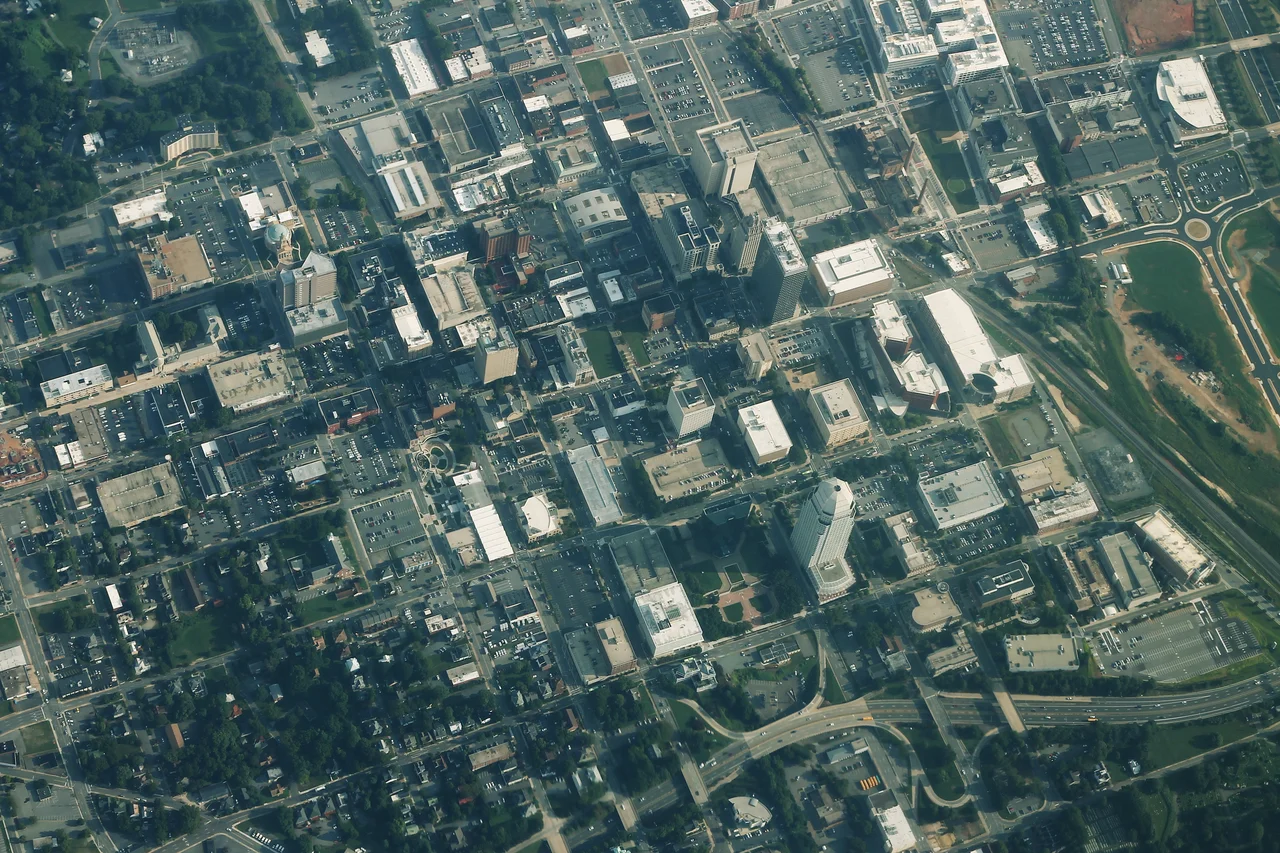
Winston-Salem sits at 36.10 degrees N, 80.24 degrees W in the northwest Piedmont of North Carolina, 65 miles northwest of the geographic center of the state. Elevation around 970 feet. Major landmarks visible from the air: the Reynolds Building downtown (314 feet, the Empire State prototype), Wait Chapel's bell tower at Wake Forest 2.5 miles north of downtown, the Lawrence Joel Coliseum near University Parkway, and the brick grid of Old Salem just south of Salem Parkway. Nearest airports: Smith Reynolds (KINT) 3 nm northeast; Piedmont Triad International (KGSO) 17 nm east in Greensboro. Recommended viewing altitude 3,000-4,500 feet AGL. The city is 25 miles west of Greensboro and 69 miles northeast of Charlotte.
Nearby Stories
- Battle of Wetzell's Mill 5 km away
- Hanging Rock State Park 5.9 km away
- Mebane's Bridge 11 km away
- 2025 North Carolina Cessna Citation II Crash 13 km away
- Wil-Cox Bridge 16 km away
- North Wilkesboro Speedway 19 km away
- Galax, Virginia 31 km away
- Deep River Camelback Truss Bridge 60 km away