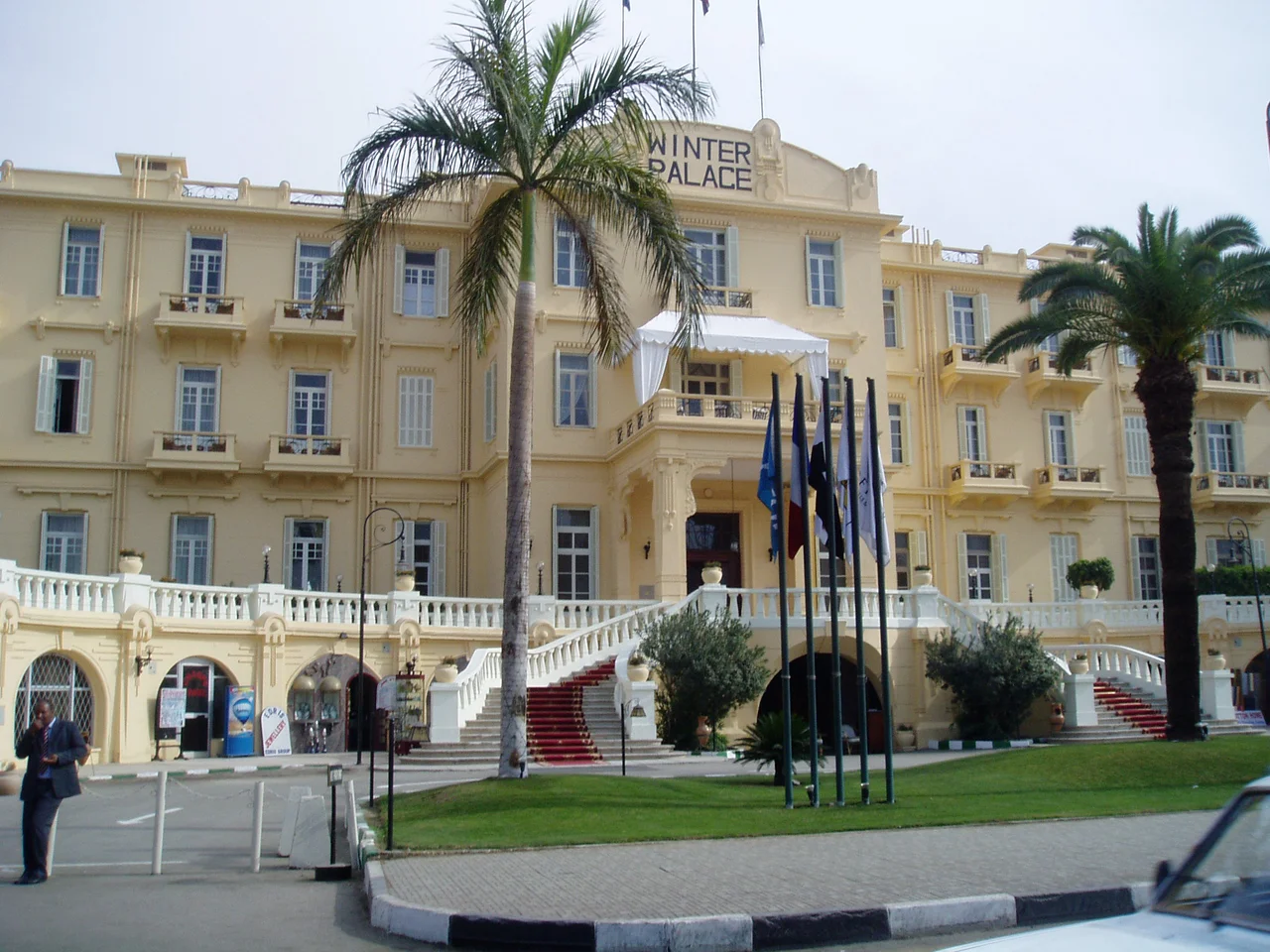

Winter Palace Hotel
In the winter of 1922 and 1923, the crowd outside a Luxor hotel learned the news the way everyone did that season: from a noticeboard. Howard Carter, the archaeologist who had just opened the tomb of Tutankhamun, used the board at the Winter Palace to dole out his bulletins to the press and the curious. The world's reporters had decamped to its terrace, cabling dispatches back to London and New York between drinks. The hotel had been built for exactly this kind of moment - a stage for the great age of Nile tourism - though no one in 1907 could have guessed its noticeboard would carry the most famous archaeological announcement in history.
Built for the Season
The hotel opened on a Saturday in January 1907, and its name tells you who it was for. Wealthy Europeans came to Upper Egypt to escape their own winters, and they wanted a palace to come back to after a day among the tombs. The Upper Egypt Hotels Company - founded in 1905 by the Cairo hoteliers Charles Baehler and George Nungovich in partnership with the travel firm Thomas Cook & Son - built it on the east bank of the Nile, just south of Luxor Temple. The opening was a production in itself: a picnic out at the Valley of the Kings, then dinner and speeches back at the hotel. Designed in the Belle Epoque style of its era, the Winter Palace set the standard for a particular kind of grand colonial-era comfort - high ceilings, a sweeping staircase, gardens running down toward the river.
Carter's Patron and Carter's Noticeboard
From its first season, one guest mattered more than the rest to history. George Herbert, the fifth Earl of Carnarvon, came to Luxor for his health and stayed for the antiquities, and he became the patron who financed Howard Carter's long, patient search for an undisturbed royal tomb. In November 1922 that search ended: Carter found the intact tomb of Tutankhamun, the boy king who had ruled more than three thousand years before. The Winter Palace became the discovery's unofficial headquarters. The international press corps filled its rooms; foreign visitors crowded its terrace hoping for a glimpse of the excavation. And Carter, besieged by questions, posted his updates on the hotel noticeboard - the slow, public drip of one of the twentieth century's great stories.
The Guests Who Came After
Carnarvon was not the only famous name to walk the gardens. Albert I, King of the Belgians, and his wife Queen Elisabeth stayed at the Winter Palace more than once - Albert was a serious mountaineer and a king who preferred quiet travel to ceremony. The crime writer Agatha Christie knew this stretch of the Nile well and is said to have worked on Death on the Nile, her 1937 mystery, during her time in Egypt; in 2004 the hotel stood in as a filming location for the television adaptation. Generations of travelers, royal and otherwise, passed through a building that had become shorthand for a certain romance of Egypt - the steamer at the dock, the dust of the west bank, the long cool evening on the terrace.
Still on the Corniche
More than a century on, the Winter Palace is still here, and still working. The original Palace wing - the historic core, with 86 rooms and a handful of suites - was joined in 1996 by a garden annex, the Pavillon, sharing the pools, tennis courts, and terraces. A 1970s addition called the New Winter Palace was demolished in 2008, leaving the old building to stand on its own dignity. The hotel changed hands as Egypt restructured its state-owned landmarks: long managed under the French Accor group's Sofitel brand, it became part of a 2023 deal that brought private Egyptian ownership - Talaat Moustafa Group - into its grand old rooms. In May 2026 it transitioned to Mandarin Oriental management, with a full restoration planned before it reopens under the Mandarin Oriental name in 2027. The Nile still slides past the front steps. The terrace still faces the sunset over the west bank, where the kings and queens have lain since long before anyone thought to build a palace for the living.
From the Air
The Winter Palace Hotel stands at 25.697°N, 32.637°E, on the east-bank corniche of the Nile in central Luxor, just south of the columns of Luxor Temple. From the air it reads as a large pale block fronting the river within the dense city grid, the green floodplain and the Theban necropolis spread out across the water to the west. Best appreciated at 1,500-3,000 feet AGL in clear morning light, with the temples of Luxor and Karnak strung along the same east bank to the north. The nearest airport is Luxor International (ICAO HELX), about 6 km east of the city center; Aswan International (HESN) lies roughly 180 km to the south up the Nile.
Nearby Stories
- Temple of Seti I (Abydos) 20 km away
- Dendera Temple complex 21 km away
- Esna 22 km away
- Abydos, Egypt 49 km away
- Mersa Gawasis 116 km away
- Kharga Oasis 147 km away
- Hurghada 184 km away
- Wadi El Gemal National Park 238 km away