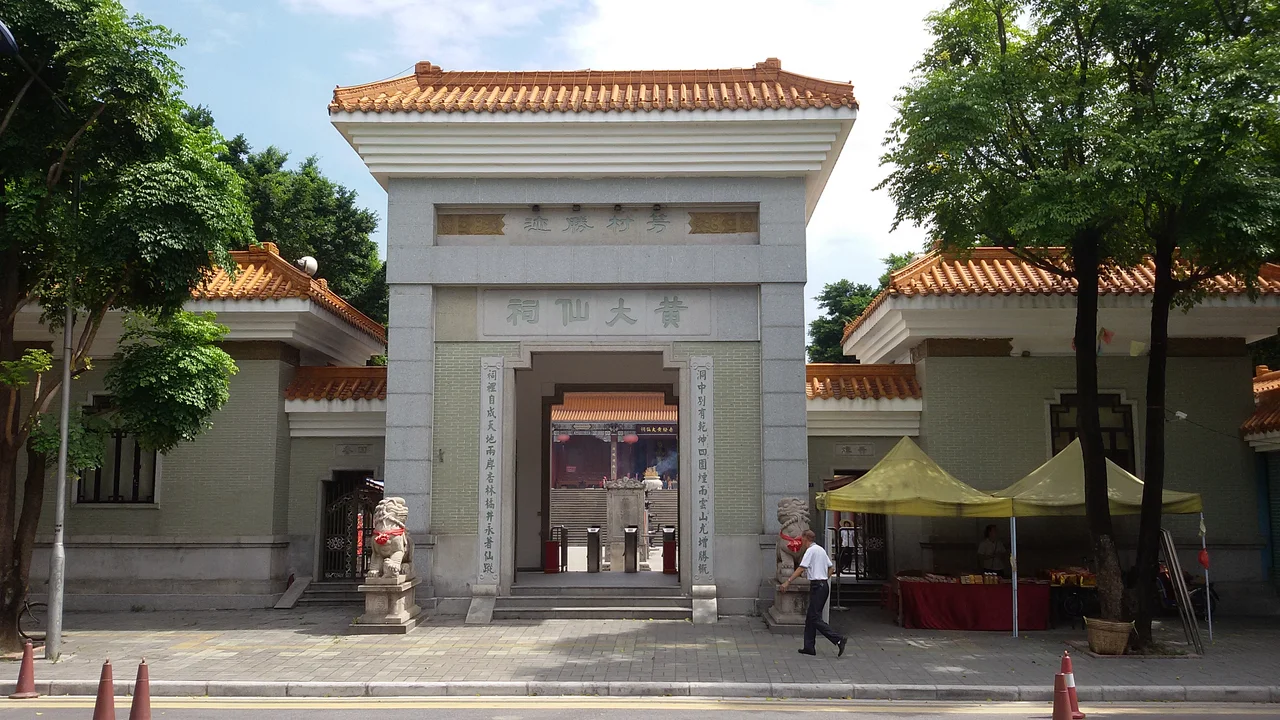

Wong Tai Sin Temple (Guangzhou)
The legend begins with a boy and his sheep. Huang Chuping — born, according to one tradition, in 338 CE in Lanxi, Zhejiang province — spent his early years as a shepherd before encountering a Taoist sage on Red Pine Mountain and beginning a spiritual practice that would eventually transform him into a deity. Forty years later, the story goes, he turned stones into sheep through the power he had cultivated. Western sources date him to approximately 284–364 CE; the discrepancy matters less than what the legend accomplished: Huang Chuping became Wong Tai Sin, the Great Immortal Wong, venerated across Guangdong, Hong Kong, and Zhejiang as a healer, his divine name literally meaning that the Great Immortal Wong possesses healing power. In the Liwan district of Guangzhou, a temple bears his name and holds things far older than the legend itself.
The Shepherd Who Became a Deity
Wong Tai Sin's trajectory from mortal to immortal follows a pattern common in Chinese religious tradition: an ordinary person encounters extraordinary grace, withdraws from the world to cultivate it, and returns — or is remembered — as something more than human. Huang Chuping's story has him herding sheep from age eight to fifteen before the encounter on Red Pine Mountain changed his direction. The text Self-Description of Chisongzi, kept at the Wong Tai Sin Temple in Hong Kong, is one of the primary sources for the details of his life.
His worship spread from his home region of Jinhua in Zhejiang province southward into Guangdong, and eventually to Hong Kong during the early twentieth century. Temples dedicated to him now exist across China, Southeast Asia, and the United States. The Guangzhou temple in Liwan district is one of the most significant, both for what it preserves and for the scale of devotion it continues to draw.
A Temple Built Around an Axis
The Guangzhou Wong Tai Sin Temple was built in a modern style that prioritizes spatial generosity — a sense of openness that visitors remark upon. Its organizing principle is an invisible central axis: the main hall, Wong Tai Sin Hall, anchors the composition at center, while subsidiary shrines and halls extend symmetrically to either side. Within the complex you will find a Guandi Temple, a Guan Yin Hall, a Lü Zu Hall, a Confucius Temple, and other shrines — a characteristic of popular Chinese religious sites that holds space for multiple traditions rather than insisting on doctrinal purity.
Above the main shrine's roof sits a dragon pearl weighing over 1,000 kilograms. Twelve giant pillars support the shrine's interior — no columns within the hall itself, leaving the floor plan open. The hall stands 22 meters tall and can accommodate up to 3,000 people. That last figure is not incidental: the temple runs overnight on Lunar New Year's Eve, when the crowds it draws demand exactly that capacity.
Wood Older Than the Temple
Among the temple's preserved cultural relics, the plaques from the main shrine, the Guan Yin Hall, and the Lü Zu Hall are claimed to be more than 2,200 years old — antiques that predated the current building and were transferred here from an earlier site. If the attribution holds, they represent some of the oldest wooden objects preserved in the world, survivors of fires, political upheavals, and the general difficulty of keeping organic material intact across two millennia of South China's humid climate.
The temple also preserves stone lions, pillar reliefs, and stone-carved couplets. One couplet, from the Guangxu reign of the Qing dynasty, was composed by Lu Weiqin, a Jinshi examination scholar from Panyu. Its characters describe the scenery of the original temple: clouds and mist on surrounding mountains, citrus groves on both banks of a stream, the immortal's traces permanent. The scholar's calligraphy and the imagery it encodes carry historical and literary value that the temple continues to curate.
Mango Trees and Living Ritual
Not everything in the temple speaks of antiquity. A former abbot planted mango trees throughout the grounds, some of which are now more than a hundred years old. Every June they bear fruit, which visitors receive as a kind of seasonal gift from the temple's living landscape. The trees are part of what makes the Guangzhou temple distinctive among Wong Tai Sin temples — a physical continuity established by a single person's decision to plant something that would outlast him.
The temple opens at 7:00 am and closes at 5:30 pm throughout the year, with the Lunar New Year exception when it stays open through the night. The rhythm of daily visitors — people seeking the healer's intercession for illness, praying for family members, burning offerings, consulting the oracle blocks — runs alongside the tourist activity without particular friction. The deity who began as a shepherd in Zhejiang, became an immortal on Red Pine Mountain, and traveled south to Guangdong still draws people who need something from him. The temple they find in Liwan district is old and modern simultaneously, like the city around it.
From the Air
Wong Tai Sin Temple (Guangzhou) sits at approximately 23.098°N, 113.222°E in the Huadi Subdistrict of Liwan District, southwest of Guangzhou's historic center. From the air, the temple complex is set within the dense urban grid of western Guangzhou, visible as a roofed courtyard arrangement in a neighborhood of mid-rise residential and commercial buildings. ZGGG (Guangzhou Baiyun International Airport) lies roughly 18 kilometers to the north. A low approach from the north at 1,500–2,500 feet over Liwan District reveals the Pearl River branching to the south and the lighter-colored temple roofline amid the surrounding development. The distinctive dragon pearl atop the main shrine is visible from a low pass.
Nearby Stories
- Shunde 12 km away
- 2015 Shenzhen Landslide 15 km away
- Mount Luofu 23 km away
- Qingyuan Maglev Tourist Line 32 km away
- Kaiping 56 km away
- Heyuan 90 km away
- Chikan, Kaiping 92 km away
- Erlitou Site Museum of the Xia Capital 1257 km away