
Wong Tai Sin Temple
On Chinese New Year's Eve, the streets outside Wong Tai Sin Temple fill hours before midnight. The worshippers who press toward the gates are not waiting for a ceremony or a performance — they are waiting for the year to turn so they can be the first to offer incense to the Great Immortal Wong. According to tradition, the earlier the incense is lit, the better the fortune that follows. Thousands of people stand in the dark to gain a few minutes of advantage in the new year. It is the kind of practice that seems to belong to a distant past, and yet it happens every year in the middle of Kowloon, in the shadow of apartment towers, at a temple that began with a single altar in a rented room a little more than a century ago.
One Man and One Picture
Wong Tai Sin Temple's origin story is specific and human. In 1915, a man named Leung Yan-am arrived in Hong Kong from Namgong village in Guangdong Province, carrying with him a picture of Wong Tai Sin — a Taoist deity who, in Leung's home region, was known for healing. At the time, Wong Tai Sin was obscure and largely unknown in Hong Kong. Leung set up an altar in his Wan Chai apartment. By March 1916, he had opened an herbal medicine shop nearby and moved the altar to the back of the shop. Customers could pray and seek advice about their ailments; Leung would then fill their prescriptions. That combination — spiritual consultation and practical medicine — attracted a following. When Leung's shop was destroyed by fire in 1918 and he returned to Guangdong, the belief he had planted remained.
From Private Shrine to Public Temple
For decades, the organisation that grew from Leung's practice — Sik Sik Yuen — operated the Wong Tai Sin Temple as a private shrine, accessible only to Taoists and their families. In 1934, Sik Sik Yuen applied to open the temple during the first lunar month of Chinese New Year. Full public access came only in 1956 — the same year the Hong Kong government proposed reclaiming the site for public housing development. It was Sik Sik Yuen's chairman, Wong Wan Tin, who pressed for the temple to stay. A small admission fee was charged at the gate, with proceeds donated to the Tung Wah Group of Hospitals. The government eventually withdrew its redevelopment plans, and Sik Sik Yuen registered as a charitable company in 1965. Today the temple admits visitors free of charge and opens daily from 7:30 am to 4:30 pm, with an all-night opening on Lunar New Year's Eve.
Gold Roofs and a Nine-Dragon Wall
The 18,000-square-metre temple complex is a feast of colour and texture. Red pillars, a gold roof with blue friezes, yellow latticework, and multi-coloured carvings define the main buildings. A Nine-Dragon Wall, modelled on the famous one in Beijing, stands within the grounds. The Great Hall houses the principal shrine to Wong Tai Sin himself. The Three-Saint Hall nearby is dedicated to Lü Dongbin, Guan Yin, and Lord Guan — figures from Taoism, Buddhism, and the Confucian tradition respectively. The temple holds literature and imagery from all three faiths, a reflection of the syncretic religious practice that has characterised popular religion in southern China for centuries. There are three ceremonial archways, the first carved with the temple's name at the entrance, the others marking the passage deeper into the complex.
Shaking for Answers
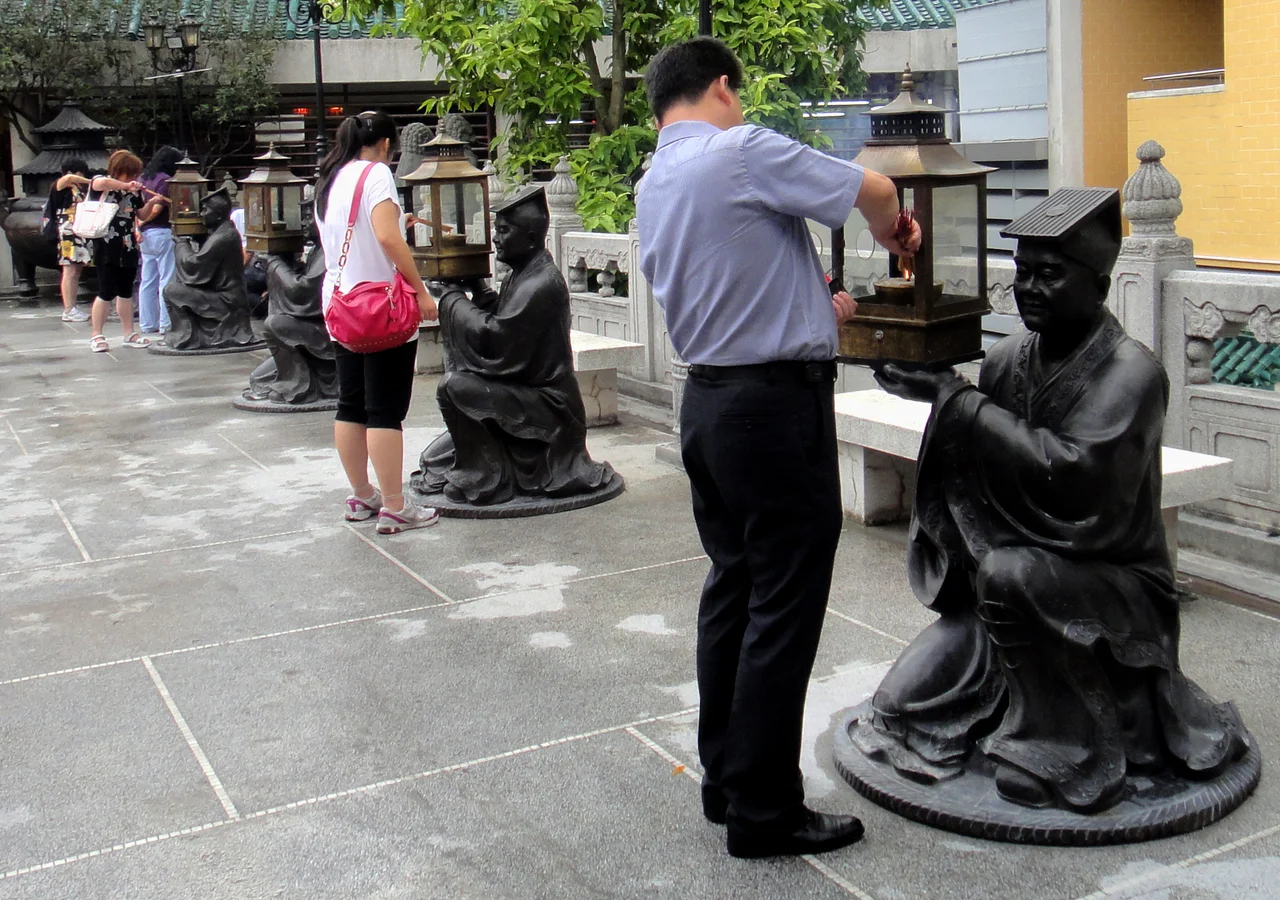
What draws most visitors to Wong Tai Sin is not the architecture but the practice of kau chim — fortune-telling by lot. A worshipper kneels at the main altar, lights incense sticks, makes a wish or poses a question, and shakes a bamboo cylinder of numbered sticks until one falls out. The stick is then exchanged at a booth for a paper bearing the same number, and a soothsayer interprets the fortune written on it. The temple's motto — *you qiu bi ying*, or 'what you request is what you get' — captures the directness of this relationship between worshipper and deity. Many visitors take their paper to multiple booths for a second opinion. Some add palm readings. The rows of fortune-telling stalls that line the path through the complex are as much a part of the temple as the shrines themselves.
A Charity That Runs Schools
Sik Sik Yuen is more than a temple administration. The organisation operates five secondary schools, four primary schools, and multiple kindergartens across Hong Kong under the 'Ho' name — Ho Fung College, Ho Lap College, Ho Dao College, Ho Ngai College, Ho Yu College, and others. This educational mission reflects a long tradition in Chinese temple organisations of combining religious practice with community service. The temple also became the first Taoist institution in Hong Kong authorised by the government to perform Taoist weddings and issue marriage certificates. Tens of millions of visitors have come to the temple since it opened fully to the public in 1956. Some come once as tourists. Many return year after year, burning incense at the same altar, shaking the same cylinder of fortune sticks, asking the same questions that people have always brought to temples: about health, family, and what comes next.
From the Air
Wong Tai Sin Temple sits at approximately 22.34°N, 114.19°E on the southern slopes of Lion Rock in northern Kowloon. VHHH (Hong Kong International Airport) lies about 28 km to the west-southwest on Lantau Island. On approach or departure over Kowloon, Lion Rock — a distinctive ridge visible at low altitude — provides a clear reference point; the temple complex sits at its southern foot, identifiable by the golden roof of its main hall within the urban grid. Recommended viewing altitude for the surrounding district is 3,000–4,000 feet. The former Kai Tak Airport runway alignment is visible to the south, extending into Kowloon Bay.
Nearby Stories
- Chapel of St. Francis Xavier 3.5 km away
- Cuiheng 4.1 km away
- 2015 Shenzhen Landslide 16 km away
- Shunde 31 km away
- Wanshan Archipelago 37 km away
- Nanxiong Formation 96 km away
- Heyuan 149 km away
- Checheng Fu'an Temple 629 km away