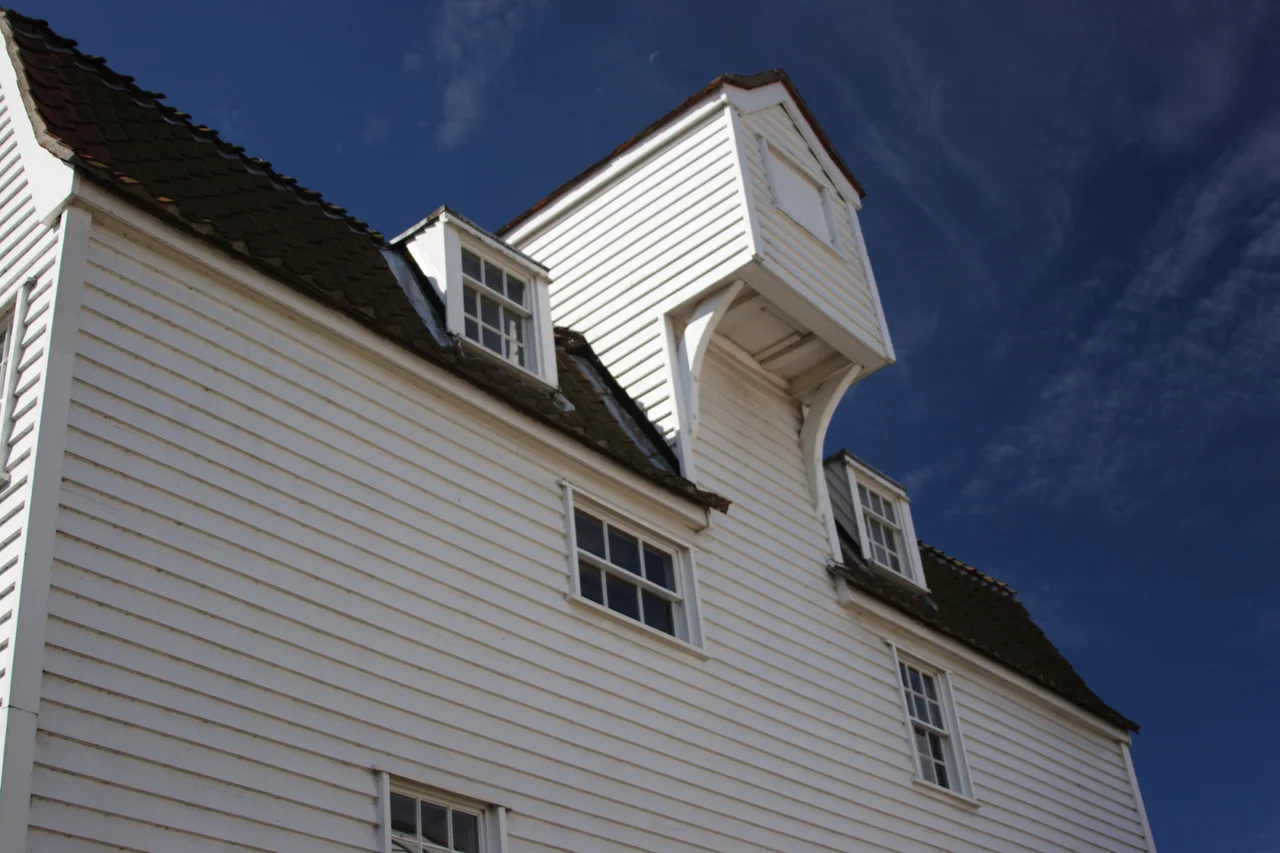

Woodbridge Tide Mill
Twice a day, when the tide on the Deben begins to ebb, a heavy oak water wheel beneath the white-clapboarded Woodbridge Tide Mill starts to turn. The mechanism is not symbolic. It is grinding wheat into wholemeal flour, which the volunteer staff bag up and sell to visitors before the next tide is high enough to refill the mill pond. Tide mills are among the oldest powered machines in Europe - the Romans built them, the Augustinian canons rebuilt them, and for most of the last two thousand years they were a sensible way to convert the moon's gravity into bread. The Industrial Revolution rendered nearly all of them obsolete. Woodbridge's mill, on the Suffolk estuary it has occupied since at least 1170, is the only one in the United Kingdom still doing the job it was built for.
An Idea Eight Centuries Old
The principle is straightforward. A mill is built where a small creek empties into a tidal estuary. As the tide rises, water flows up the creek and is allowed to fill an artificial pond behind the mill. At high water, a sluice gate closes. As the tide falls outside the gate, the water in the pond is released through a wheel, providing several hours of dependable power between each tide. The Augustinian canons of Woodbridge Priory operated a mill on this site in 1170 - the first documentary mention - and probably from earlier. It is not known how many mills have stood here in total. Three is the best estimate. Henry VIII acquired the operation in 1536 during the Dissolution of the Monasteries. The Augustinians may have rebuilt the mill just before they lost it. Elizabeth I later granted the mill and the former priory to her royal favourite Thomas Seckford, after which it passed through a long sequence of private owners until being rebuilt again in the seventeenth century. That seventeenth-century structure, weatherboarded in white Suffolk boarding and roofed in the gambrel double-pitch profile, is the building still standing today.
How It Actually Works
The pond that powered the original mill covered about seven acres - large enough to provide several hours of milling per tide cycle. That original pond is now the Woodbridge marina, full of yachts. The trust that operates the mill has built a smaller demonstration pond of about half an acre, sufficient to power the wheel for tourist demonstrations and small-scale flour production. Inside, the machinery is a study in the early Industrial Revolution: cast-iron gearing, wooden shafts as thick as a person's torso, the great upright shaft transmitting power from the water wheel below to the millstones above. The miller's task was to manage tide times and grain - to be ready when the water came, to mill what was needed before the pond emptied, and to estimate how much wheat could be processed before the next tide cycle began. Lateness was punished by a long wait. The mill is Grade I listed, the highest level of statutory protection in English heritage law. The machinery itself is part of why.
From Closure to Restoration
By the outbreak of the Second World War, only a handful of working tide mills survived in Britain. Steam, and then electricity, had made them obsolete a century earlier; the few that kept running did so because their owners had nowhere else to mill. Woodbridge's mill closed in 1957 as the last commercially operating tide mill in Britain - the very end of a working tradition that stretched back to the Romans. It was derelict by 1968, when Mrs Jean Gardner bought it and launched a restoration that opened it to the public in 1973. A charitable trust took over, staffed by volunteers, and in 2011 the trust undertook a more thorough restoration: a new water wheel, fully restored machinery, and the regulatory clearances needed to produce flour for sale. The mill reopened in 2012. With the Eling Tide Mill in Hampshire currently out of action for maintenance, Woodbridge is the only tide mill in the United Kingdom that can regularly grind wheat grain producing wholemeal flour for resale - a distinction that puts the Suffolk operation, for the time being, alone.
The Deben Setting
The mill sits at the foot of Woodbridge town, looking across the marina toward Sutton Hoo on the opposite bank of the Deben - the burial site where, in 1939, archaeologists uncovered the great Anglo-Saxon ship burial with its gold and garnet shoulder clasps and iron helmet. The geography is not coincidental. The Deben's tidal range is large enough and reliable enough that it has supported water-powered mills for a thousand years and ship burials for a thousand more. Walking down from Woodbridge railway station, visitors pass yachts moored in what used to be the mill pond, climb the wooden steps to the mill door, and find themselves inside a working machine. On milling days, the noise is considerable - timber on timber, water on wheel, the low rumble of millstones at work. The flour bags sold in the gift shop are the small, edible end of an industrial process that has been happening here for at least eight hundred and fifty years.
From the Air
Woodbridge Tide Mill stands at 52.09 degrees north, 1.32 degrees east, on the western bank of the River Deben at the foot of Woodbridge town. The mill is small but distinctive - a three-storey white-clapboarded structure with a gambrel roof, beside the marina basin. Recommended viewing altitude is 1,000-2,000 feet for the best detail. The Deben estuary is the obvious navigation reference; Sutton Hoo lies directly opposite on the eastern bank. Nearest airfields are RAF Wattisham (EGUW) to the west and Norwich (EGSH) to the north. RAF Bentwaters and RAF Woodbridge - both Cold War USAF bases, both closed - are immediately east. North Sea fog drifts inland on calm mornings; afternoon visibility is usually better.
Nearby Stories
- Walton-on-the-Naze 2.7 km away
- Clare, Suffolk 9.5 km away
- RAF Lakenheath 10 km away
- RAF Hardwick 11 km away
- Beeleigh Abbey 13 km away
- Four Days' Battle 45 km away
- Southern Bight 75 km away
- Battle of Lowestoft 79 km away