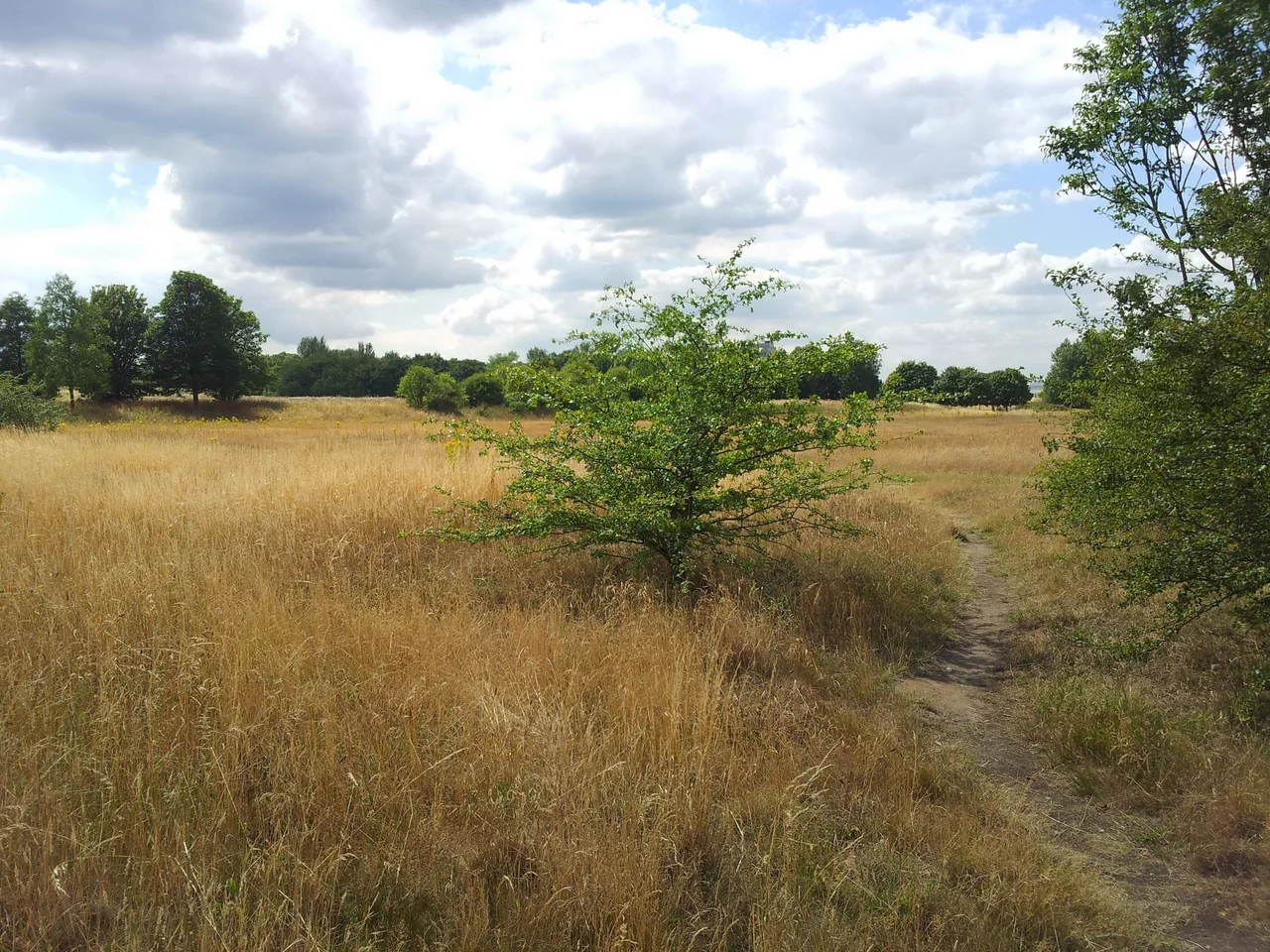

Woolwich Common
Until the mid-eighteenth century, the people of Woolwich grazed cattle on a slope of Shooter's Hill, dug peat there, gathered gorse for fuel, and called it the common because it belonged to all of them. By the 1720s the Board of Ordnance had begun firing mortars across it. By the 1770s a full artillery range was operating. By 1801 the army had bought the land outright, paid the parish £3,000 for the lost gravel rights, and built a ha-ha to keep civilians off the military half. The neighbours never fully accepted any of it, and the arguments lasted more than a hundred years.
The Longest Façade in London
The Royal Artillery Barracks runs along the north edge of the common in a single Neoclassical line designed by James Wyatt between 1776 and 1802. It is the longest building façade in London, a fact that does not quite hit you until you start walking and the colonnade keeps going and going. Across the road stands Government House from 1781, the only grand house from the row of officers' villas that once lined the common's east side, the rest demolished in the 1970s for the Woolwich Common Estate. General Charles George Gordon, who would later die at Khartoum, was born at 29 Woolwich Common in 1833. The Garrison Church of St George next door was bombed in 1944 and only the shell still stands, its Neo-Romanesque arches open to the sky and surviving mosaic fragments still visible on the walls.
An Artillery Range Beside the Pram-Pushers
In 1847 mortar and howitzer practice took place at the battery every Monday, Wednesday and Friday from half past nine in the morning. Civilians walked the public side of the ha-ha, kept their cattle there, and listened to the guns from a few hundred metres away. Use of the common for mortar practice ended around 1873 when artillery training moved to Shoeburyness in Essex, but the saluting battery kept firing into the twentieth century. From early on, military horses trained here. A Veterinary Establishment opened on the western edge in 1804, eventually expanding into the Royal Horse Infirmary that became headquarters of the Army Veterinary Department in 1859. In 1887 a Remount Depot was built nearby, the year the Army Remount Service took over from individual regiments the job of buying and training cavalry horses for the entire army.
From Field Telephony to Nuclear Bombs
The Signals Experimental Establishment moved onto the common in 1916, set up in a cluster of huts just south of Ha-ha Road, working on early field telephony and inter-aircraft radio communication. The site grew steadily over a quarter century until the SEE moved out to Dorset in 1943. Six years later, the Atomic Weapons Research Establishment took the site over and quietly turned it into a laboratory for developing, testing, and manufacturing components of Britain's first nuclear weapons. The workforce went from 155 in the early 1950s to 487 within a few years. The facility closed in 1964. The last buildings were not cleared until 2011, when they were removed to let the King's Troop, Royal Horse Artillery ride out onto the common from their new barracks across the road.
Bombs, Cricket, and an Olympic Range
In World War II the area was heavily bombed, both for the military presence and the anti-aircraft battery sitting on the common itself. After the war Royal Artillery 'At Home' open days continued to draw crowds until the 1970s, when they were stopped because of the IRA threat. Cricket has been played on Barrack Field since the early eighteenth century, first by Woolwich Cricket Club and then, until well into the twentieth century, by the Royal Artillery Cricket Club which admitted only officers. The 2012 Summer Olympics put their shooting events here. The London Marathon route still runs across the common every spring. Most days now it is jogging and dog walking, and once a year in September a funfair takes a section.
The Monuments Made of Captured Cannons
John Bell's Crimean War Memorial of 1861 stands on the parade ground of the Royal Artillery Barracks: a bronze figure of 'Honour' handing out laurel wreaths, the entire statue cast from Russian cannons captured at Sevastopol. Along Repository Road, more historic cannons sit on display, though others were taken away when the Royal Artillery left Woolwich in 2007. The Rotunda nearby is a strange survival: John Nash designed it in 1814 as a temporary structure in St James's Park to celebrate the peace at the end of the Napoleonic Wars, then it was dismantled and re-erected here between 1819 and 1822 to house captured trophies and artillery models. Until 2001 it was the Royal Artillery Museum. Now, in a final inversion, it serves as a boxing ring for the King's Troop.
From the Air
Woolwich Common lies at 51.48 degrees N, 0.05 degrees E on the north slope of Shooter's Hill in southeast London. London City Airport (EGLC) is roughly 5 km north across the Thames. Heathrow (EGLL) lies about 30 km west. From above, the common reads as a triangular green wedge ringed by the long line of the Royal Artillery Barracks to the north and the Mock Tudor façade of the former Royal Military Academy to the south.
Nearby Stories
- Hampton, London 1.1 km away
- Queenborough Castle 3.2 km away
- Groombridge Place 4 km away
- North Weald Airfield 4.9 km away
- Kings Langley Palace 8.3 km away
- White House Farm murders 11 km away
- Port Lympne Mansion 22 km away
- Amberley Museum & Heritage Centre 31 km away