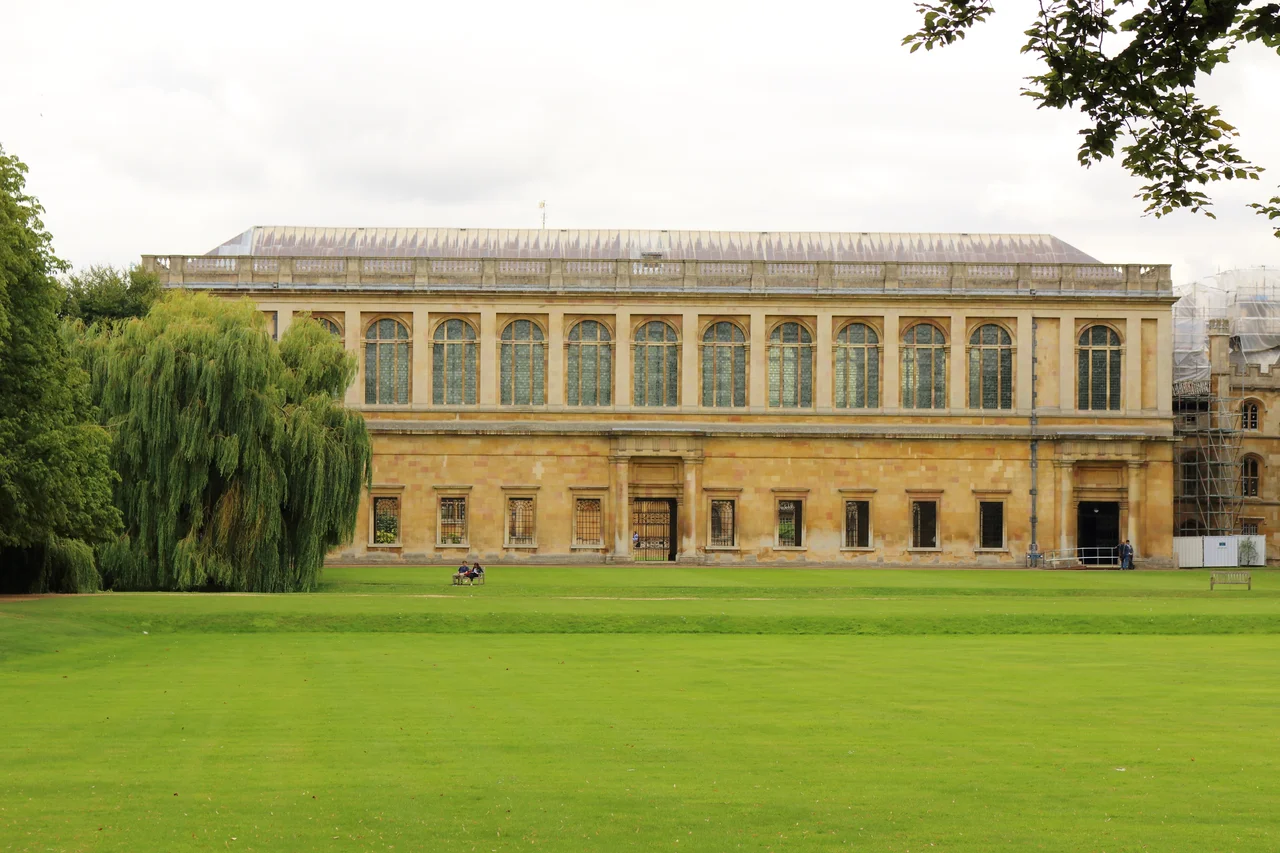

Wren Library
Westminster Abbey refused the statue. Lord Byron's reputation for immorality, the Abbey's dean judged, made him unfit for Poets' Corner. So the marble Byron — carved by the Danish sculptor Bertel Thorvaldsen — went instead to the Wren Library at Trinity College, Cambridge, where it stands at the end of a long room full of extraordinary things. Nearby on the same shelves: the first edition of Newton's *Principia Mathematica*, with Newton's own handwritten corrections for the second edition. A.A. Milne's original manuscript for *Winnie-the-Pooh*. Ramanujan's lost notebook, rediscovered after decades. Several notebooks in Ludwig Wittgenstein's hand. The Wren Library does not merely hold books. It holds the working documents of people who changed how the world thinks.
A Room Built for Light
Christopher Wren designed the library in 1676, and it was completed in 1695. At the time, it was a radical act of architectural thinking. Most libraries of the period were dark places, their books kept in shadowed recesses. Wren positioned his library over an open colonnade — giving the upper room generous windows on both sides, flooding it with the even, comfortable light that scholars need to read. He also played a subtle structural trick: the floor of the library sits several feet below the external division between the two storeys, so the interior feels taller and more spacious than the facade suggests. The proportions that look right from the courtyard below serve a different purpose inside. The book stacks run perpendicular to the walls, between the windows. At the end of each stack, a limewood carving by Grinling Gibbons — one of England's greatest woodcarvers — marks the space. Above, plaster busts of notable writers look down over the shelves.
The Collection Inside
Approximately 1,250 medieval manuscripts are held here, and over 1,100 of them have been digitised. The range is extraordinary. An eighth-century copy of the Epistles of St Paul. The twelfth-century Eadwine Psalter from Canterbury, the thirteenth-century Trinity Apocalypse, and the fifteenth-century Trinity Carol Roll. William Caxton printed the first book in English, and Wren Library holds several of his works, including that first book and the first dated printed book produced in England. There are autograph poems by John Milton. A fourteenth-century manuscript of *Piers Plowman*. The Capell collection of early Shakespeare editions. And, more unusually, handwritten notes by Robert Oppenheimer describing the Trinity atomic bomb test — a document whose title echoes the college that contains it, though not by design.
The Window They Covered Up
At the south end of the library, a stained-glass window was completed in 1775 by William Peckitt, based on a design by Giovanni Battista Cipriani. The window is 5.03 metres wide and 2.44 metres tall, and depicts Fame presenting Isaac Newton to King George III, while Francis Bacon records the occasion and allegorical figures of Britannia and two cherubs attend. It is, in short, a window celebrating Enlightenment achievement on a spectacular scale. The scholars who used the library in the nineteenth century found it distracting. Thick curtains were drawn over it. For decades, one of the library's most extraordinary features was blocked from view. The curtains are gone now.
Open to All
The Wren Library is open to the public, though opening hours are limited. There is no admission charge. Visitors enter Nevile's Court through Trinity College and walk along the cloister beneath the colonnade before ascending to the reading room above. The building is a Grade I listed structure, part of the complex that includes Trinity's Great Court and New Court. The statues on the roof balustrade — representing Divinity, Law, Medicine, and Mathematics — were carved by Gabriel Cibber and can be seen from the court below. Inside, the room is still used as a working library. The books on the shelves are real working manuscripts, not facsimiles, and the air of the place reflects that: quiet, carefully maintained, still in use after more than three centuries.
From the Air
Wren Library is located at 52.207°N, 0.115°E, on the bank of the River Cam in central Cambridge. The library is identifiable from low altitude as the long, colonnaded building facing Nevile's Court. Trinity College sits west of the river, with the distinctive roofline of the library visible from above. Nearest airport: Cambridge (EGSC), approximately 3 miles northeast.
Nearby Stories
- Walden Abbey 4.6 km away
- Bury St Edmunds 5.5 km away
- RAF North Pickenham 8.1 km away
- Ampthill 9.5 km away
- RAF Wittering 10 km away
- Murder of Una Crown 12 km away
- Colchester Community Stadium 18 km away
- John Bunyan Museum 19 km away