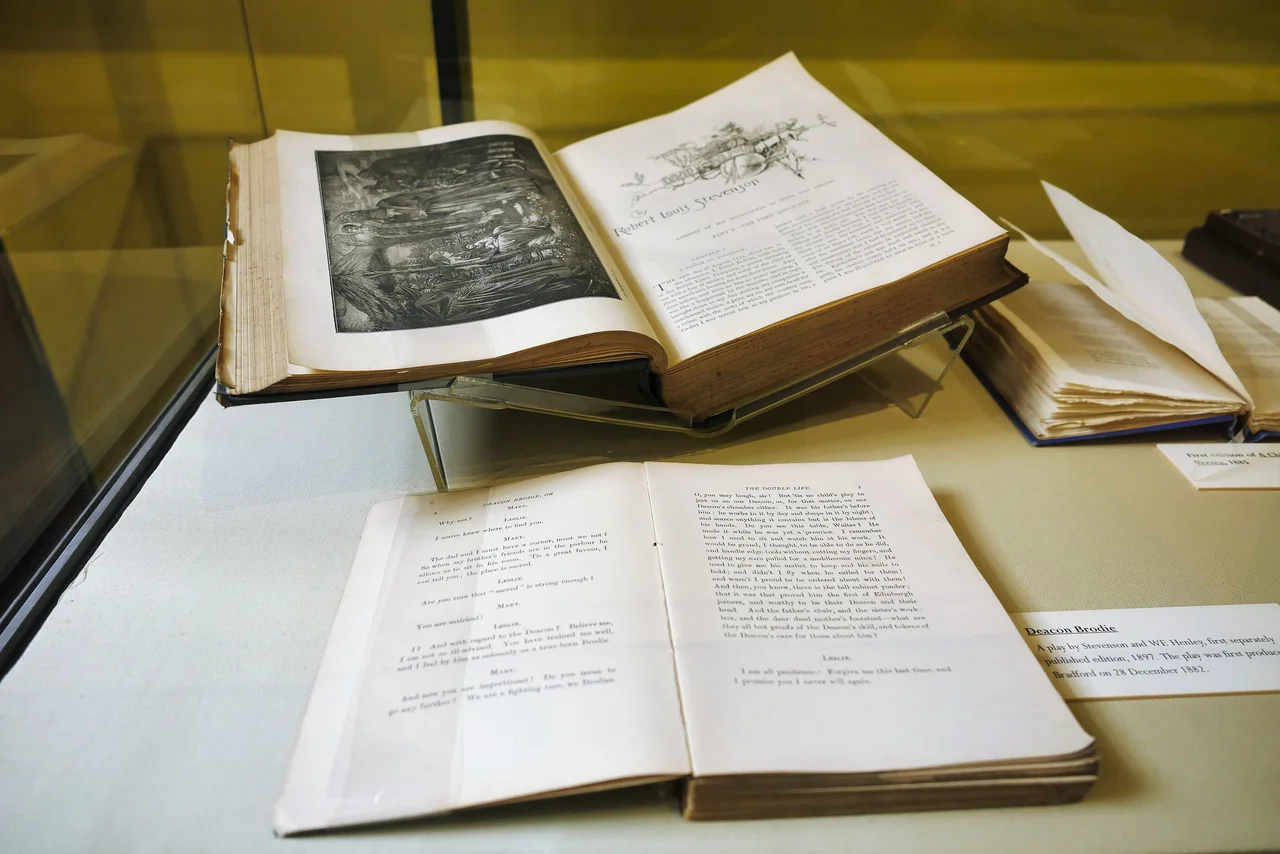

Writers' Museum
Surely, chess playing is a sad waste of brains. The line is Walter Scott's, recorded by his biographer J. G. Lockhart, and it explains why a chessboard and chessmen once owned by the writer now sit in a glass case in Edinburgh's Writers' Museum. Scott as a boy played chess. As he grew older, he decided he would rather learn languages, and he stopped. The board and pieces in the museum are the residue of that choice: a hobby abandoned because the writer was already drafting Waverley in his head. The museum is full of small objects like this, things that reveal their owners by the way the owners refused to use them.
Lady Stair's House
The museum lives inside Lady Stair's House, a seventeenth-century townhouse tucked into Lady Stair's Close, a narrow alley off the Lawnmarket end of the Royal Mile. The building was originally a private residence; in the early twentieth century it was converted into a museum dedicated to three Scottish writers, Robert Burns, Walter Scott, and Robert Louis Stevenson, the three considered, then and now, the foundational voices of modern Scottish literature. The museum is run by the City of Edinburgh Council. The courtyard outside is Makars' Court, which has been called an evolving national literary monument: paving stones inscribed with quotations from Scottish writers, added over decades, so that every walk through it adds another voice.
Burns and a Carnival of Toasts
On display is an invitation card to the Scottish Burns Club's Seventy-First Annual Supper, held at Napier University's Craiglockhart Campus on Saturday 29 January 1994. The menu: egg mayonnaise, scotch broth, haggis, roast turkey, pear melba, coffee. The toast list runs the length of the card: The Queen, The Immortal Memory of Robert Burns by an advocate named Charles H. Johnston, The Lassies by J. Gibson Kerr with a reply by Mrs Dorothea Sharp, Our Guests and Kindred Clubs replied to by John Millar of the Colinton Burns Club, a Vote of Thanks to the Artists, and Auld Lang Syne to close. Burns Suppers have been held every January 25th, around the world, since 1801. The Edinburgh ones are particular, formal, ritualised in ways that would have amused the poet himself. A looping soundtrack at the museum plays extracts from Burns's letters and poems.
Scott's Slippers
In December 1830, Lady Honoria Louisa Cadogan and her daughters Lady Augusta Sarah and Lady Honoria Louisa visited Walter Scott at Abbotsford. They noticed his uncomfortable-looking slippers. After they got home, they sent him new ones, woven in pink and blue wool, lined with silk, with leather soles, based on a pattern Cadogan claimed had been worn by a fifteenth-century Persian named Ghazi Khan. Scott died less than two years later, in September 1832. The slippers eventually entered the collection of Sir Hugh Walpole, a great admirer who, in private, thought of himself as Scott's reincarnation. The slippers are now in the museum. They were probably worn very little. They are evidence of one of the literary friendships Scott collected late in life, when his health was failing and his finances were collapsing under the weight of the publisher Constable's bankruptcy.
Stevenson Travels with a Donkey
Robert Louis Stevenson took a copy of George Borrow's The Bible in Spain with him on his 1878 walking trip through the Cevennes mountains in southern France, along with a sleeping bag and the donkey, Modestine, who carried his luggage. Travels with a Donkey in the Cevennes was the resulting book, and an early classic of the modern travel memoir. The museum displays the Borrow volume next to an illustration by Walter Crane based on the line: I lay lazily smoking and studying the colour of the sky, as we call the void of space, from where it showed a reddish-grey behind the pines to where it showed a glossy blue-black between the stars. Stevenson was twenty-eight, in poor health, and writing partly to win the financial independence he needed to marry Fanny Osbourne. Beside the Crane illustration are pages from Moral Emblems, a collection of cuts and verses Stevenson's stepson Lloyd Osbourne printed at the Villa-am-Stein in Davos in the winter of 1881 to 1882, when Stevenson was convalescing there. One verse begins: Come lend me an attentive ear, A startling moral tale to hear, Of Pirate Rob and Chemist Ben, And different destinies of men.
The Anonymous Paper Sculpture
In 2011, an unknown artist began leaving intricate paper sculptures at literary venues across Edinburgh: at the National Library of Scotland, the Scottish Poetry Library, the Filmhouse, the Storytelling Centre. Each came with a note declaring support for libraries, books, words, and ideas. The Writers' Museum received one called 10 Street Scene. Its sides are made of pages from Ian Rankin's novel Hide and Seek. It shows the scene from Stevenson's Strange Case of Dr Jekyll and Mr Hyde in which Edward Hyde attacks a woman in the street. The artist has never been publicly identified. The sculptures became one of the most celebrated mysteries in Scottish cultural life of the 2010s. They are also a fitting addition to a museum about Burns, Scott, and Stevenson: an anonymous tribute to the idea that books still matter enough for someone to spend hours cutting them into shapes, and then to give the result away without taking credit.
From the Air
The Writers' Museum sits at 55.95 deg N, 3.19 deg W, in Lady Stair's Close just off the Lawnmarket end of the Royal Mile in central Edinburgh. From the air, look for the spine of the Royal Mile running between Edinburgh Castle to the west and Holyrood Palace to the east. The museum is closer to the castle end. Edinburgh Airport (EGPH) is six miles west. Best viewed from 2,000 to 4,000 feet, with the castle rock, Calton Hill, and Arthur's Seat all visible as orientation features.
Nearby Stories
- Ardoch Roman Fort 2.2 km away
- Craignethan Castle 3.1 km away
- Haddington 3.8 km away
- Balvaird Castle 4.3 km away
- Battle of Kilsyth 9.4 km away
- Siege of St Andrews Castle 9.9 km away
- Neidpath Castle 11 km away
- Melrose Abbey 15 km away