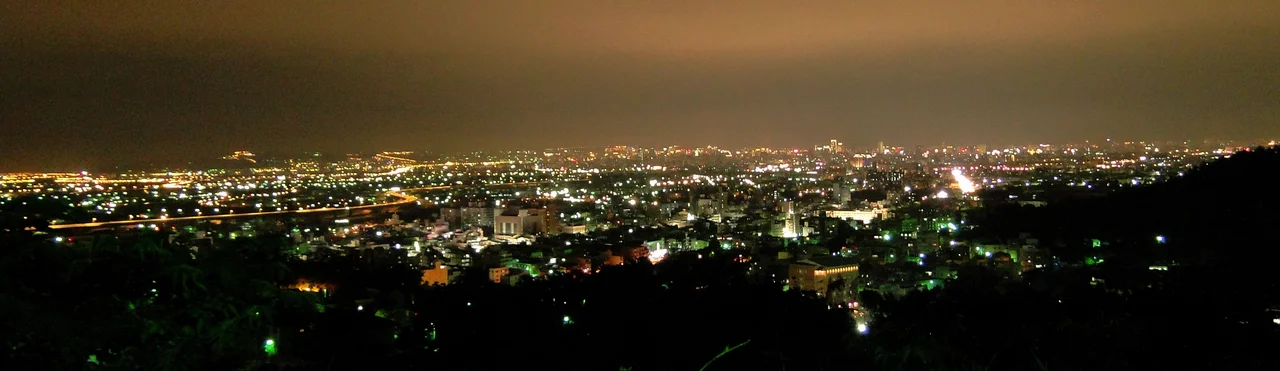

Wufeng District
The district's original name was Atabu — from the Arikun people, who lived here before the Lin family arrived, before the administrative grid arrived, before anyone called this place Wufeng at all. That older name is still remembered, still claimed. The Arikun were a plains indigenous group, and the land they knew now holds one of Taiwan's most storied aristocratic estates, a museum built inside the wreckage of an earthquake, a symphony orchestra, and two universities. Wufeng District, in southern Taichung, compresses a great deal of history into 98 square kilometers.
The Lin Family's Long Tenure
The Wufeng Lin Family Mansion and Garden is Taiwan's largest surviving intact ancient building complex — a sprawling compound of courtyards, reception halls, gardens, and residential quarters that grew across several generations of one of Taiwan's most influential families. The Lins arrived in Wufeng in the eighteenth century and accumulated landholdings, influence, and a complex relationship with successive governing powers. The complex is divided into an Upper House and a Lower House, the latter including the residence of Lin Hsien-tang, a celebrated poet, cultural leader, and — throughout the Japanese colonial period — an unyielding figure in Taiwan's non-armed resistance movement. Lin Hsien-tang refused throughout his life to speak Japanese or wear a kimono. In October 1921 he helped found the Taiwan Cultural Association, which worked to sustain Taiwanese identity through lectures, newspapers, and public education during a period when colonial administration was pushing hard in the other direction. Today his residence is a museum, and the broader compound anchors the district's identity as a place where history has been preserved rather than cleared away.
September 21, 1999
Before dawn on that date, a magnitude 7.6 earthquake ruptured along the Chelungpu Fault, which runs directly beneath Wufeng. About 100 people in the district died. Guangfu Junior High School, sitting directly on the fault line, was destroyed when the ground beneath it lifted and broke — one section of the school physically elevated by the fault movement, the running track buckled and split. The 921 Earthquake Museum of Taiwan was built on the school's ruins rather than clearing them away. The preserved wreckage — the crumpled gymnasium, the upheaved sports ground, the collapsed classroom blocks — forms the core of the museum. Walking through it means walking through the moment of rupture, preserved in concrete and steel. The museum treats the disaster not as spectacle but as education: seismic science, community recovery, and the particular vulnerability of a densely built island sitting atop multiple active fault systems.
Elephant Trunk Mountain and the Wu Stream
Two geographic features define Wufeng's shape. The Wu Stream, called Wu Xi, runs along the district's southern border, separating it from Nantou County. Xiangbi Shan — Elephant Trunk Mountain — rises in the eastern part of the district, its profile lending the landscape one of those topographic details that become landmarks simply through daily familiarity. The agricultural character that has defined Wufeng for generations persists alongside the museums and universities: the district is described as mainly agricultural, and the lowland farmland between the foothills and the urban fringe still produces the crops that fed Nantou and Taichung for generations. National Freeway No. 6, which climbs into the mountains toward Puli and Nantou, exits here at the Jiujeng interchange, making Wufeng a gateway to the interior.
Culture, Institutions, and a Symphony
Beyond the earthquake museum and the Lin estate, Wufeng has accumulated an unusual density of cultural institutions for a district its size. The National Taiwan Symphony Orchestra is based here — one of the country's premier performing ensembles, housed in a purpose-built facility. Asia University and Chaoyang University of Technology both have campuses in the district, and the Asia Museum of Modern Art, affiliated with Asia University, occupies a building designed by the Japanese architect Tadao Ando. Government institutions cluster here too: the Bureau of Cultural Heritage, the K-12 Education Administration, and the Assembly Affairs Museum of the Legislative Yuan, occupying the buildings of the former Taiwan Provincial Council. Wufeng is the administrative location for the Tri-Mountain National Scenic Area headquarters. None of this happened by accident — Wufeng's position at the southern edge of Taichung, near major freeway connections and an hour from the Central Mountain Range, has made it a natural institutional landing zone.
From the Air
Wufeng District lies at approximately 24.07°N, 120.70°E on the southern fringe of the Taichung metropolitan area. From altitude, the district's agricultural flats and the low rise of Xiangbi Shan to the east are visible, with the Chelungpu Fault scarp traceable as a subtle ridge running north-south through the landscape. The Wu Stream defines the southern edge. RCMQ (Taichung International) is approximately 15 km to the northwest — Wufeng sits along a direct approach line to the airport from the southeast. Best viewed at 4,000–6,000 feet to distinguish the Lin family estate compound in the district center and the 921 Earthquake Museum grounds near Provincial Highway 63.
Nearby Stories
- Shigang Dam 2.7 km away
- Taixi, Yunlin 4.9 km away
- Xitou Nature Education Area 7.2 km away
- Lintianshan Forestry Culture Park 11 km away
- Taroko National Park 20 km away
- Smangus 36 km away
- China Airlines Flight 611 56 km away
- Taiwan Strait 69 km away