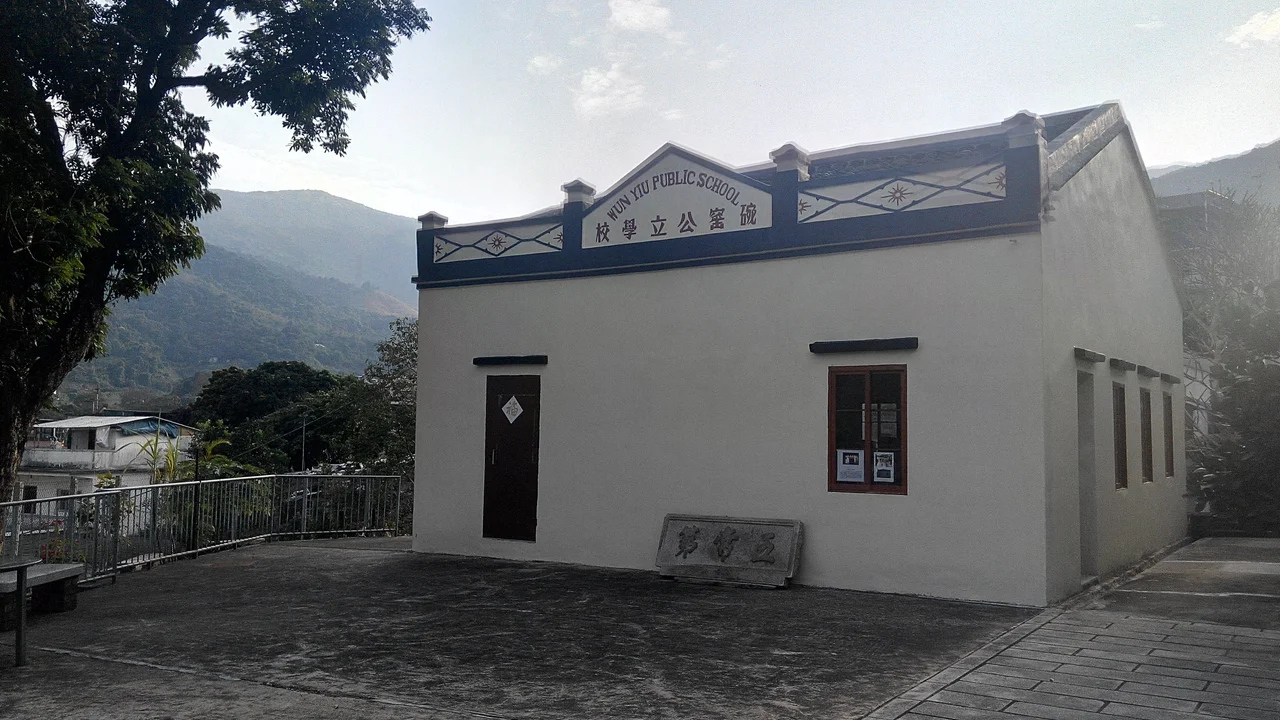

Wun Yiu Village
Somewhere in the hills above Tai Po, the ground still holds the memory of fire. Wun Yiu Village — divided into the upper settlement of Sheung Wun Yiu and the lower Ha Wun Yiu — looks unremarkable from the Wilson Trail path that crosses it. But beneath the surface and tucked into its declared monument sites lies a story that stretches from the Ming dynasty potters who first worked this clay, through Hakka migrants who bought out a kiln and kept the trade alive for centuries, to the economic pressures that finally extinguished the last kiln fires in 1932. Few places in Hong Kong carry quite this concentration of ceramic heritage in such a quiet hillside pocket.
Blue and White from the New Territories
The Man and Tse clans were the first to see the potential in Wun Yiu's earth. During the Ming dynasty (1368–1644) they began producing blue and white porcelain here — the style associated with the great imperial kilns further north, rendered in a more local idiom for regional markets. The clay was workable, the kaolin accessible from nearby mines, and the hillside location allowed for drainage and airflow suited to kiln construction. By the time the Qing dynasty was consolidating its hold over southern China, Wun Yiu had built a reputation as the only significant porcelain-producing centre in the New Territories. In 1674 — the 13th year of the Kangxi Emperor's reign — the Ma clan, Hakka migrants originally from Changle county in Guangdong, arrived in Tai Po and purchased the kilns from the Man clan. That transaction marked the beginning of a new chapter: the Ma clan would operate and expand this cottage industry for more than 250 years.
The Ma Clan's Long Tenure
The Hakka Ma family made Wun Yiu their trade identity. Generation after generation, they fired porcelain in kilns that climbed the hillside, with a 300-metre trackway — still traceable today — running from the upper kaolin mines down to the workshop. Workers loaded raw clay at the top and walked it downhill to be processed, shaped, glazed, and fired. By the time of the 1911 census, Ha Wun Yiu had a population of 60, with 26 males, while Sheung Wun Yiu counted 129 residents, 53 of them male. These were not large communities, but the kiln work supported and defined them. What ended the enterprise was not failure of craft but the logic of coastal trade: cheaper, higher-quality porcelain from other Guangdong kilns undercut the Wun Yiu market steadily through the late nineteenth and early twentieth centuries. The kilns stopped firing in 1932 — not with a dramatic closure, but with the simple cessation that comes when a trade can no longer compete.
What the Archaeologists Found
Long after the last kiln cooled, the remains of the ancient kilns were investigated by archaeologists, who found something unusual: relics illustrating the complete process of porcelain production, from raw materials to finished wares, surviving in situ. This completeness — raw clay, forming tools, kiln furniture, fired and misfired vessels — made the Wun Yiu kilns unusually valuable as a record of how pre-industrial Hong Kong made and traded ceramics. The kilns have since been declared monuments under Hong Kong law. Walking the site, visitors can still read the hillside terracing that once held the kiln structures, and the trackway's route remains visible — a ghost of the labour that once animated this place.
The Potter's Patron and His Temple
The Ma clan did not only leave behind kilns. They also built the Fan Sin Temple in Sheung Wun Yiu — dedicated to Fan Tai Sin Sze, the patron saint of potters — and it remains the only temple devoted to this deity in all of Hong Kong. A wooden plaque carved in 1790, the geng-xu year of the Qianlong Emperor, attests that the temple was already over two centuries old when it was recorded. The temple did not survive the twentieth century without damage: a serious fire in the mid-1970s destroyed many historic relics and forced a restoration in 1976, during which the calligraphy and paintings above the entrance were repainted. Four commemorative stone plaques record the restorations of 1897, 1925, 1964, and 1976 — a ledger of care across generations. The temple was declared a monument on 30 December 1999. After a further restoration it is open to visitors, its incense smoke rising in the same hillside air where kiln smoke once rose for centuries before.
Quiet Legacy on the Wilson Trail
Today Wun Yiu is crossed by Section 8 of the Wilson Trail — a long-distance hiking route that threads through the New Territories. Most hikers pass through without knowing what lies beneath the surface and within the declared-monument sites. The two villages continue as recognized communities under the New Territories Small House Policy and are represented within the Tai Po Rural Committee. What gives Wun Yiu its particular character is the layering: Ming dynasty ceramic origins, Hakka clan enterprise, a patron temple with no counterpart elsewhere in Hong Kong, and archaeological remains that document a craft in its entirety. The kaolin is still in the ground. The trackway still points downhill. The temple still stands.
From the Air
Wun Yiu Village lies at approximately 22.4343°N, 114.1637°E in the hills east of Tai Po town centre, within the New Territories. Approach from the south at 1,500–2,500 feet to see the valley setting and hillside terracing. The nearest major airport is Hong Kong International Airport (VHHH), approximately 35 km to the southwest. Tai Po Hui and the Tolo Harbour coastline provide clear navigation references. The area sits inland from Tolo Harbour; in clear conditions the green hillside folds around the village are visible from the air.
Nearby Stories
- Chapel of St. Francis Xavier 3.5 km away
- Cuiheng 4.1 km away
- 2015 Shenzhen Landslide 16 km away
- Shunde 31 km away
- Wanshan Archipelago 37 km away
- Nanxiong Formation 96 km away
- Heyuan 149 km away
- Checheng Fu'an Temple 629 km away