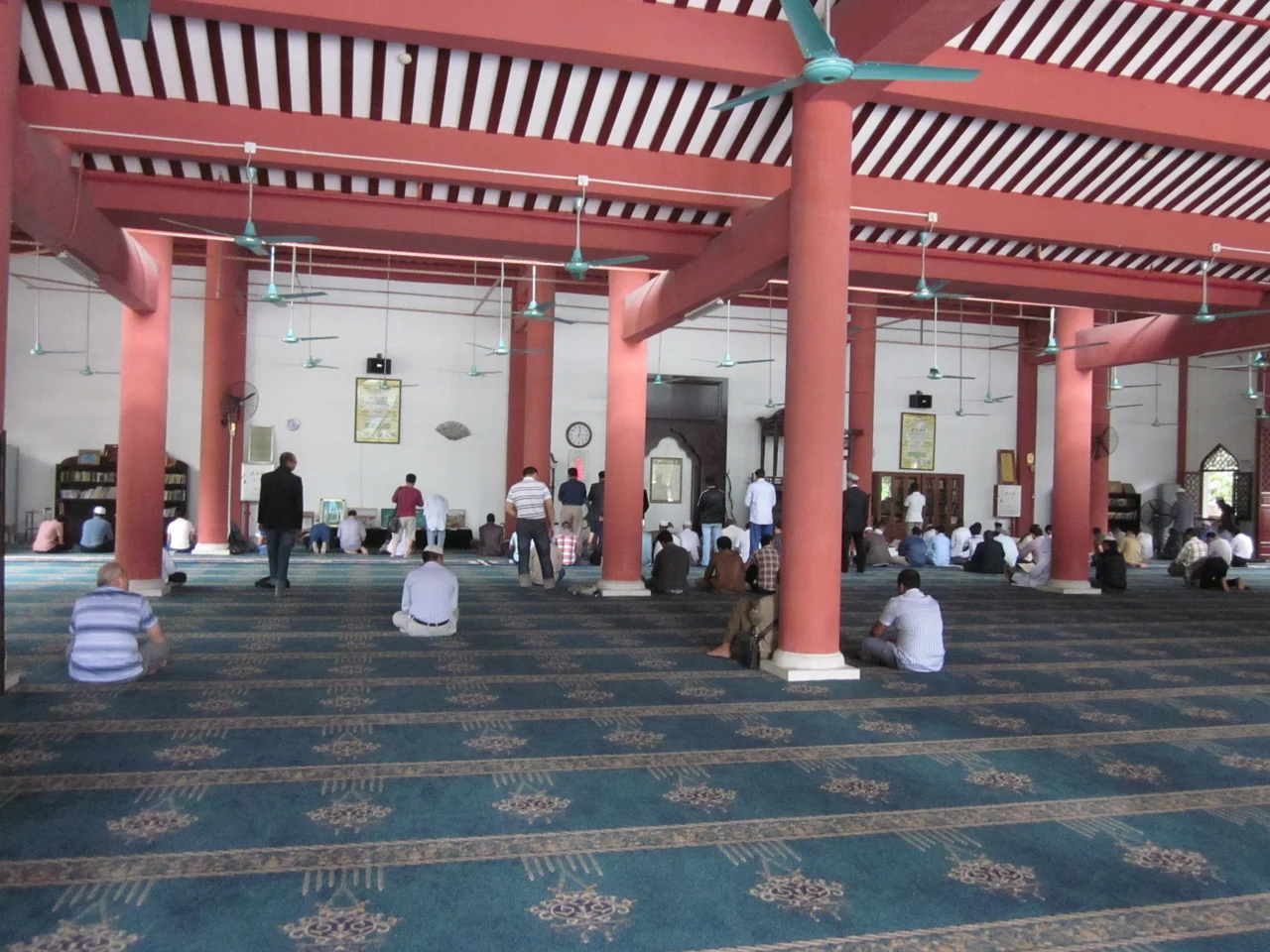

Xianxian Mosque
Somewhere in the grounds of the Xianxian Mosque, forty early Muslim missionaries are buried. The mosque in Yuexiu District — the largest in Guangzhou — has carried the name Hui-hui cemetery almost as long as it has been a place of worship, because the dead and the living have shared this ground from the beginning. The tradition connecting the site to Saad ibn Abi Waqqas, one of the Prophet Muhammad's companions, places the arrival of Islam in Canton among the earliest maritime missions in history: not conquest, not trade policy, but a religious journey by sea to the furthest edge of the known world.
The Companion Who Came to Canton
Saad ibn Abi Waqqas (c. 595–674 CE) was among the most distinguished of the Prophet's companions, a military commander who played a central role in the early Islamic conquests of Persia and Iraq. Islamic tradition also credits him with a very different mission: a diplomatic and religious voyage to China during the Tang dynasty, made at the Prophet's direction, to bring the message of Islam to the Tang emperor.
Both the Xianxian Mosque and the nearby Huaisheng Mosque — one of the oldest mosques in China, with its famous minaret called the Light Tower — are attributed to Saad ibn Abi Waqqas and his companions. The tradition holds that he made multiple journeys to China, and that the tomb bearing his name, located in the Xianxian Mosque compound, marks the site where he was eventually buried. Whether the attribution is historically verifiable or represents a pious tradition that accumulated over centuries, the consequence is the same: Canton became, in Islamic memory, the place where the faith arrived in China, carried by someone who had known the Prophet personally.
A Cemetery That Became a Mosque
The Xianxian Mosque was originally built during the Tang dynasty — the same period of confident cosmopolitan opening that brought Arab merchants, Persian traders, and Buddhist pilgrims to Canton's harbor. The Silk Road had a maritime branch long before it had a name, and Guangzhou sat at its eastern terminus. The Arab and Persian Muslim communities that settled in the city during the Tang period built mosques and buried their dead here; the Xianxian compound grew from that need.
The name Hui-hui cemetery persisted because the graves came first. Forty famous Arab Muslim missionaries were buried on this ground, their presence making the site sacred before the architecture was substantial enough to fully enclose them. The cemetery is now on the roof of the prayer hall — an unusual arrangement that keeps the dead literally above the living in prayer, the building growing up around what could not be moved.
Ming Architecture on a Tang Foundation
The current structure was built in the Ming dynasty style, though it stands on a site whose sacred use began centuries earlier. The mosque covers a total area of 1,860 square meters, with 1,077 square meters of constructed space. A two-story prayer hall capable of accommodating 1,000 worshipers anchors the complex, supported by a pavilion, wing rooms, and other facilities.
Inside, the aesthetic tends toward garden: trees and flowers give the interior a quality closer to a courtyard than a hall, softening the sense of enclosure. This approach — a mosque that breathes, that lets plants grow alongside prayer — reflects the Chinese Islamic architectural tradition that developed over centuries of synthesis, where mosques often incorporated garden elements and curved rooflines borrowed from the surrounding built environment rather than maintaining strict architectural distance from it. The Xianxian Mosque reads as a Chinese building dedicated to Islamic worship, which is precisely what it is.
The Oldest Islam in China
Guangzhou's claim to be the port where Islam first arrived in China rests on a convergence of evidence: the city's documented role as China's primary maritime gateway during the Tang dynasty; the presence of large Arab and Persian Muslim communities in historical records; and the traditions surrounding both the Huaisheng Mosque and the Xianxian site. Whether Saad ibn Abi Waqqas himself walked these streets or whether his name was attached to the site by a community that needed to anchor their faith in apostolic authority, the effect on the city was real.
The Xianxian Mosque today sits within easy walking distance east of Guangzhou Railway Station, embedded in the urban fabric of a city that has been absorbing outsiders for over a thousand years. The forty missionaries in the rooftop cemetery have been here longer than the current building, longer than the Ming dynasty that built it, longer perhaps than the oral traditions that remembered their names. The prayer hall below them continues to accommodate a thousand worshipers. The largest mosque in Guangzhou stays open, rooted in ground that has been considered sacred since the Tang dynasty's merchants first arrived by sea.
From the Air
The Xianxian Mosque is located at approximately 23.148°N, 113.255°E in the Yuexiu District of Guangzhou, near Guangzhou Railway Station. From the air, the mosque compound sits within the dense urban grid of central-northern Guangzhou, identifiable by its courtyard layout and garden vegetation amid surrounding mid-rise development. ZGGG (Guangzhou Baiyun International Airport) lies roughly 12 kilometers to the north-northeast; the Xianxian Mosque is almost directly on the visual approach path from the airport to the Pearl River, making it one of the first significant historic sites visible when descending into the city. Recommended viewing altitude 1,500–2,500 feet. The Guangzhou Railway Station complex to the west serves as the primary navigation anchor.
Nearby Stories
- Shunde 12 km away
- 2015 Shenzhen Landslide 15 km away
- Mount Luofu 23 km away
- Qingyuan Maglev Tourist Line 32 km away
- Kaiping 56 km away
- Heyuan 90 km away
- Chikan, Kaiping 92 km away
- Erlitou Site Museum of the Xia Capital 1257 km away