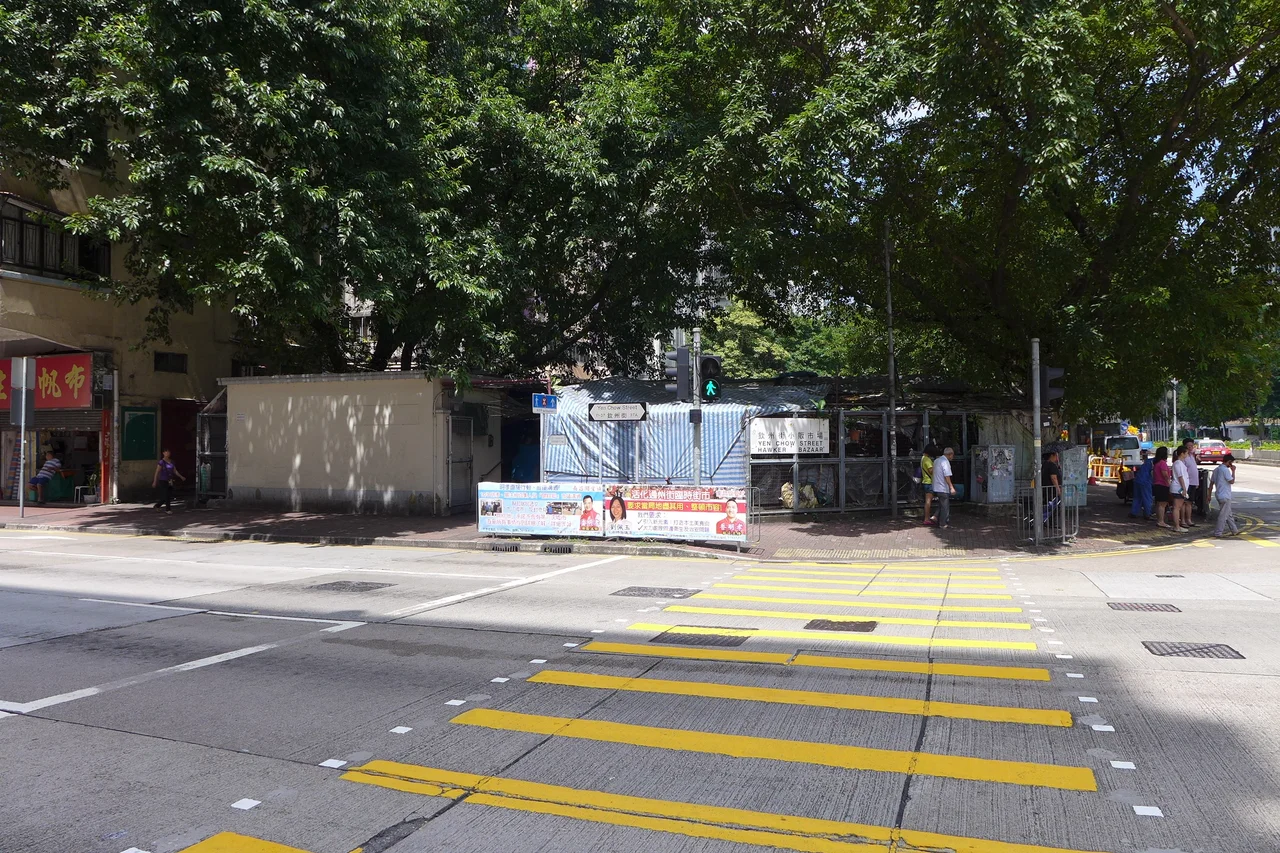

Yen Chow Street Hawker Bazaar
In Sham Shui Po, one of Kowloon's densest and most working-class districts, a covered market at the corner of Yen Chow Street and Lai Chi Kok Road has spent decades selling what the neighbourhood's garment trade runs on: fabric by the metre, zips by the bag, buttons, trimmings, lace, and the accumulated paraphernalia of making things from cloth. Its Cantonese name, Pang Jai, means simply the little shed — an affectionate diminutive for a structure that was never meant to be permanent and somehow became one of Hong Kong's best-known craft and fashion-supply destinations. Design students, dressmakers, costume makers, and seasoned textile professionals all know where to find it. Or where it was.
Built by Displacement
The Yen Chow Street Hawker Bazaar owes its existence to an earlier disruption. When construction on the MTR's Tsuen Wan Line proceeded in the 1970s, the market was forced to vacate its previous location and relocated to its present site on Yen Chow Street, where it established itself in 1978. At its peak the market held more than 200 vendors, their stalls packed with bolts of fabric in every weight and colour, notions, haberdashery, and the specialist supplies that the surrounding garment workshops depended on. Sham Shui Po had long been associated with affordable goods and trade supply — electronics, clothing, and the raw materials for making things — and Pang Jai fitted naturally into the district's working character. The market became a resource not just for professionals but for generations of craft enthusiasts who came to hunt through the stalls for particular weaves, unusual prints, or remnant lengths.
The Second Notice
The government had already signalled its intentions in 1981 when it designated the site for residential use. For decades, this future remained theoretical. Then, in August 2016, the Food and Environmental Hygiene Department issued formal notice to market tenants: the site was to close to make way for a public housing development. Licensed tenants were offered two options — relocation to the Tung Chau Street Temporary Market, or buyback of their licences at prices widely reported to be well below market value. The offer was contentious before it even reached the hawkers' desks. Of the roughly 50 operators in the market at the time, only 33 were formally recognized by the department. The remaining 17 received no relocation offer and no compensation arrangement — effectively excluded from the process.
The Question of Identity
How the FEHD determined who was and was not a legitimate operator became a second controversy layered on top of the first. The department's position was that many stalls were registered under a single name in a so-called 'husband and wife file' — one registrant representing a couple's joint business. Yet among the 33 recognized operators, some couples had both partners registered. The criteria, such as they were, were not made public. When hawkers presented electricity bills, sales receipts, and other operational documents as evidence of their status, these were rejected as insufficient proof of identity. The Shed Tsai Concern Group — a community organization that formed to support the hawkers — issued statements calling the process opaque and demanding collective recognition of all operators. The campaign drew attention from the press and from the Hong Kong design community, which had long depended on Pang Jai's supplies.
What a Cloth Market Meant
To understand why Pang Jai mattered beyond its immediate operators, consider what it supplied. The Sham Shui Po district has historically been a hub for Hong Kong's garment and textile industries. Small workshops, tailors, costume designers for film and theatre, and independent fashion designers all sourced material in the area. Pang Jai's concentrated stalls — covering fabrics from cotton and linen to synthetics and specialty weaves — made it possible to find unusual materials without travelling to multiple suppliers. For design students at nearby institutions it functioned as a hands-on education in materials. The market's closure and the contested relocation process removed not just a set of commercial licences but a particular kind of urban knowledge — where to find a specific weight of interfacing, who stocks the best embroidered trims — that accumulates in a place over forty years and does not automatically transfer to a different address.
From the Air
The Yen Chow Street Hawker Bazaar is located at approximately 22.3297°N, 114.1588°E in Sham Shui Po, on the western Kowloon Peninsula. From the air, Sham Shui Po presents as a dense residential and commercial grid immediately west of the Lai Chi Kok area. The nearest major airport is Hong Kong International Airport (VHHH), roughly 18 km to the west across Lantau and the waters of the Kap Shui Mun channel. At low approach altitudes, the Sham Shui Po street grid is identifiable by its uniform block pattern; the market intersection of Yen Chow Street and Lai Chi Kok Road sits in the district's central-western portion.
Nearby Stories
- Chapel of St. Francis Xavier 3.5 km away
- Cuiheng 4.1 km away
- 2015 Shenzhen Landslide 16 km away
- Shunde 31 km away
- Wanshan Archipelago 37 km away
- Nanxiong Formation 96 km away
- Heyuan 149 km away
- Checheng Fu'an Temple 629 km away