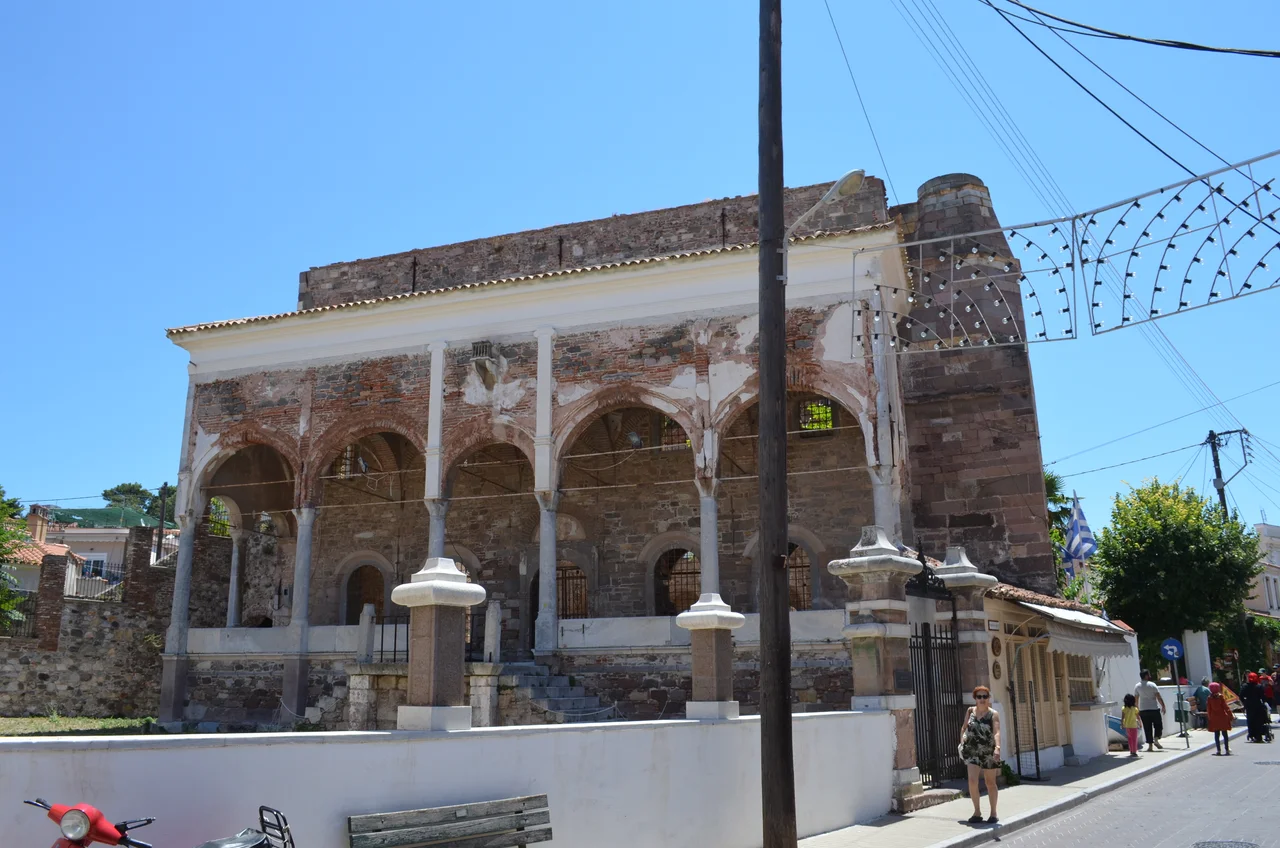

Yeni Mosque, Mytilene
The dome came down in 1951, and looters carried off the rubble to sell. For four decades after that, rain fell straight into the prayer hall. Yet the Yeni Mosque still stands at the center of Mytilene's old Turkish bazaar, the largest and newest of the Ottoman mosques Lesbos ever raised, refusing to vanish even after its roof, its congregation, and the empire that built it had all gone.
Built by the Tax Collector
In 1825, Mustafa Agha Koulaxiz, the local governor and tax collector of Mytilene, built his mosque where it would matter most: in the bazaar district, among the shops the Muslim merchants kept. He named it Yeni, meaning new. Around it grew a whole complex of religious life. A madrasa, founded by Hadji Muhammed Agha, taught the young. The mansion of the Mufti Halim Pasha stood nearby, and an Ottoman cemetery spread to the north and east. This was not a lone monument but the beating institutional heart of a community that had made Epano Skala its own for centuries.
An Architect's Curiosity
What makes the Yeni Mosque remarkable is not its size alone but its design. It is one of only five surviving examples in Greece of the quatrefoil plan, a four-lobed clover shape that gives the interior an unusual rhythm. Its high-drum dome once rose far from the outer walls, leaving a sense of soaring space within. The building fused two architectural worlds: Ottoman form and Byzantine inheritance, the new faith borrowing the engineering vocabulary of the old. In a single structure, the long Christian and Islamic histories of the Aegean met and held hands.
The Year Everyone Left
In 1923, the Muslim community of Lesbos was compelled to leave under the population exchange agreed between Greece and Turkey. Rural Muslims sheltered briefly inside the mosque before their own departure, a last gathering under a roof that would not hold much longer. Their exodus mirrored that of the Orthodox Christians forced out of Turkey at the same moment, treaty-bound and irreversible, two communities torn from homes their families had held for generations. With its people gone, the Yeni Mosque was abandoned. The dome collapsed in 1951; what could be sold was sold, and the weather did the rest.
Saved by the Neighbors
Demolition was proposed, and the locals refused it. Their opposition kept the wrecking crews away. In 1956 the Hellenic Ministry of Culture classified the Yeni Mosque as a monument for the first time, and in 1979 the municipality commissioned architect Constantinos Mylonas to draft a preservation plan, though the money to act took another twenty years to appear. Early restoration finally proceeded under the 14th Ephorate of Byzantine Antiquities. In 2014 the mayor, Spyros Galinos, pledged European Union funds to finish the job. The mosque survives because the descendants of those who replaced its worshippers chose to protect what their predecessors had built and left behind.
From the Air
Located at 39.110°N, 26.558°E on Ermou street in Epano Skala, the old Turkish market quarter of Mytilene, Lesbos. Look for the distinctive high-drum dome (now restored in part) set back from the surrounding rooftops near the harbor. Recommended viewing altitude 1,500–3,000 ft. Nearest airport: Mytilene International Airport (ICAO LGMT), roughly 7 km south. The Turkish mainland lies a short hop east across the strait. Clear Aegean mornings give the sharpest detail of the dense old town.
Nearby Stories
- Eresos 9.6 km away
- Lyrnessus 15 km away
- Battle of the Oinousses Islands 17 km away
- Antandrus 31 km away
- Volissos 41 km away
- St. Helena Church 44 km away
- Akhisar Museum 70 km away
- Battle of Imbros 96 km away